Algeria
 Egypt
 Libya
 Morocco
 Sudan
 Tunisia
 Benin
 Burkina Faso
 Cabo Verde
 Côte d'Ivoire
 Ghana
 Guinea
 Guinea-Bissau
 Liberia
 Mali
 Mauritania
 Niger
 Nigeria
 Senegal
 Sierra Leone
 The Gambia
 Togo
 Cameroon
 Central African Republic
 Chad
 DR Congo
 Equatorial Guinea
 Gabon
 Republic of the Congo
 São Tomé and Príncipe
 Burundi
 Comoros
 Djibouti
 Eritrea
 Ethiopia
 Kenya
 Madagascar
 Malawi
 Mauritius
 Mozambique
 Rwanda
 Seychelles
 Somalia
 South Sudan
 Tanzania
 Uganda
 Angola
 Botswana
 Eswatini
 Lesotho
 Namibia
 South Africa
 Zimbabwe
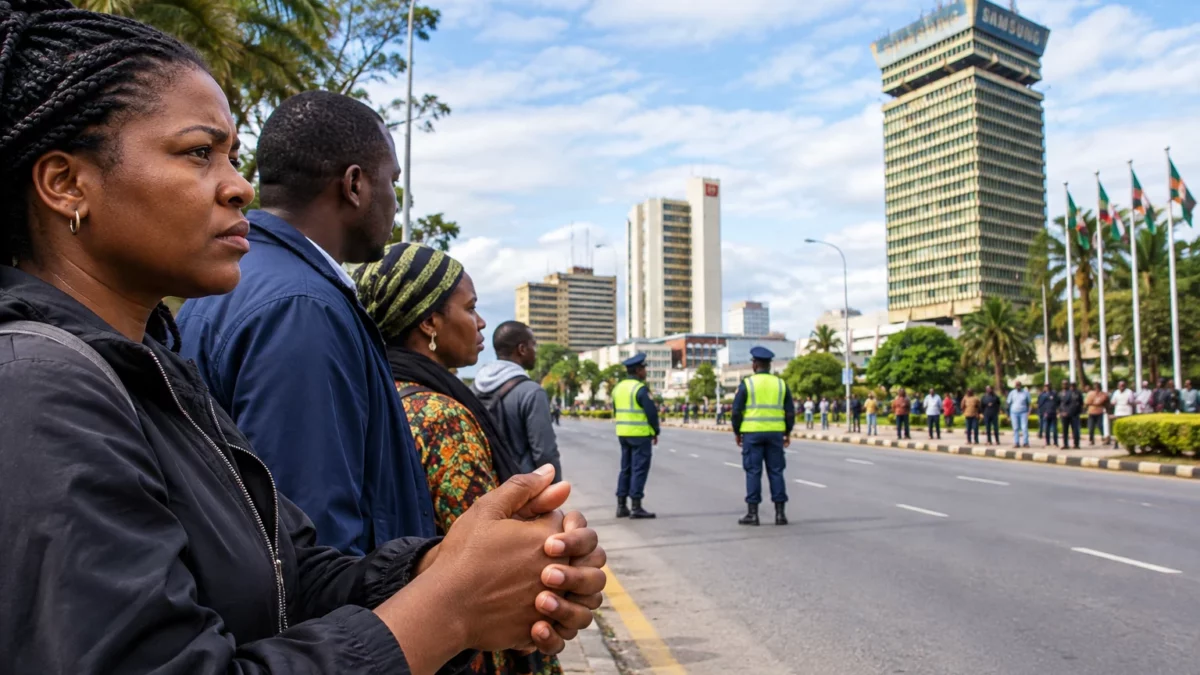
In Lusaka, the debate over the length of presidential power has shifted from the National Assembly to the streets. But on 25 November, Zambians who wanted to defend term limits and those who wanted them scrapped were unable to hold their marches as planned. Police had asked them not to march, citing national security.
A constitutional controversy becomes a political test
Zambia is emerging from a presidential election that has left divisions. The 13 August 2026 vote returned Hakainde Hichilema for a second term. The Electoral Commission declared him the winner on 18 August, with about 60% of the vote. His main rival, Brian Mundubile, disputed the result. Observers from the Southern African Development Community (SADC), the regional organisation of southern African countries, called on the parties to respect the legal framework and preserve the transparency of the electoral process.
Tensions are not confined to the results. After the vote, opposition officials were arrested and charged. The case involving Mundubile, in particular, is contributing to a climate in which civic organisations and regional partners are closely watching political challenges. The authorities and the opposition offer different interpretations of the post-election period; it is therefore important to distinguish judicial facts from political allegations.
Another issue gained momentum in October, when a youth collective submitted a petition to Parliament calling for the presidential term limit to be scrapped. The collective says it is acting without party affiliation. In response, civil society organisations sought to organise a march in defence of retaining the limit. Two opposing rallies were thus announced in Lusaka for Wednesday 25 November.
Marches halted before they began
According to reports by several Zambian media outlets, police advised the organisers not to proceed with their plans, citing security concerns. Neither march therefore took place on the scheduled date. The decision prevented supporters of each position from gathering publicly in the capital, without resolving the disagreement over possible constitutional reform.
The contrast is striking: the rallies were intended to defend opposing positions, but both faced the same restriction. In the reports consulted, police officials did not publicly detail the specific risks behind their advice. Organisers of the march in favour of retaining the limit are awaiting a new date, according to available information. Whether a subsequent rally goes ahead will therefore depend on discussions with the authorities.
The presidency, for its part, has said that Hichilema would respect the Constitution and was not involved in the campaign to change the rule. The minister responsible for home affairs, Clement Andeleki, has also said that the president is not seeking a third term. For supporters of the limit, these assurances do not dispel their concerns: they are calling for a more explicit political position in response to the reform proposals.
Zambia’s Constitution provides for a five-year presidential term. Article 106 governs the length of a term and succession to the presidency; the two-term limit is at the heart of the current controversy. Amending a constitutional provision, however, requires a legal and parliamentary process. A petition submitted to elected representatives is therefore neither an adopted reform nor proof that the head of state wants to stand again.
Freedom of assembly and confidence after the election
The immediate issue is the right to peaceful assembly. Authorities may invoke security to regulate a demonstration, but a ban or postponement without a sufficiently specific explanation risks fuelling mistrust. For civic organisations, the practical challenge is also to secure a date, route and conditions that allow people to demonstrate without violence or intimidation.
This concern comes amid a sensitive post-election climate. Civil society groups and human rights organisations have raised concerns about arrests and the space available for dissent. These criticisms do not replace a court’s findings, just as government assurances alone are not enough to close the debate. How the authorities handle future gatherings will provide a tangible indication of the openness of public debate.
The consequences extend beyond Lusaka’s political leaders. Residents who rely on transport, street trading or day-to-day activities in the capital may be affected by disruption or security measures. In the provinces, the constitutional controversy is also playing out through petitions, civic networks and local debates. Political participation is therefore not limited to exchanges between leaders and parliamentarians.
A signal watched across southern Africa
Zambia belongs to SADC, where institutional stability and political transitions remain regional concerns. The question of term limits arises in several African countries, but the rules and procedures differ from one state to another. The Zambian debate must therefore be considered in its national context, rather than reduced to a uniform trend across the continent.
What happens next will depend on three things: whether civil society can set a new date for a march, how the petition proceeds in Parliament and how clearly officials state their positions. The case involving Brian Mundubile and other post-election cases will also remain under scrutiny, particularly to check that judicial proceedings move forward in a manner that respects the rights of those concerned.
For now, no third term is at stake at the ballot box: Hichilema has just begun a second term, and no reform removing the limit has been adopted. The controversy is about the possibility of changing the rule, the actors defending it and the conditions in which Zambians can express their disagreement. Confidence in the institutions will be measured by the answers to these questions, rather than by statements of principle.
Verified references: Zambian report on the marches and police advice, information on the planned demonstration in Lusaka, presidential result announced by the Zambian presidency and SADC statement on the electoral process.