Algeria
 Egypt
 Libya
 Morocco
 Sudan
 Tunisia
 Benin
 Burkina Faso
 Cabo Verde
 Côte d'Ivoire
 Ghana
 Guinea
 Guinea-Bissau
 Liberia
 Mali
 Mauritania
 Niger
 Nigeria
 Senegal
 Sierra Leone
 The Gambia
 Togo
 Cameroon
 Central African Republic
 Chad
 DR Congo
 Equatorial Guinea
 Gabon
 Republic of the Congo
 São Tomé and Príncipe
 Burundi
 Comoros
 Djibouti
 Eritrea
 Ethiopia
 Kenya
 Madagascar
 Malawi
 Mauritius
 Mozambique
 Rwanda
 Seychelles
 Somalia
 South Sudan
 Tanzania
 Uganda
 Angola
 Botswana
 Eswatini
 Lesotho
 Namibia
 South Africa
 Zimbabwe
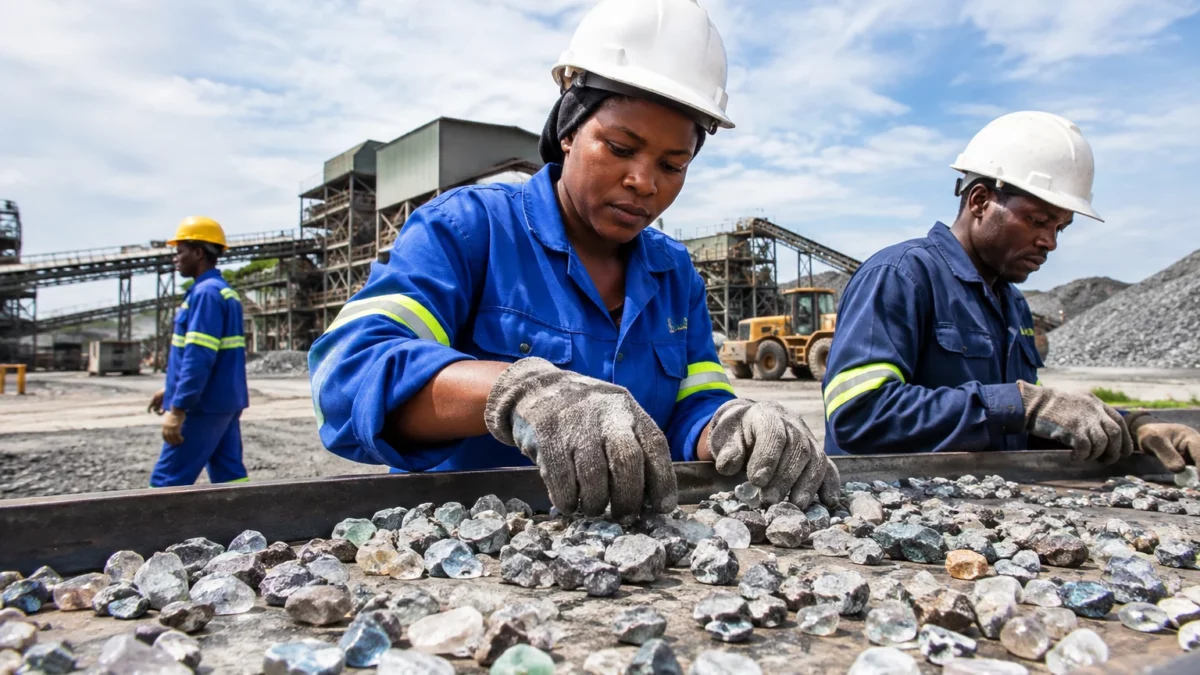
An increase in rough-stone sales does not automatically translate into an equivalent rise in public revenue. In Zambia, the outcome also depends on the type of emeralds sold, the price achieved and the levies actually due to the state.
A year driven by premium stones
Gemfields’ latest sale raised $35.3 million. Held from 12 to 26 November 2026, it featured premium-quality rough emeralds extracted from Kagem, in Copperbelt Province. All 45 lots on offer were sold, for a total of 220,059 carats.
Buyers were able to view the lots in Bangkok before submitting confidential bids online. The announced average price reached $160.47 per carat, against $146.08 at the comparable sale in May. Fifty-five companies took part in the auction, according to results published by Gemfields.
With this sale, Kagem’s auctions totalled $91.7 million in 2026. The mining group describes this as the third-highest amount since it began selling in 2009. It exceeds the $78.4 million recorded in 2025, but remains below the record $148.6 million set in 2022. A financial publication reporting the company’s announcement confirmed the data for the November sale.
The breakdown by category helps explain the increase. The two premium-quality stone sales generated $62.1 million, against nearly $37 million in 2025. By contrast, revenue from commercial-quality stones fell from about $42 million to $29.6 million. The annual increase therefore rests mainly on the most highly valued stones, rather than on a uniform rise in sales.
State ownership, but revenues must be distinguished
Gemfields owns 75% of Kagem, while the remaining 25% is held by the Industrial Development Corporation (IDC), a Zambian state-owned company responsible for managing government investments. This stake gives the country a direct interest in the mine’s capital. It does not, however, mean that the gross proceeds from the auctions go entirely to the Treasury.
Gemfields says the proceeds from the sale will be repatriated to Zambia and that royalties due to the state will be calculated on the auction prices. Zambia’s mining law provides for a 6% royalty on the gross value of gemstones under the 2024 Minerals Regulation Commission Act. The amount actually collected depends on the applicable tax rules and declared transactions; it cannot be equated with the sale’s turnover.
The distinction matters for public finances. In 2025, mining royalties generated 16.088 billion kwacha in net revenue, according to the Zambia Revenue Authority’s annual report. This figure covers the entire extractive sector, dominated by copper, and not Kagem alone. It nevertheless highlights the importance of mining levies to state resources.
Global markets weigh on local results
The November sale comes in a mixed year. In September, Kagem’s commercial-quality stones raised $29.6 million, at an average price of $9.72 per carat. This level, far below that of premium stones, underlines how the composition of the lots affects revenue, even when buyers purchase every lot.
The auctions alone do not describe the situation at the mine or in nearby communities. The reported amount is a gross sale value. It does not show how much is spent on operating costs, investment or payments to local suppliers. Nor does it provide information on the benefits for jobs and businesses in the Copperbelt. These issues require separate data.
The sale takes place in an economy where mining makes a significant contribution to public revenue. According to the Zambian tax authority, mining and quarrying accounted for 30% of total gross revenue in 2025. Dependence on resource income makes public finances sensitive to international prices, but also to the performance of operations smaller than the copper industry.
A concern for Zambia and southern Africa
For Zambia, a member of the Southern African Development Community (SADC), the Kagem case reflects a regional debate: how to increase the value retained in producing countries beyond the extraction and sale of raw materials. The emeralds are examined in Bangkok and sold electronically. This arrangement gives access to international buyers, but also highlights the role of overseas marketplaces in setting prices.
The IDC’s stake and the collection of royalties are two channels through which economic value flows back to the country. Their practical impact, however, depends on revenue transparency, regular payments and the ability to develop local activities around the stones: cutting, certification, marketing and training. Auction figures alone cannot measure this progress.
The 2026 result is therefore a positive signal for sales of premium-quality stones, but not a complete measure of Kagem’s contribution to the Zambian economy. The company’s next financial disclosures and national tax data will make it possible to assess how the reported proceeds translate into royalties and local benefits.