Algeria
 Egypt
 Libya
 Morocco
 Sudan
 Tunisia
 Benin
 Burkina Faso
 Cabo Verde
 Côte d'Ivoire
 Ghana
 Guinea
 Guinea-Bissau
 Liberia
 Mali
 Mauritania
 Niger
 Nigeria
 Senegal
 Sierra Leone
 The Gambia
 Togo
 Cameroon
 Central African Republic
 Chad
 DR Congo
 Equatorial Guinea
 Gabon
 Republic of the Congo
 São Tomé and Príncipe
 Burundi
 Comoros
 Djibouti
 Eritrea
 Ethiopia
 Kenya
 Madagascar
 Malawi
 Mauritius
 Mozambique
 Rwanda
 Seychelles
 Somalia
 South Sudan
 Tanzania
 Uganda
 Angola
 Botswana
 Eswatini
 Lesotho
 Namibia
 South Africa
 Zimbabwe
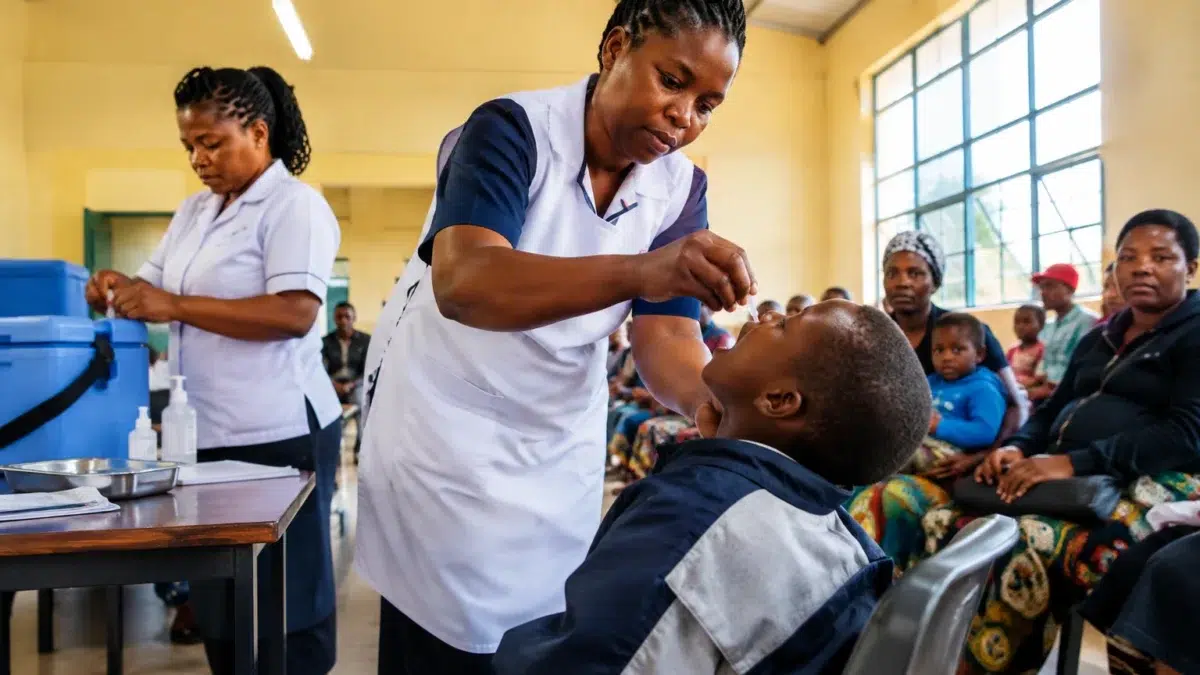
Producing vaccines locally is not enough to protect a population. Access to safe drinking water, healthcare services and reliable stocks is also essential. With the launch of construction at ZAMVAX, Zambia wants to address a frequently fragile link: the supply of cholera vaccines.
A Zambian project with regional reach
Construction was launched on 17 November 2026 in the Lusaka-South Special Economic Zone, near the capital, Lusaka. The facility is being developed by ZAMVAX, a joint venture 60% owned by the Industrial Development Corporation (IDC), a Zambian state-owned company, and 40% by Chinese firm Jijia International Medical Technology. The two partners signed their joint-venture agreement on 2 November.
The project comes against a backdrop of cholera outbreaks that regularly cross borders. In southern Africa, population movements, trade and transport networks link affected areas. The response therefore also depends on co-ordination between countries, particularly within the Southern African Development Community (SADC), the regional organisation bringing together southern African states.
Zambia experienced a severe epidemic in 2023 and 2024. The authorities then mobilised exceptional infrastructure to accommodate patients, while schools were closed. More recently, the World Health Organization reported a new outbreak in 2026. These episodes are a reminder that vaccination is a preventive tool, but does not replace access to safe water and sanitation, surveillance or rapid treatment.
A first step, not yet full production
The first phase of the project is valued at about $24.1 million. It is intended to enable the filling, packaging and quality control of oral cholera vaccines, with a stated capacity of up to 20 million doses a year. Initially, the plant will use bulk imported antigens: it will therefore carry out some industrial stages locally, without yet manufacturing all the vaccine components.
A later phase is intended to introduce local antigen production, moving towards end-to-end manufacturing. The project also envisages, in time, vaccines against human papillomavirus and malaria, as well as veterinary products. These remain prospective developments: they will depend in particular on investment, regulatory approvals and the plant’s ability to meet quality requirements.
The overall cost put forward for the programme is $213 million, spread across several stages. This figure should be distinguished from the first tranche, the only one linked to the site’s launch. Nor does the stated capacity mean that doses will be available immediately: construction, process validation and regulatory checks must come before any commercialisation.
Zambia’s Health Minister, Roma Chilengi, presented the project as a response to supply-chain disruptions exposed by the Covid-19 pandemic. His argument centres on security of supply: when a global crisis slows deliveries, industrial capacity based in the country can provide greater room for manoeuvre. It does not, however, automatically remove dependence on raw materials, equipment or external financing.
From a local plant to health security
For the authorities, the issue goes beyond the availability of a vaccine. Regular production could help plan campaigns, reduce exposure to import delays and support outbreak preparedness. The expected benefits would first reach health services and populations in exposed areas, as well as workers and suppliers involved at the industrial site.
The promise will nevertheless depend on several practical conditions. Zambian teams will need training, recognised quality standards must be maintained and arrangements made to purchase the doses. Vaccines will also need to reach districts far from Lusaka. A plant located in the economic capital does not, on its own, solve distribution difficulties in rural areas or inequalities in access to healthcare.
The commercial dimension also matters. The IDC and Jijia present the facility as one that could serve neighbouring markets. For that ambition to be realised, products will need to obtain the necessary approvals in each country and be included in predictable purchasing mechanisms. Regional co-operation can facilitate outbreak surveillance and co-ordination of supplies, but each state retains its own public health procedures.
The project also forms part of the ambition championed by the African Union and Africa CDC to develop vaccine manufacturing on the continent. The continental goal is to produce locally 60% of the vaccines used in Africa by 2040. Africa’s capacity remains limited today. ZAMVAX could contribute to that trajectory, provided it moves beyond filling imported products and gradually builds skills, infrastructure and a more complete supply chain.
Next steps to watch
The groundbreaking marks an industrial commitment, not yet a health outcome. Key indicators will be progress on construction, the facility’s actual commissioning, quality validation and any eventual move to local antigen production. The stated annual capacity will need to be measured against the doses actually manufactured and distributed.
For Zambia and its SADC neighbours, the challenge will be to link this new capacity to the needs of prevention campaigns and emergency responses. The fight against cholera remains inseparable from access to water and sanitation. But production based in the region could shorten some supply delays and give African countries greater influence over how they organise their health security.