Algeria
 Egypt
 Libya
 Morocco
 Sudan
 Tunisia
 Benin
 Burkina Faso
 Cabo Verde
 Côte d'Ivoire
 Ghana
 Guinea
 Guinea-Bissau
 Liberia
 Mali
 Mauritania
 Niger
 Nigeria
 Senegal
 Sierra Leone
 The Gambia
 Togo
 Cameroon
 Central African Republic
 Chad
 DR Congo
 Equatorial Guinea
 Gabon
 Republic of the Congo
 São Tomé and Príncipe
 Burundi
 Comoros
 Djibouti
 Eritrea
 Ethiopia
 Kenya
 Madagascar
 Malawi
 Mauritius
 Mozambique
 Rwanda
 Seychelles
 Somalia
 South Sudan
 Tanzania
 Uganda
 Angola
 Botswana
 Eswatini
 Lesotho
 Namibia
 South Africa
 Zimbabwe
An election test for Lusaka and southern Africa
In Zambia, a presidential election is never just about a name. It also shows whether recent growth has begun to reach households, young people seeking work and rural areas still highly exposed to poverty. The 2026 vote has therefore become a political test for Hakainde Hichilema, as well as a signal watched across southern Africa, where electoral stability remains a central concern.
The country is one of the continent’s major copper producers, a strategic asset at a time when critical minerals are playing an increasingly important role in international power dynamics. Zambia is also a key member of SADC, the Southern African Development Community, which closely monitors elections in the region. In Lusaka, the political capital and centre of the count, the election is therefore set in a dual context: national, with the outgoing president seeking a second term, and regional, with African and European observers watching closely.
Partial results strongly favour the incumbent
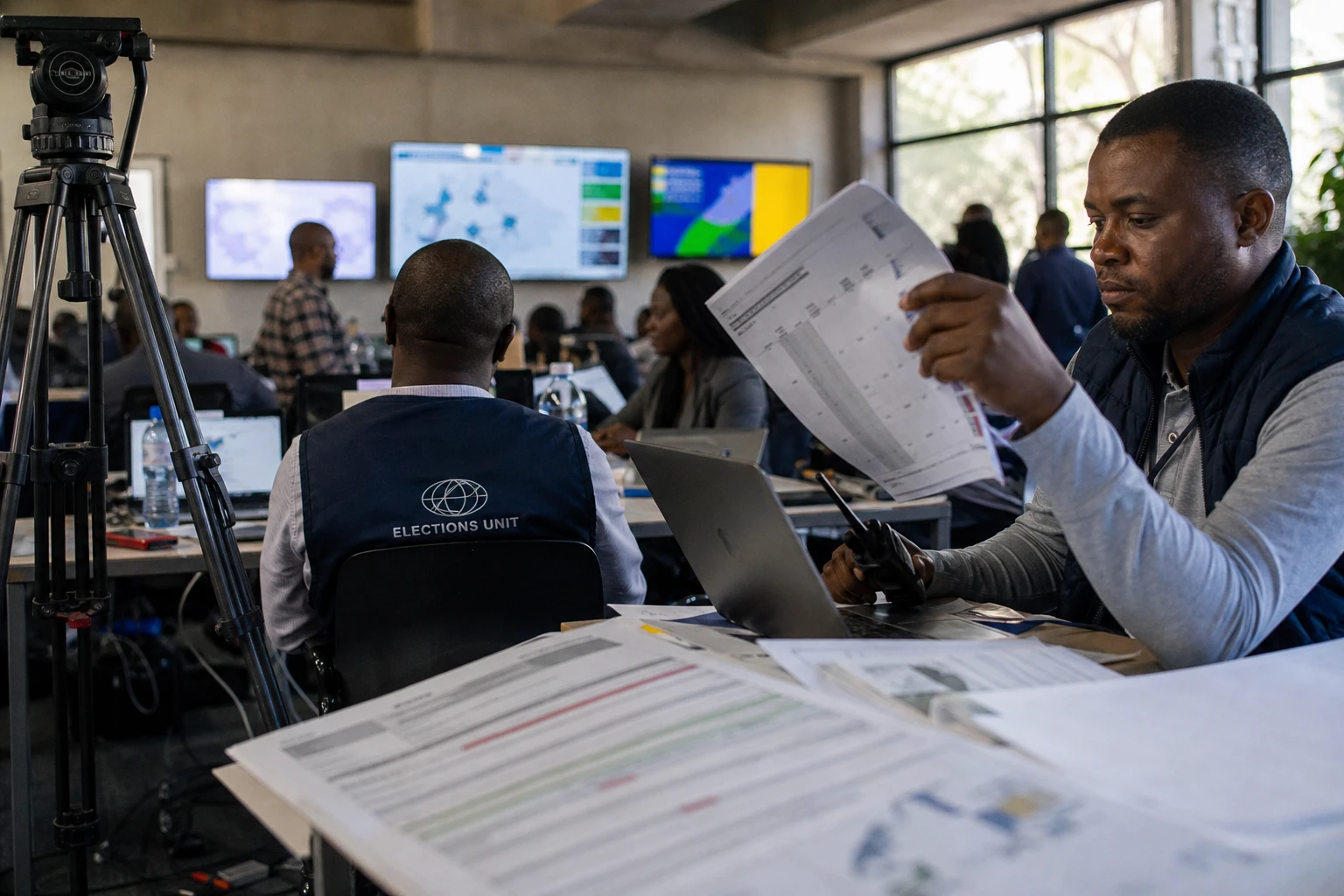
According to figures released during the count, Hakainde Hichilema was leading with 1,544,140 votes, or 58.87% of the vote, after results had come in from 135 of the 226 constituencies. His main challenger, Brian Mundubile, had 1,030,662 votes among the 14 candidates in the race. Zambia’s electoral system provides for victory in the first round with an absolute majority of valid votes; otherwise, the top two candidates must face each other in a run-off.
By the time these partial results were circulating, the count had already been suspended for about six hours following reports of attacks on electoral staff and the alleged theft of marked ballot papers. The electoral commission then resumed the process under heightened surveillance. The authorities also reported one death on election day in a neighbourhood on the outskirts of Lusaka, and nine arrests. These developments explain the caution of observers, who urged political actors to avoid inflammatory remarks before the final results are announced.
The SADC observer mission said the interruption had caused “uncertainty and concern”, while the European Parliament delegation described the suspension as disproportionate. These positions matter because they shape perceptions of the election’s credibility in a region where electoral integrity remains a major political benchmark.
A tense campaign, a country seeking tangible benefits
The vote took place in a generally calm atmosphere on the day itself, but the campaign was marked by opposition allegations of intimidation, arrests and violence. The European Union, meanwhile, said some restrictions had created an uneven playing field. This highlights a key point: in Zambia, the electoral debate is not only about the incumbent’s record, but also about the space available to rivals to campaign and scrutinise the process.
Hichilema, elected in 2021 after several attempts, has highlighted his management of the debt and the economic recovery. The argument carries weight in Lusaka, particularly among business circles and those hoping for greater predictability. But social conditions remain harsher. The World Bank estimates that a large share of the population still lives on less than $3 a day, and its analysis shows that poverty remains heavily concentrated in rural areas. In other words, for many Zambians, macroeconomic progress has yet to translate into an immediate improvement in household budgets or employment.
Brian Mundubile, for his part, capitalised on a message focused on the cost of living, agriculture and civil liberties. This stance resonates with voters who do not necessarily reject economic reforms, but want to see their effects in markets, electricity, informal incomes and basic services. In a country of 22 million people, popular sentiment matters almost as much as budget aggregates. That is where the political choice is being made.
What Zambia’s election means for the region
Zambia has a rare tradition on the continent: since the return to multiparty politics in 1991, changes of government have taken place through the ballot box. This institutional continuity lends weight to every presidential election. It also explains the attention from SADC, the European Union and strategic partners such as China and the United States, all of whom are concerned about the stability of a country whose copper is important to global supply chains.
If Hichilema confirms his lead, he will enter a second term facing a dual expectation: to maintain macroeconomic discipline and deliver more visible gains for households. If a run-off becomes necessary, the stakes will change, as inter-party alliances and the ability to secure the counting process will become decisive. In either case, the immediate next steps will unfold in Lusaka, but the impact will extend beyond Zambia: it concerns electoral credibility in southern Africa, the management of mineral resources and whether a recovery in growth can be turned into social progress.