Algeria
 Egypt
 Libya
 Morocco
 Sudan
 Tunisia
 Benin
 Burkina Faso
 Cabo Verde
 Côte d'Ivoire
 Ghana
 Guinea
 Guinea-Bissau
 Liberia
 Mali
 Mauritania
 Niger
 Nigeria
 Senegal
 Sierra Leone
 The Gambia
 Togo
 Cameroon
 Central African Republic
 Chad
 DR Congo
 Equatorial Guinea
 Gabon
 Republic of the Congo
 São Tomé and Príncipe
 Burundi
 Comoros
 Djibouti
 Eritrea
 Ethiopia
 Kenya
 Madagascar
 Malawi
 Mauritius
 Mozambique
 Rwanda
 Seychelles
 Somalia
 South Sudan
 Tanzania
 Uganda
 Angola
 Botswana
 Eswatini
 Lesotho
 Namibia
 South Africa
 Zimbabwe

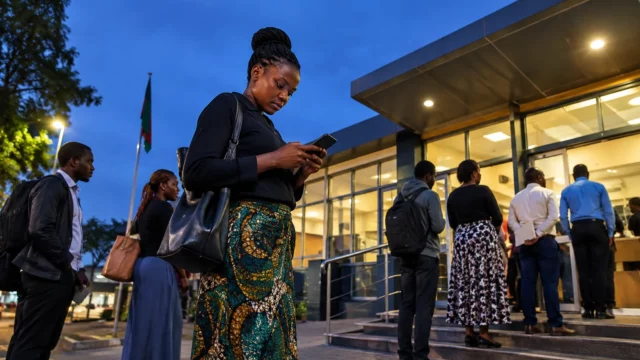
A connected phone alone does not guarantee digital access. People must also be able to buy it, pay for mobile data and connect to a reliable network. In Zambia, ambitions to expand smartphone ownership have put these three conditions at the heart of the debate on digital inclusion.
Targets go beyond network coverage alone
The Zambian government aims to increase broadband access to 80% of the population over five years. Over the same period, a target of 10 million additional smartphones was cited by Technology and Science Minister Felix Mutati during a meeting with Airtel Zambia on 5 November 2026.
A second Zambian publication also reported this ambition, presented as an effort to be pursued with telecoms operators. However, the available information does not specify whether the 10 million figure refers to sales, devices distributed or new users equipped with smartphones. This distinction will be essential in assessing progress.
The regional context also matters. Zambia is a member of the Southern African Development Community (SADC), which is working to coordinate digital transformation and reduce gaps in access between countries and populations. The national challenge is therefore part of a regional question: how to turn network expansion into genuinely accessible use.
A gap between available networks and usage
According to figures cited at the meeting, the country has about 27 million telecoms connections, of which 12.4 million are associated with smartphones. These figures, attributed to the latest report by the Zambia Information and Communications Technology Authority (ZICTA), do not necessarily represent an equivalent number of people: one user may have several SIM cards or devices.
The ministry presents the smartphone as a way to access online public services, payments and information useful to economic activities. Felix Mutati specifically mentioned digital payment of road taxes. But the availability of a service does not guarantee its adoption, especially when the device, data or necessary skills remain out of reach.
Coverage indicators already show this gap. The International Telecommunication Union estimates that 4G networks covered 91.2% of the population in 2024. This figure measures the presence of a signal, not the number of people actually connected. An International Growth Centre analysis published in September 2026 says that internet access remains unequal in rural areas.
The cost of phones and data
Airtel Zambia chief executive Hussam Baday outlined several options: making entry-level models more affordable, considering tax measures and developing operator financing. He also mentioned programmes aimed at low-income households, farmers and women in rural areas.
These proposals raise the question of how costs are shared. A tax cut can reduce the purchase price, but its impact depends on whether the savings are passed on to consumers. Credit makes immediate acquisition easier, while potentially adding to household budgets if incomes are irregular. Measures tailored to local realities will therefore be crucial.
The cost of connectivity then weighs on everyday use. GSMA Mobile Connectivity Index scores cited in the available data point to lower affordability for the poorest 40% than for the population as a whole. Indicators are particularly low for 1 GB and 5 GB data baskets. They measure relative ability to access services, not the price paid directly by each household.
The consequences vary by location and activity. In Lusaka, where services and networks are more concentrated, a smartphone can make procedures and payments easier. In rural areas, farmers also need stable coverage, affordable data and services suited to their practices. For women, access to a device and control over its use can pose additional obstacles.
The next step: measuring real access
The strategy cannot therefore be assessed solely by the number of devices put into circulation. It will be necessary to track their price, network quality outside urban centres, the cost of data and the share of residents who actually use the internet. Digital skills, local content, trust in services and data protection also matter.
Across SADC, Zambia’s experience illustrates a shared challenge: mobile coverage is expanding, but meaningful access remains unequal. ZICTA’s next figures and concrete measures announced on device prices will help determine whether the target of 10 million improves usage, rather than simply increasing ownership. The five-year timeframe sets a direction; the milestones and means of monitoring progress still need to be specified.