Algeria
 Egypt
 Libya
 Morocco
 Sudan
 Tunisia
 Benin
 Burkina Faso
 Cabo Verde
 Côte d'Ivoire
 Ghana
 Guinea
 Guinea-Bissau
 Liberia
 Mali
 Mauritania
 Niger
 Nigeria
 Senegal
 Sierra Leone
 The Gambia
 Togo
 Cameroon
 Central African Republic
 Chad
 DR Congo
 Equatorial Guinea
 Gabon
 Republic of the Congo
 São Tomé and Príncipe
 Burundi
 Comoros
 Djibouti
 Eritrea
 Ethiopia
 Kenya
 Madagascar
 Malawi
 Mauritius
 Mozambique
 Rwanda
 Seychelles
 Somalia
 South Sudan
 Tanzania
 Uganda
 Angola
 Botswana
 Eswatini
 Lesotho
 Namibia
 South Africa
 Zambia
 Zimbabwe
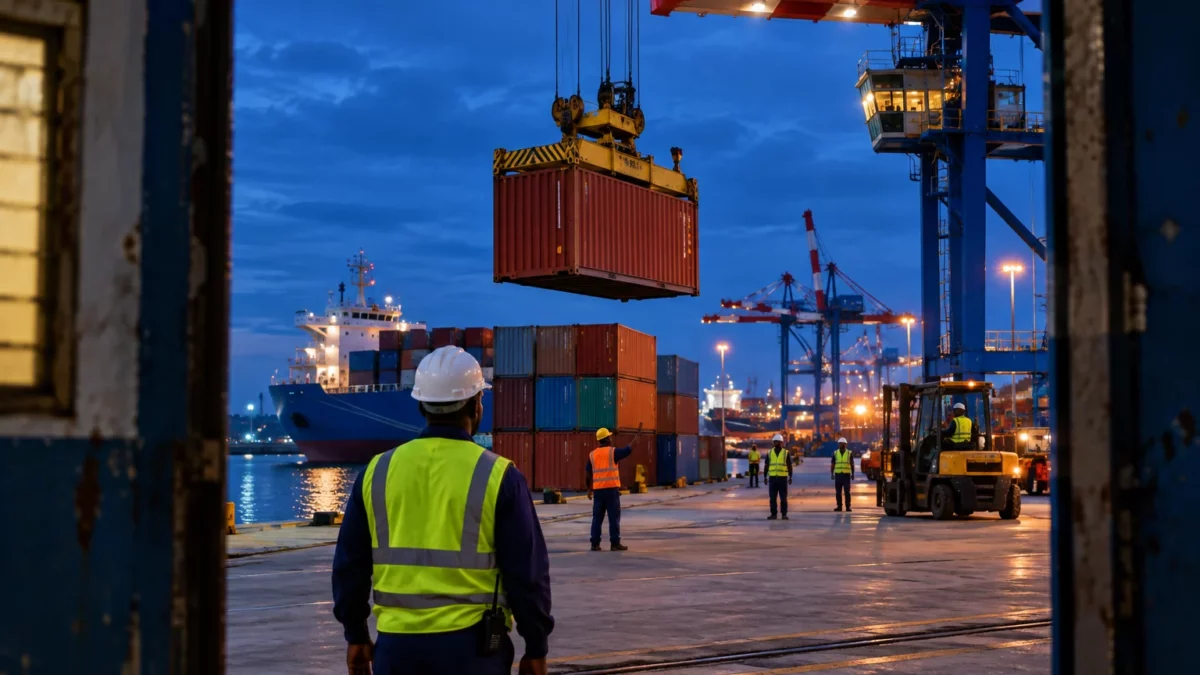
Ports can invest in larger terminals and accommodate giant ships without controlling their main variable: demand. In West Africa, the expected decline in container traffic in 2026 highlights this dependence and poses a practical question for the region’s economies: how can ports become more than gateways for imports?
Port trajectories that differ
West African ports serve different economies, from Nigeria to Togo, as well as Ghana, Senegal and Côte d’Ivoire. They compete for port calls and cargo, but also serve as access points for landlocked countries. Their performance therefore depends as much on maritime trade as on roads, borders and overland logistics chains.
These platforms are also part of a changing continental market. The African Continental Free Trade Area (AfCFTA), which aims to facilitate trade between African countries, could expand regional flows. But its impact on port volumes will depend on the practical implementation of trade rules, infrastructure and production capacity.
After a period of strong growth, a reversal is forecast for West Africa. In its “Container Market Annual Review and Forecast 2026/27”, published in September 2026, consultancy Drewry forecasts a decline in regional container traffic this year, followed by a recovery in 2027. The document presents forecasts, not a definitive tally for the year.
Contraction forecast after two years of growth
According to figures attributed to Drewry in the available material, West African traffic is estimated to have risen by 15.8% in 2024 and then by 19.4% in 2025. The region is therefore estimated to have accounted for 39.3% of African container traffic last year, up from 37% in 2024. This growth strengthened the position of ports on the west coast in maritime networks serving the continent.
The trend is said to have reversed in 2026. The same data indicate a 7% year-on-year regional decline in the second quarter, following a fall in the previous quarter. They also report contractions of 15.2% at the port of Lomé, Togo, and 4.2% in Lagos, Nigeria. These local and regional figures could not be confirmed against a second independent data series consulted here: they should therefore remain attributed to Drewry, rather than be presented as consolidated data.
The reported forecast for all of 2026 is 17.3 million TEU, a 5.5% decline from the 18.3 million forecast for 2025. TEU, or twenty-foot equivalent unit, is the standard measure used for container capacity and traffic. Drewry is then expected to forecast 18.1 million TEU in 2027, a 4.8% increase that would not be enough to return to the 2025 level.
Across Africa, the executive summary of Drewry’s report also forecasts a weaker 2026: the continent’s port throughput is expected to fall by 1.8%, before growing by 3.1% in 2027. These continental figures do not necessarily contradict the steeper decline forecast for West Africa: they aggregate sub-regions with differing trends.
Domestic demand at the heart of the equation
A port handles the goods entrusted to it. A decline in volumes may therefore reflect weaker demand, changes in shipping routes or logistical difficulties. On its own, it does not show that terminals are performing less well or that all the economies they serve are contracting.
For importers, inflation, the cost of credit and exchange-rate fluctuations can make purchases of consumer goods or equipment more difficult. Companies that rely on imported inputs may also cut or postpone orders. Households are affected indirectly, as the cost of goods shipped in containers can push up shop prices.
Shipping costs also matter. The text presenting Drewry’s forecasts cites an 11.3% rise in the average global container freight rate in 2026, including fuel. This figure has not been independently confirmed in the sources consulted. Nor is it enough to explain the decline in West Africa: demand factors, national variations and shipping companies’ choices must be examined separately.
The effects of a slowdown are uneven. Port authorities and operators may see their revenues and terminal utilisation change. Road hauliers, freight forwarders, stevedores and small businesses linked to incoming goods may also feel fluctuations in activity. In landlocked countries, the costs and delays of port transit feed through to inland supply chains.
Moving more regional produce
Greater port capacity remains useful when trade grows, but it does not automatically generate goods to transport. To reduce their dependence on imports, the region’s economies can seek to develop local processing, exports of manufactured goods and trade between neighbouring countries. This also requires reliable land corridors and predictable customs procedures.
For ports, the challenge is to handle more balanced flows: imports, exports and regional trade. Such diversification could make activity less sensitive to fluctuations in domestic purchasing power or external supply costs. It is not, however, an immediate response to a fall in traffic, and depends on industrial and trade decisions taken in each country.
The recovery forecast for 2027 remains a projection. The next figures will show whether the 2026 trough is temporary and whether volumes are rising across different ports, rather than at just a few hubs. For member states of ECOWAS, the Economic Community of West African States, the issue goes beyond competition between terminals: it also concerns the ability to link ports to regional markets and move more goods made on the continent.