
 Algeria
 Egypt
 Libya
 Morocco
 Sudan
 Tunisia
 Benin
 Burkina Faso
 Cabo Verde
 Ghana
 Guinea
 Guinea-Bissau
 Liberia
 Mali
 Mauritania
 Niger
 Nigeria
 Senegal
 Sierra Leone
 The Gambia
 Togo
 Cameroon
 Central African Republic
 Chad
 DR Congo
 Equatorial Guinea
 Gabon
 Republic of the Congo
 São Tomé and Príncipe
 Burundi
 Comoros
 Djibouti
 Eritrea
 Ethiopia
 Kenya
 Madagascar
 Malawi
 Mauritius
 Mozambique
 Rwanda
 Seychelles
 Somalia
 South Sudan
 Tanzania
 Uganda
 Angola
 Botswana
 Eswatini
 Lesotho
 Namibia
 South Africa
 Zambia
 Zimbabwe
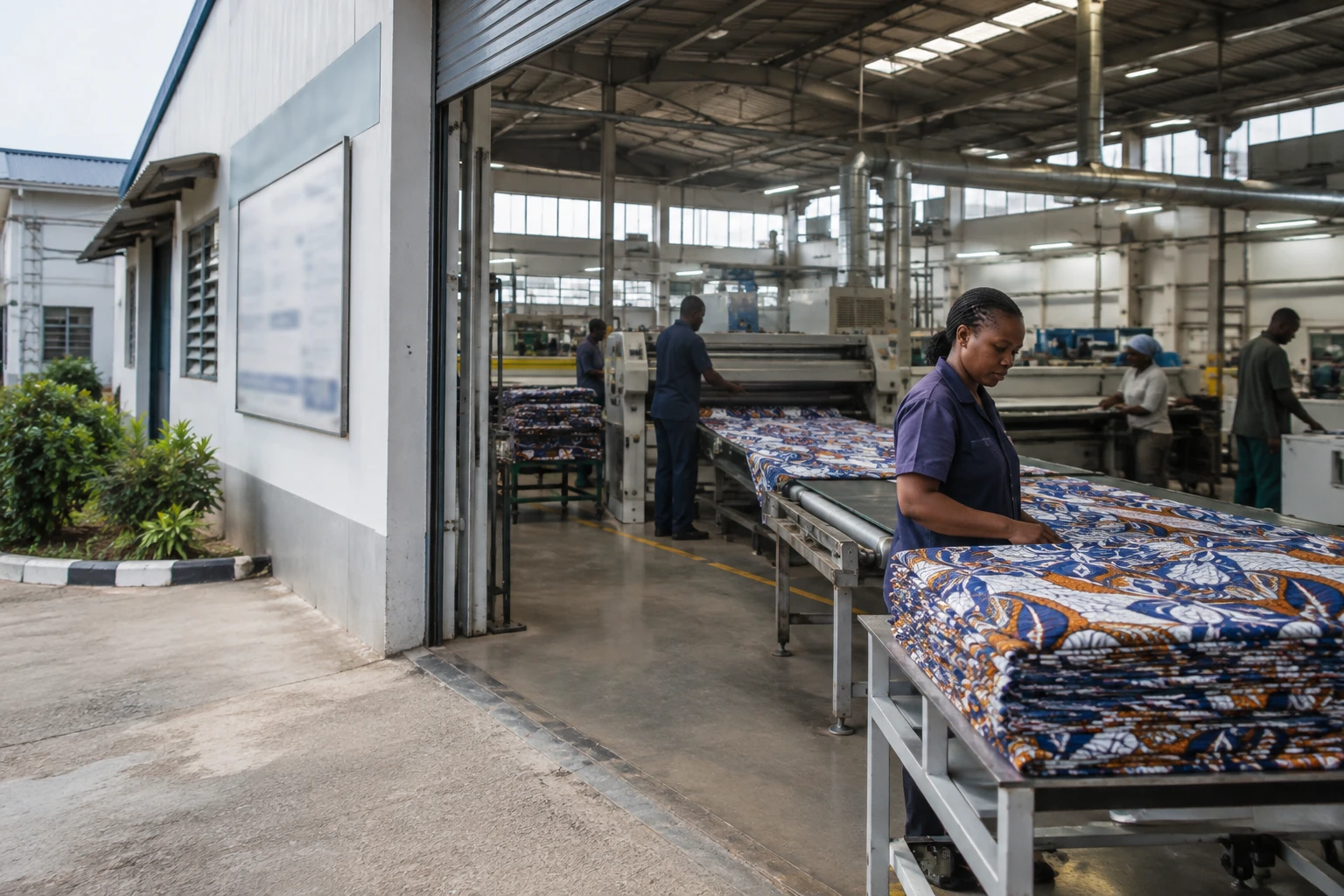
A factory can sell almost as much and still get some breathing space. That is the signal from Uniwax in Côte d’Ivoire: sales remain stable, but its operating accounts have returned to the black. The question now is whether this improvement can withstand competition from imported fabrics and a change of shareholder.
A regional market under pressure
Uniwax manufactures and sells printed textiles from Côte d’Ivoire. Its sales extend beyond national borders, notably into several West African markets. The company therefore operates in a commercial space larger than its domestic market alone.
ECOWAS, the Economic Community of West African States, governs some of this trade and regional competition. In a decision dated 22 May 2026, its Regional Competition Authority examined the acquisition of Uniwax by Compagnie ivoirienne de coton (COIC). The institution estimates that Asian imports account for between 80% and 85% of the volumes consumed in the regional textile market. This figure illustrates competitive pressure, but does not on its own measure Uniwax’s sales or the situation in each country.
The sector also links two stages of industry: cotton production and ginning, followed by its transformation into printed fabric. COIC operates mainly upstream, while Uniwax processes and sells textiles. Their combination could therefore bring part of the value chain closer together, without automatically guaranteeing more favourable outlets or prices.
Flat sales, a return to operating profit
In the first nine months of 2026, Uniwax reported revenue of CFA22.48bn, almost unchanged from the corresponding period a year earlier. Net profit reached CFA990.8m. Operating profit, which measures performance before financing costs and tax, was also close to CFA1bn.
The contrast with the previous period is notable: operating profit had been about CFA350m in the red. The activity report published on 28 October attributes the recovery to higher production, better control of expenses and a sales mix more favourable to margins. Figures cited in an Ivorian financial analysis confirm the main published amounts. However, they do not on their own make it possible to distinguish precisely the contribution of each measure.
Producing more can help spread a factory’s fixed costs across a larger number of items. But this improvement is sustainable only if the goods produced find buyers and inventories remain under control. A positive operating result is therefore an encouraging sign, but not yet proof of an established recovery.
The comparison of net profit also calls for caution. The 2025 accounts were restated: comparable figures show a loss of CFA546.6m in the first nine months. The accounts originally published, by contrast, showed a profit of CFA8.14bn, largely linked to an exceptional gain. The two figures therefore do not use the same accounting basis. The current increase should not be presented as a direct rise on the amount published last year.
A change of owner midway through the recovery
The operating performance comes during a period of shareholder transition. On 18 September 2026, threshold-crossing declarations established that COIC held 72.29% of Uniwax’s capital, following the transfer of shares previously held by companies in the Vlisco group. The ECOWAS Competition Authority had authorised the transaction in May. It noted, among other things, the complementarity between COIC’s cotton activities and Uniwax’s textile processing.
The change of shareholder cannot, however, be considered the cause of the results for the first nine months. According to published information, efforts to cut costs and improve production had begun before the transaction. They had already contributed to first-half results. The recovery initiated by the company must therefore be distinguished from the strategy its new shareholder may choose to pursue next.
Another change complicates the interpretation of sales: the Woodin brand left Uniwax’s operating scope after the transfer of the majority stake. The 2.4% increase in sales of the Uniwax brand reportedly offset this departure, keeping overall revenue almost unchanged. Thus, stable revenue does not mean that all brands or activities performed in the same way.
Next step: turning efficiency into sales
For employees and suppliers, a factory improving its operating performance can offer greater visibility. For management and the new shareholder, the challenge is to extend productivity gains without undermining jobs, quality or supply. For traders and consumers, the issue also concerns the availability, price and appeal of fabrics in the face of imported products.
In Côte d’Ivoire, the issue concerns the local processing of a raw material produced in the country. Across West Africa, it raises a broader question: can a regional value chain become more competitive when imports occupy a major place in markets? The ECOWAS Authority authorised the combination while indicating that it would monitor how competition develops after the transaction.
Uniwax’s next results will show whether margins remain positive and whether sales are genuinely growing on a like-for-like basis. Industrial investment and the development of regional sales outlets will also need to be monitored. For now, the signal is clear but limited: ongoing operations have recovered, while sales remain almost flat.



