Algeria
 Egypt
 Libya
 Morocco
 Tunisia
 Benin
 Burkina Faso
 Cabo Verde
 Côte d'Ivoire
 Ghana
 Guinea
 Guinea-Bissau
 Liberia
 Mali
 Mauritania
 Niger
 Nigeria
 Senegal
 Sierra Leone
 The Gambia
 Togo
 Cameroon
 Central African Republic
 Chad
 DR Congo
 Equatorial Guinea
 Gabon
 Republic of the Congo
 São Tomé and Príncipe
 Burundi
 Comoros
 Djibouti
 Eritrea
 Ethiopia
 Kenya
 Madagascar
 Malawi
 Mauritius
 Mozambique
 Rwanda
 Seychelles
 Somalia
 South Sudan
 Tanzania
 Uganda
 Angola
 Botswana
 Eswatini
 Lesotho
 Namibia
 South Africa
 Zambia
 Zimbabwe
A war fuelled far beyond Khartoum
In Khartoum, the fighting is no longer simply a clash between two Sudanese military forces. It is now part of a wider war economy, in which recruitment, financing, transport and arms networks cross several borders. That is the picture painted by a new UN report, as the conflict between the Sudanese Armed Forces and the Rapid Support Forces enters its fourth year.
For Sudan, this changes everything. It means the war depends not only on the balance of power at home. It also relies on external intermediaries, companies, logistics networks and political support that prolong the fighting and complicate any lasting mediation. Already scarred by territorial fragmentation and the collapse of large parts of its economy, the country is seeing its conflict become a regional as well as a national issue.
What the UN report says
The document, made public by the Human Rights Council’s international fact-finding mission, says it found “reasonable grounds” to believe that a transnational network supplied the Rapid Support Forces with weapons, logistical support, training and foreign personnel, including Colombian contractors involved in advanced weapons systems and drones. The mission adds that individuals and entities operating from, or linked to, the United Arab Emirates played an important role in networks recruiting, financing, transporting and deploying military contractors, as well as providing material support to the Rapid Support Forces.
The report also notes that drones supplied from abroad strengthened the capabilities of the Sudanese army, although its findings on this support remain preliminary. The investigators are consequently asking the Security Council to extend the arms embargo imposed on Sudan. The mission says the weapons, funding, personnel and technology fuelling the war must be contained.
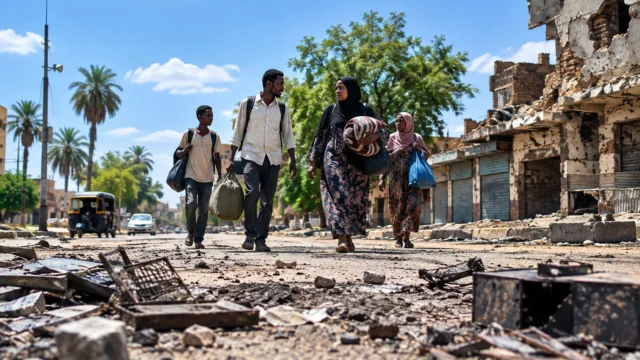
The figures show the scale of the collapse. According to the Associated Press, citing the report, the conflict has already killed at least 59,000 people, displaced about 13 million and pushed several parts of the country towards famine. These tolls remain difficult to verify day by day, but they reinforce the United Nations’ repeated warnings of a humanitarian crisis on a continental scale.
A limited embargo is no longer enough
Sudan is already subject to a Security Council sanctions regime dating back to Darfur. But this framework has historically focused on the western region, while the war that began on 15 April 2023 has spread to the country’s heartland and reshaped Sudan’s military landscape. The Security Council’s Panel of Experts is indeed mandated to monitor violations of the arms embargo and attacks on civilians, but the framework has not yet been extended to the entire country.
This is where the debate becomes political. Extending the embargo across Sudan would mean treating the war as a national conflict rather than a crisis confined to Darfur. It would complicate arms transfers, drone supply lines and mercenary networks, which often pass through neighbouring countries, commercial platforms or more discreet financial channels. For civilians, this could reduce the flow of weapons striking markets, schools, hospitals and residential areas. For the warring parties, it would mean greater international pressure on their foreign backers.
The problem, however, cannot be solved by a single resolution. The United Nations has already documented the use of drones in the war, attacks on civilians and the destruction of essential infrastructure. The report therefore recalls a simple reality: as long as supply channels remain open, the warring parties will find what they need to keep fighting. Unless enforced, the embargo becomes a rule without effect.
What this says about Sudan and the region
For Sudan, the stakes go beyond diplomacy in New York or Geneva. The country has become a crossroads of regional rivalries, where security interests, calculations involving neighbouring countries and opaque commercial networks intersect. The UN has already noted this year that entities from several countries were involved in moving personnel and equipment to the Rapid Support Forces. Precedents from other African theatres show that a conflict can escalate quickly when its foreign backers remain untouched.
The continental implications are clear. If the Security Council chooses to widen the embargo, it will send a signal about tackling cross-border supply chains that fuel wars in Africa. If it refrains, the Sudanese war will remain yet another example of a conflict in which international pressure comes after armed networks have become deeply entrenched. Either way, the Sudan crisis highlights a reality familiar to the African Union and regional organisations: without controls on arms flows, financial monitoring and discipline among transit states, no mediation lasts long.
In Sudan, the question is therefore no longer simply who is gaining ground. It is also who is fuelling the machinery of war, and how far the international community will allow these networks to operate. A decisive part of the conflict’s outcome now depends on that.