Algeria
 Egypt
 Libya
 Morocco
 Sudan
 Tunisia
 Benin
 Burkina Faso
 Cabo Verde
 Côte d'Ivoire
 Ghana
 Guinea
 Guinea-Bissau
 Liberia
 Mali
 Mauritania
 Niger
 Nigeria
 Senegal
 Sierra Leone
 The Gambia
 Togo
 Cameroon
 Central African Republic
 Chad
 DR Congo
 Equatorial Guinea
 Gabon
 Republic of the Congo
 São Tomé and Príncipe
 Burundi
 Comoros
 Djibouti
 Eritrea
 Ethiopia
 Kenya
 Madagascar
 Malawi
 Mauritius
 Mozambique
 Rwanda
 Seychelles
 Somalia
 South Sudan
 Tanzania
 Angola
 Botswana
 Eswatini
 Lesotho
 Namibia
 South Africa
 Zambia
 Zimbabwe
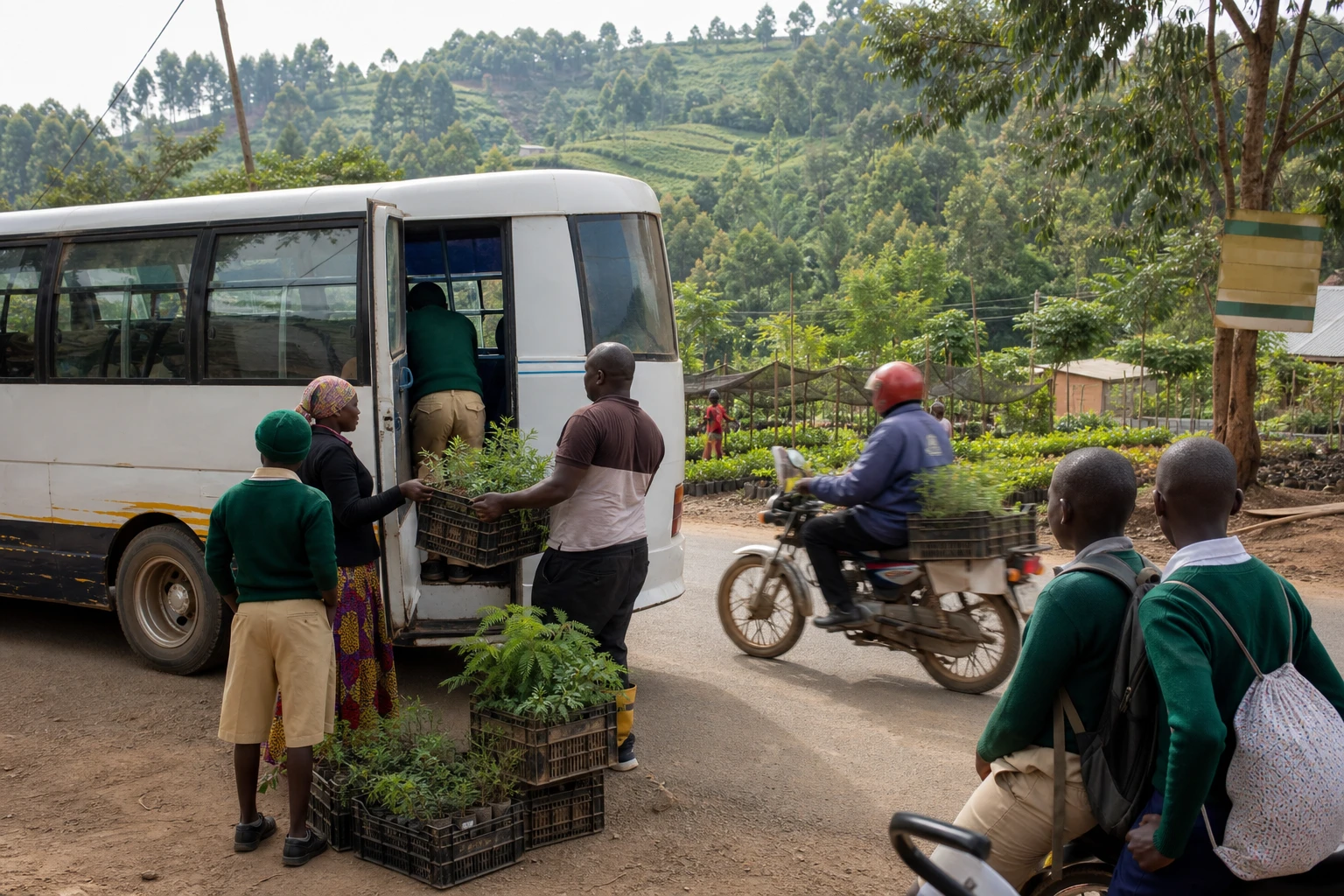
At Bwindi, protecting mountain gorillas also takes place beyond the park boundaries. In the hills of south-western Uganda, planting a tree can reduce pressure on the forest, provide wood for families and maintain a corridor useful to wildlife.
This approach brings together conservation, local incomes and education for young people. It responds to a simple reality: the protected forest is surrounded by farming villages where people need firewood, medicinal plants, fruit and materials for handicrafts.
At Bwindi, a rich forest surrounded by villages
Bwindi Impenetrable National Park covers about 32,092 hectares. UNESCO has listed it as a World Heritage Site since 1994, because of its biodiversity and its role for mountain gorillas.
The site is in Kanungu District, not far from the border with the Democratic Republic of the Congo. It belongs to a wider ecological area linked to the forests and landscapes of the Great Lakes region.
Bwindi is home to nearly half of the mountain gorillas still living in the wild. The latest detailed data available for the Bwindi area and neighbouring Sarambwe Reserve put the population at 459 in the 2018 census. The global population then exceeded 1,000.
This progress does not mean the species is out of danger. The mountain gorilla remains classified as “Endangered” by the International Union for Conservation of Nature. Its habitat remains limited and fragmented. Disease, human disturbance, climate change and agricultural pressure continue to threaten its future.
Planting near villages to protect the heart of the park
In several communities, local organisations are developing nurseries and distributing seedlings for private plots. The aim is to bring resources closer to homes, reducing the need to take them from protected areas.
The trees are used, among other things, for firewood. Some species can also provide fruit, plants used in traditional medicine or materials for handicrafts. This availability reduces the time spent collecting resources and can ease pressure on Bwindi’s forest edges.
The Ugandan organisation Change a Life Bwindi says it prioritises the restoration of native species, the protection of existing vegetation and the reconnection of degraded areas. This method is therefore not simply about producing more seedlings. It seeks to restore environments capable of retaining water, protecting soils and supporting varied biodiversity.
In 2023, residents of Kanungu District had already planted 20,000 trees towards a target of 50,000 by 2024, according to Ugandan media outlet The Nile Post. The project aims in particular to create a community conservation area covering about 100 acres.
The local dimension is essential. Families are not merely being asked to protect an animal associated with international tourism. They can obtain resources that meet their everyday needs. This approach strengthens support for conservation, although it does not eliminate tensions over access to land and resources.
Schools involved in passing on knowledge
Planting programmes also involve schools. Pupils take part in planting trees and learn how a forest ecosystem works.
This education links biodiversity protection to practical issues: water quality, soil erosion, agriculture and income from tourism. It can also help families develop lasting habits, provided the seedlings survive and communities receive regular support.
In south-western Uganda, several environmental initiatives support the establishment of school nurseries and the planting of native species. The goal goes beyond raising awareness. It is about giving young people a role in managing an area where human activities and wildlife live side by side every day.
Tourism brings income, but is not enough
Gorilla tourism is a mainstay of the economy in the Bwindi region. Visitor permits and activities related to welcoming travellers generate revenue for the state, operators and neighbouring communities.
According to the Associated Press, Uganda’s revenue-sharing scheme includes payments to communities through local authorities. The revenue can fund projects related to water, health or infrastructure.
However, this windfall is distributed unevenly. Formal tourism businesses benefit more from visitors than households far from the tourist circuits. Jobs can also be seasonal. For rural families, trees planted on their own land therefore offer a more direct benefit than the mere promise of tourism income.
The Covid-19 pandemic exposed the fragility of a model heavily dependent on international visitors. When arrivals fell, revenue for conservation and villages came under pressure. Reforestation thus offers an environmental response, as well as a form of economic diversification.
An issue that extends beyond Uganda’s borders
Mountain gorilla conservation is part of regional cooperation between Uganda, Rwanda and the Democratic Republic of the Congo. Gorillas move through landscapes that do not stop at administrative borders. Protecting one mountain range therefore also depends on conditions in neighbouring parks.
This dimension concerns, in particular, the East African Community, a regional organisation bringing together several countries in the sub-region and seeking to strengthen trade and cross-border cooperation. It also involves African Union mechanisms on biodiversity and the fight against land degradation.
For Kampala, the challenge now is to consolidate the gains made. This means monitoring plantings, protecting corridors, distributing revenue more fairly and ensuring the effective participation of communities, including those historically marginalised in conservation policies.
At Bwindi, the future of gorillas therefore depends not only on the number of animals counted. It also depends on the ability to maintain a functioning forest and villages able to live there without exhausting its resources. The next step will be to establish, on the ground, how many planted trees actually grow into sustainable forests.