Algeria
 Egypt
 Libya
 Morocco
 Sudan
 Tunisia
 Benin
 Burkina Faso
 Cabo Verde
 Côte d'Ivoire
 Ghana
 Guinea
 Guinea-Bissau
 Liberia
 Mali
 Mauritania
 Niger
 Nigeria
 Senegal
 Sierra Leone
 The Gambia
 Togo
 Cameroon
 Central African Republic
 Chad
 DR Congo
 Equatorial Guinea
 Gabon
 Republic of the Congo
 São Tomé and Príncipe
 Burundi
 Comoros
 Djibouti
 Eritrea
 Ethiopia
 Kenya
 Madagascar
 Malawi
 Mauritius
 Mozambique
 Rwanda
 Seychelles
 Somalia
 South Sudan
 Tanzania
 Angola
 Botswana
 Eswatini
 Lesotho
 Namibia
 South Africa
 Zambia
 Zimbabwe
In oil-rich Uganda, the wait is nearly over
In Kampala, oil is no longer an abstract promise. It has become a race against the calendar, costs and investor confidence. After years of postponed announcements, Uganda is now targeting its first commercial crude exports by the end of September 2026, according to reports carried this week in the specialist press, while Ugandan officials continue to aim for a first barrel this year.
This moment matters far beyond the fields of Lake Albert. In a landlocked East African country that is a member of the East African Community, joining the ranks of producers will alter regional dynamics. It also changes a very practical question: how to turn this new windfall into a lever for development, rather than merely a source of volatile public revenues.
An industrial project built around two blocks and a long corridor
The heart of Uganda’s project rests on two developments. Tilenga, operated by TotalEnergies, comprises several fields in the districts of Buliisa and Nwoya. Kingfisher, operated by CNOOC, is the other pillar. Together, they are expected to drive the country’s production ramp-up, with capacity targets that remain high in the operator’s documents and Ugandan public statements. As at 31 May 2026, TotalEnergies says drilling is progressing on 227 wells and major surface facilities at Tilenga are advancing.
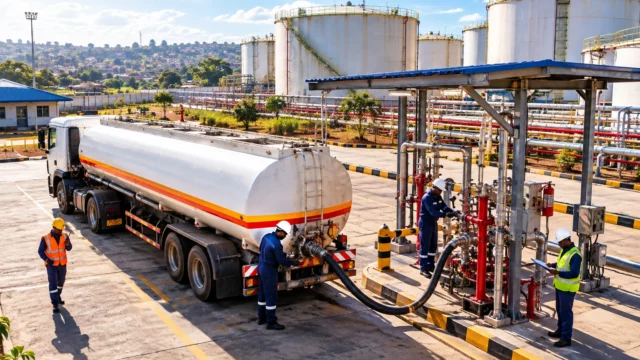
To export this crude, Uganda is relying on the East African Crude Oil Pipeline, or EACOP: a 1,443-kilometre heated pipeline that is intended to link Hoima, in the west of the country, to the Tanzanian port of Tanga. The infrastructure continues to be presented as a central component of the project. TotalEnergies’ publications report that pipeline installation work is continuing in Uganda and Tanzania, with the Tanga terminal at an advanced stage.
The Ugandan state has a direct role in the project. The Uganda National Oil Company holds a stake alongside the Tanzania Petroleum Development Corporation and CNOOC, while TotalEnergies remains the dominant player. This structure explains the central importance of public decisions in delivering the project on schedule.
The real issue remains the project’s price tag
The industrial shift does not erase the financial vulnerabilities. EACOP’s cost has risen sharply from initial estimates. An analysis by the Institute for Energy Economics and Financial Analysis now puts the project at about $5.6bn, an increase of around 55%. This inflation weighs on expected profitability and could reduce the net share accruing to the Ugandan state, since cost-recovery mechanisms give priority to expenses incurred by the companies.
In Kampala, however, the official message remains optimistic. In March 2026, Uganda’s parliament cited the Petroleum Authority of Uganda’s estimate that compensation for people affected by the EACOP route was 98% complete. TotalEnergies, for its part, reports near-total rates of signatures and payments in its own monitoring updates. The figures do not say the same thing, but they point to a shared reality: the project has passed its most politically difficult stage, securing land occupation and the corridor.
The courts have also entered the equation. Ugandan farmers went to the UK High Court in early July 2026 to challenge the terms of compensation linked to the pipeline. Such litigation is a reminder that, for families living along the route, the oil question is measured first in hectares, displacement and replacement income.
Banks have sent a different signal. Several major institutions, including BNP Paribas, Société Générale and Standard Bank, have declined to support the project’s financing, citing environmental and social risks. The financiers’ withdrawal has not halted the project, but it has tarnished its international image and increased its reliance on capital already committed.
Expected windfall, but electricity access remains unequal
The Ugandan government presents the project as a catalyst for energy sovereignty. The Petroleum Authority of Uganda says associated gas will not be flared, but will instead be put to use for local needs. This approach makes sense in a country where electricity access is expanding, though it still does not reach everyone equally. The International Energy Agency puts electricity access in Uganda at a still-limited level, with stark disparities between urban and rural areas. Other data, reported by the authorities and industry bodies, confirm that only a proportion of households are connected to the national grid.
This reality gives oil two faces. For the government, it promises revenues, infrastructure and new fiscal capacity. For households, particularly outside Kampala, the stakes are more immediate: reliable electricity, roads, schools, healthcare and jobs. The state wants to ensure that crude does not leave the ground without benefiting the real economy. That is where the difference between a windfall and transformation will be decided.
The African precedent is well known. Several producer countries have seen mining or oil revenues fuel cycles of debt, recurrent spending or dependence on global prices. Others have tried to build sovereign wealth funds, transparency rules or targeted investments. Uganda is now at this crossroads, obliged to turn initial production into a lasting impact rather than a temporary boom.
What this story says about East Africa
At regional level, the Ugandan project goes beyond energy alone. It tests the East African Community’s ability to manage a major cross-border project, protect the rights of people living along its route, and reconcile industrialisation, the environment and market integration. The pipeline crosses Tanzania, making it a matter of economic and logistical co-operation between Kampala and Dodoma as well.
At continental level, Uganda is entering a category that demands new trade-offs. A country still facing incomplete electricity access wants to become a hydrocarbon exporter while pursuing a gradual energy transition. It is one of the most visible contradictions in Africa today: financing development with fossil resources while already preparing for what comes next. What happens next will depend above all on three concrete dates: the effective commissioning of the facilities, the start of exports and the Ugandan state’s ability to capture its share of added value without costs absorbing most of the gains.