Algeria
 Egypt
 Libya
 Morocco
 Sudan
 Tunisia
 Benin
 Burkina Faso
 Cabo Verde
 Côte d'Ivoire
 Ghana
 Guinea
 Guinea-Bissau
 Liberia
 Mali
 Mauritania
 Niger
 Nigeria
 Senegal
 Sierra Leone
 The Gambia
 Togo
 Cameroon
 Central African Republic
 Chad
 DR Congo
 Equatorial Guinea
 Gabon
 Republic of the Congo
 São Tomé and Príncipe
 Burundi
 Comoros
 Djibouti
 Eritrea
 Ethiopia
 Kenya
 Madagascar
 Malawi
 Mauritius
 Mozambique
 Rwanda
 Seychelles
 Somalia
 South Sudan
 Tanzania
 Angola
 Botswana
 Eswatini
 Lesotho
 Namibia
 South Africa
 Zambia
 Zimbabwe

In Kampala, the challenge is no longer simply to attract foreign capital. The Ugandan government is now seeking partnerships that can produce goods locally, transfer technology and open up new markets for the country’s businesses. It is in this spirit that Uganda is preparing to hold its first business and investment forum with Italy.
A meeting focused on economic transformation
The meeting will be held in Rome on 13 and 14 October 2026 under the theme “Unlocking Shared Prosperity”. The event is being organised by the Ugandan embassy in Italy, alongside several Italian and international partners, including Confindustria, the United Nations Industrial Development Organization and the Italian Trade Agency.
The announcement was made in Kampala on 28 September 2026 by Uganda’s ambassador to Italy, Elizabeth Paula Napeyok, and Henry Mayega, head of international economic cooperation at Uganda’s Ministry of Foreign Affairs. The organisers expect representatives of governments, businesses, banks, financial institutions and development partners to attend.
The programme is intended to prioritise direct exchanges between businesses and public authorities. Business and institutional meetings are planned, along with discussions on joint ventures, project financing and the establishment of Italian companies in Uganda.
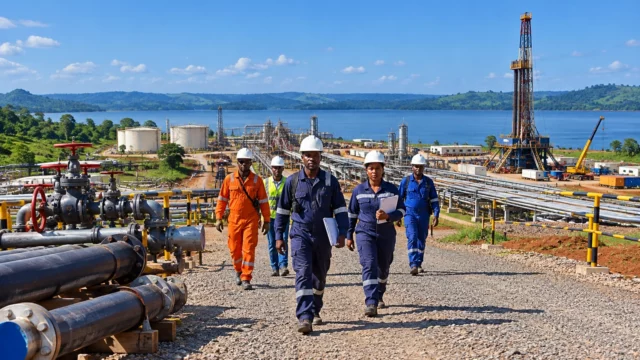
The target sectors are numerous: agribusiness, manufacturing, infrastructure, energy, renewable energy, construction, information technology, healthcare, pharmaceuticals, logistics and tourism. This breadth reflects Kampala’s priority: ensuring that foreign investment is not limited to raw materials or major construction projects.
A relationship within Kampala’s East African strategy
The closer ties with Rome come as Uganda seeks to strengthen its position in East Africa’s value chains. The country is a member of the East African Community, or EAC, which facilitates the movement of goods and economic cooperation among several states in the region. An investment based in Uganda can therefore target a market larger than that of its own farmers and consumers.
The country’s geographical position adds to its appeal. Kampala lies at the heart of trade between the Great Lakes countries and East Africa. The road and rail corridors linking Uganda to the ports of Mombasa in Kenya and Dar es Salaam in Tanzania remain essential for its imports and exports.
For Italian companies, Uganda could provide a gateway to a growing regional market. For Kampala, the challenge is to turn this geographical advantage into industrial capacity, skilled jobs and higher-value exports.
Italy’s development cooperation considers Uganda one of its priority African countries for 2024-2026. This reflects Rome’s desire to deepen its economic ties with the continent, particularly in agriculture, infrastructure, energy and vocational training.
Turning investment into productive projects
Available data show that Uganda is already attracting significant amounts of foreign direct investment. According to data from the United Nations Conference on Trade and Development, inflows reached about $3.4bn in 2025. This places the country among East Africa’s leading destinations for investment.
This growth should, however, be interpreted with caution. Flows may be concentrated in a handful of major projects, particularly in energy, hydrocarbons, transport or infrastructure. An annual increase therefore does not automatically mean the economy is diversifying sustainably.
The Ugandan government specifically wants to direct more of this capital towards local processing. It is focusing on manufacturing, pharmaceutical production, agribusiness and digital services. In these sectors, foreign investment can have a broader impact if it involves Ugandan businesses, universities and training centres.
The issue also concerns small and medium-sized enterprises. A major foreign project may generate few local benefits if domestic suppliers, technicians and service providers are left out. By contrast, partnerships with Ugandan companies can spread standards, skills and technology.
The forum’s success will therefore depend less on the number of participants than on the commitments that follow. The authorities will need to present projects that are sufficiently developed to enable investment decisions. They will also need to clarify the land, tax, customs and energy rules that directly affect the profitability of industrial activities.
The anticipated role of the future business support hub
The forum builds on an existing bilateral effort. The two countries are working to establish a future Business Hub in Kampala. The facility is intended to provide services to companies, strengthen skills, facilitate technology transfer and support international partnerships.
Such a tool could help Ugandan businesses better understand the requirements of the Italian market and, more broadly, those of the European Union. It could also assist Italian companies with local procedures, from identifying a partner to arranging project finance.
But its impact will depend on how accessible it is. Large companies already have networks and specialist advisers. SMEs, particularly those based outside Kampala, have a greater need for practical information, suitable financing and regular administrative support.
An impact extending beyond the Kampala-Rome axis
The closer ties between Uganda and Italy come at a time when several African countries are seeking to diversify their economic partners. Competition between the continent’s capitals is fierce for investment in agriculture, clean energy, healthcare, infrastructure and digital technology.
For Uganda, the Rome meeting will therefore be a test. It will need to show whether diplomatic announcements can lead to funded projects, trade contracts and industrial alliances. The next step will be to track the commitments made after the meetings, as well as the Italian multisectoral mission announced for Kampala in November 2026.
Across the EAC, the outcome will also be closely watched. If strong partnerships emerge in agricultural processing, pharmaceuticals or renewable energy, they could strengthen Uganda’s position in regional trade. Otherwise, the forum risks becoming another showcase in an increasingly competitive African race.