Algeria
 Egypt
 Libya
 Morocco
 Sudan
 Tunisia
 Benin
 Burkina Faso
 Cabo Verde
 Côte d'Ivoire
 Ghana
 Guinea
 Guinea-Bissau
 Liberia
 Mali
 Mauritania
 Niger
 Nigeria
 Senegal
 Sierra Leone
 The Gambia
 Togo
 Cameroon
 Central African Republic
 Chad
 DR Congo
 Equatorial Guinea
 Gabon
 Republic of the Congo
 São Tomé and Príncipe
 Burundi
 Comoros
 Djibouti
 Eritrea
 Ethiopia
 Kenya
 Madagascar
 Malawi
 Mauritius
 Mozambique
 Rwanda
 Seychelles
 Somalia
 South Sudan
 Tanzania
 Angola
 Botswana
 Eswatini
 Lesotho
 Namibia
 South Africa
 Zambia
 Zimbabwe
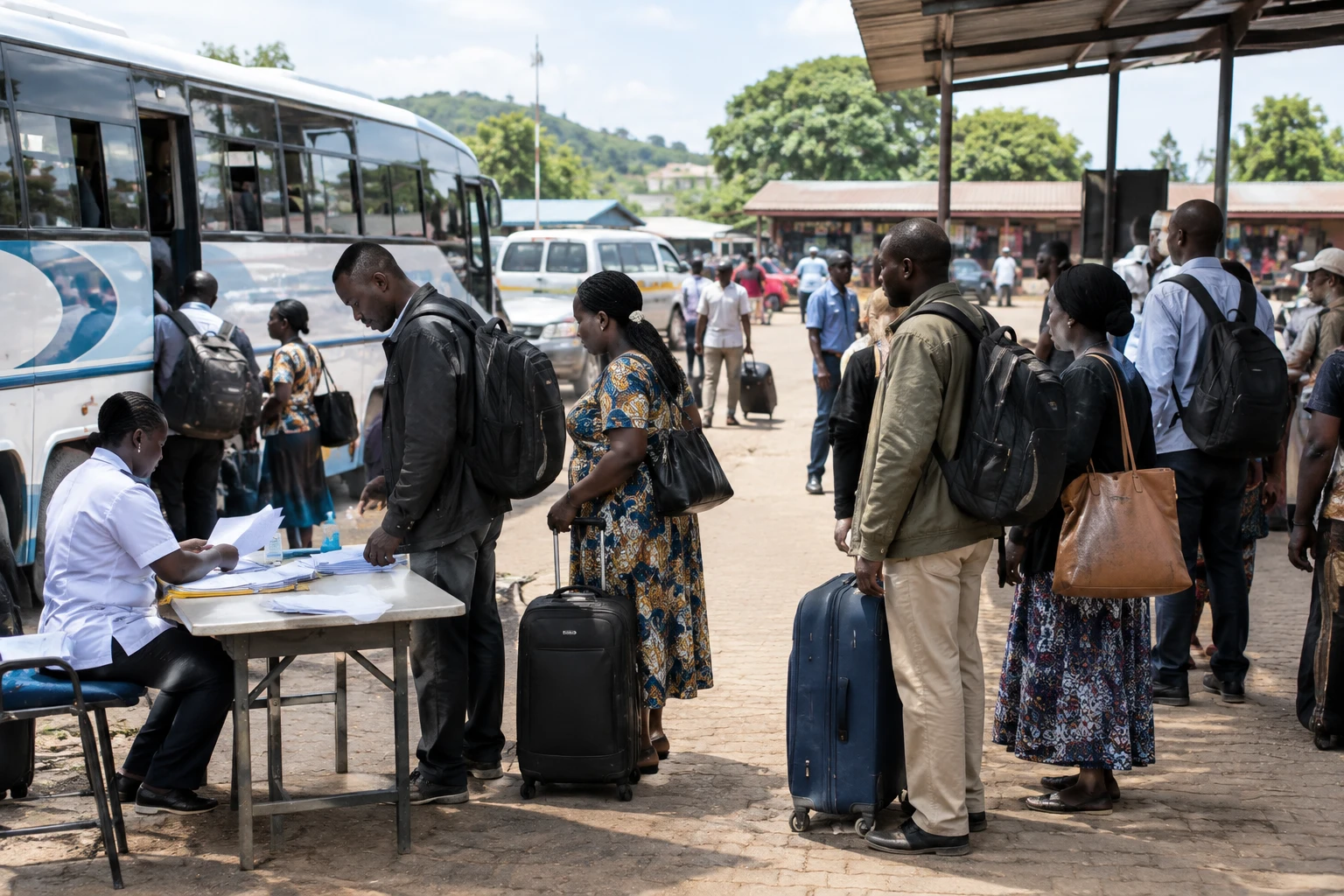
A busy border cannot easily be closed without affecting work travel, trade and family ties. Uganda’s response to Ebola must therefore balance two priorities: reducing the risk of transmission and maintaining essential crossings between border communities.
Regional vigilance after Uganda’s outbreak ends
On 28 July 2026, Ugandan authorities declared the Bundibugyo virus disease outbreak in the country over. The last patient had left hospital on 16 June. But the Democratic Republic of the Congo (DRC), its neighbour to the west, was still facing a major outbreak. Regular travel links the two countries, particularly in border areas.
Since then, cases have been recorded in Kenya and Nigeria. On 6 October, Kenya announced a case in a man who had arrived from the DRC via Uganda. On 20 October, Nigeria confirmed an infection in Abuja in a traveller who had arrived from Uganda. These events put border checks and contact tracing at the centre of the regional response. The World Health Organization (WHO) is stressing cross-border coordination and surveillance, while Uganda and the DRC had already agreed to co-operate on traveller monitoring and epidemiological investigations.
Quarantine for some returnees, wider checks
On 25 October, Uganda’s health minister, Chris Baryomunsi, announced in Kampala that Ugandans returning from travel to the DRC would be placed in quarantine for 21 days at their own expense. This period corresponds to the usual maximum incubation period monitored for Ebola. The measure applies to people returning from the DRC; it does not mean that all travellers entering Uganda are automatically subject to quarantine.
The ministry has also stepped up checks on travellers at Entebbe International Airport and land border posts. People entering the country must provide their contact details and itinerary so they can be traced if a health investigation requires it. The authorities warned that concealing information could lead to prosecution. According to the reported announcements, no exemption from checks is to be granted to diplomats or United Nations staff.
Travel from the DRC is restricted to journeys deemed essential, including those by humanitarian workers and truck drivers. Travellers who do not meet the requirements may be turned back at their own expense. Transit through Uganda after a stay in the DRC is also covered by the restrictions. These decisions, presented as public health measures, may nevertheless directly affect cross-border workers, transport operators and families travelling between the two countries.
Investigation under way into Abuja case
The journey taken by the patient diagnosed in Nigeria remains a sensitive issue. Ugandan and Nigerian authorities are continuing their investigations to establish her movements, contacts and the likely place where she was exposed to the virus. At this stage, the fact that she arrived in Abuja from Uganda is not, by itself, enough to conclude that she was infected there. The WHO says available information does not show that she travelled to the DRC.
This distinction matters: a travel itinerary is not proof of transmission. Authorities must compare accounts, movement data and laboratory results before determining any possible links between cases reported in different countries. Kampala also says that people monitored after contacts associated with the Kenyan case have completed their surveillance period, with no further transmission detected in Uganda.
The Bundibugyo strain responsible for the current outbreak is distinct from the Zaire strain. Uganda’s health ministry says no approved vaccine or targeted treatment is available for this strain. Rapid detection of symptoms, isolation and medical care therefore remain essential. Treatment capacity near border areas can also reduce the need for patients to travel to major cities or across the border.
Treating people near communities without cutting trade
The response is not limited to checks. According to the Ugandan authorities, teams from the country have set up three treatment units in the DRC, with a total of 240 beds. A fourth unit was due to open in Bulongo on the Wednesday after the 25 October announcement. The aim is to bring care closer to the communities concerned and avoid patients having to cross the border for treatment. These capacities should, however, be understood as official announcements, not as independent confirmation that the units are fully operational.
This approach illustrates the need for a co-ordinated response: national restrictions are not enough when the same community spans both sides of a border. In August, Ugandan and Congolese health administrations reaffirmed their co-operation on surveillance and preparedness. Traveller monitoring, rapid referral of sick people and information in locally used languages matter as much as checks at official posts, particularly when daily travel follows several routes.
Paid quarantine also raises questions of fairness. The financial burden may weigh more heavily on low-income households, small traders and workers whose earnings depend on regular travel. For the measure to be effective and understood, it must be accompanied by clear information on quarantine sites, conditions and ways to report symptoms. The authorities have not publicly provided details on all these aspects in the reported announcements.
A test of health co-operation in East Africa
Uganda is a member of the East African Community (EAC), which brings several countries in the region together on economic and co-operation issues. Movement between Uganda, the DRC, Kenya and Rwanda makes health co-ordination particularly important. The Abuja case also shows that air travel can quickly connect distant outbreak sites, without establishing where an infection was contracted.
The immediate priority is to clarify chains of transmission and maintain effective surveillance without treating every journey as suspicious. Further information from health ministries, the WHO and the Africa Centres for Disease Control and Prevention will need to clarify the findings of investigations, the evolution of cases and the actual capacity of deployed teams. For residents of border areas, the quality of this co-ordination will determine whether health protection can advance without bringing a lasting halt to the trade on which their daily activities depend.