Algeria
 Egypt
 Libya
 Morocco
 Sudan
 Tunisia
 Benin
 Burkina Faso
 Cabo Verde
 Côte d'Ivoire
 Ghana
 Guinea
 Guinea-Bissau
 Liberia
 Mali
 Mauritania
 Niger
 Nigeria
 Senegal
 Sierra Leone
 The Gambia
 Togo
 Cameroon
 Central African Republic
 Chad
 DR Congo
 Equatorial Guinea
 Gabon
 Republic of the Congo
 São Tomé and Príncipe
 Burundi
 Comoros
 Djibouti
 Eritrea
 Ethiopia
 Kenya
 Madagascar
 Malawi
 Mauritius
 Mozambique
 Rwanda
 Seychelles
 Somalia
 South Sudan
 Tanzania
 Angola
 Botswana
 Eswatini
 Lesotho
 Namibia
 South Africa
 Zambia
 Zimbabwe
In Kampala, a sigh of relief, but no let-up
In the Ugandan capital, the end of an outbreak never looks like a simple administrative victory. It marks a respite, certainly, but also the moment when vigilance must remain high, especially when the border is porous and exchanges with the east of the Democratic Republic of the Congo continue to fuel the health risk. Uganda has just brought an Ebola outbreak to a close without losing sight of the neighbouring outbreak, which remains active and is harder to contain.
The East African country declared its Ebola outbreak over on Tuesday 28 July 2026, after 42 days without a new case, or two incubation cycles — the period set by the World Health Organisation before an outbreak is considered over. The last patient was discharged from isolation in Kampala on 16 June. Since then, no further infections have been recorded in Uganda.
Uganda’s health ministry confirmed that the outbreak, declared on 15 May, had totalled 20 confirmed cases and two deaths. Of those infected, 15 came from the DRC and crossed the border to seek treatment before their infection was identified. Five Ugandan health workers were subsequently infected through contact with these imported cases. The figures point to a clear pattern: the virus did not establish sustained community transmission in Uganda, but it exploited cross-border movement and pressure on healthcare facilities.
A crisis contained through close monitoring
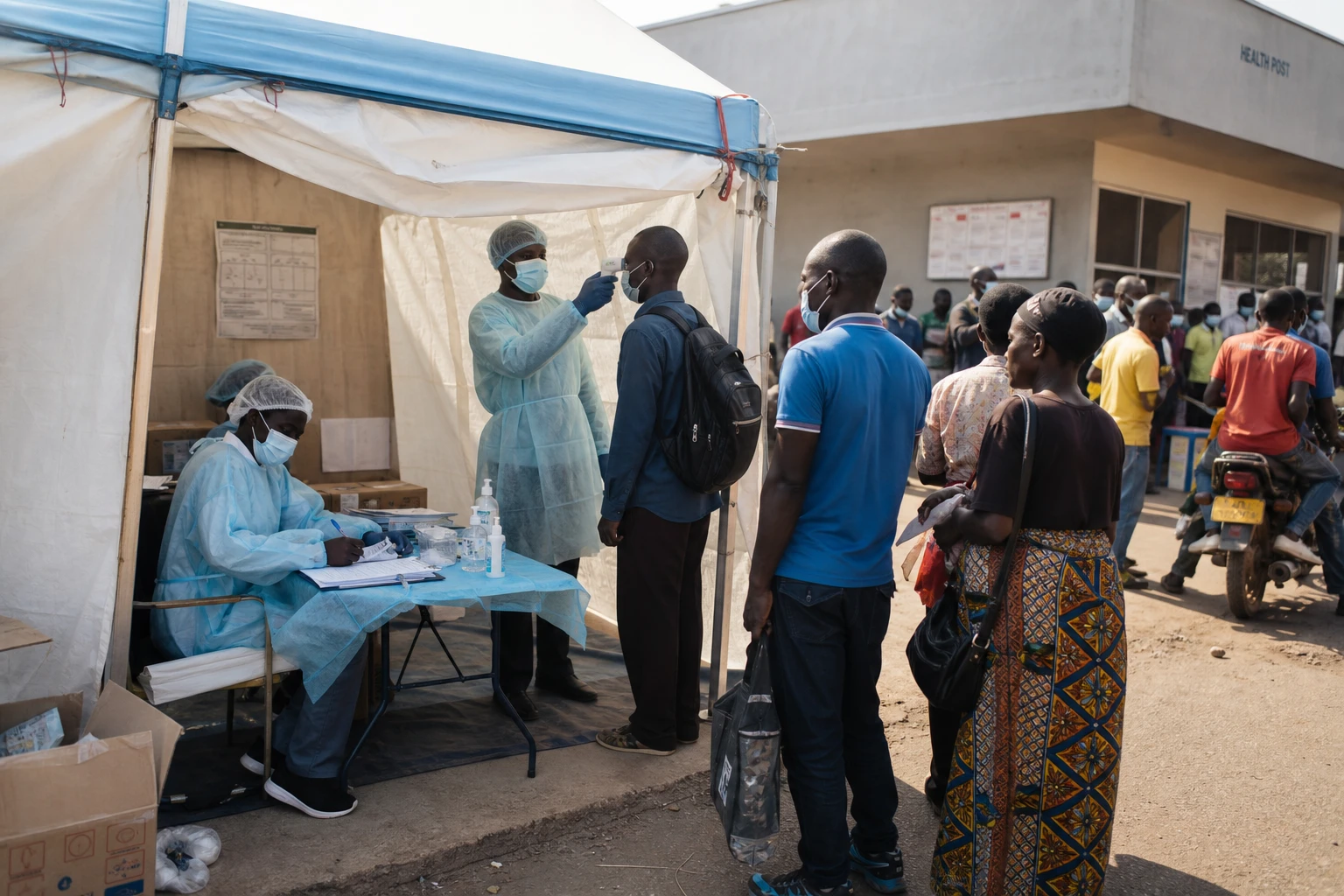
For health authorities, the decisive factor was the ability to trace chains of transmission. Kampala says contacts were identified, monitored and kept under observation until the end of their surveillance period. No unexplained source of community infection was identified. This traceability weighed heavily in the decision to lift the alert, as it makes it possible, at this stage, to rule out the idea of hidden transmission of the virus in the population.
Genomic analyses also confirmed the Bundibugyo strain of the Ebola virus. First identified in Uganda in 2007, this strain is a reminder of a reality that is often underestimated: the country is not merely a transit zone, but also a centre for advanced epidemiological surveillance, with accumulated experience in responding to haemorrhagic fevers. In this case, the alert was raised quickly and the outbreak was contained without major spread.
This success does not erase an important limitation. At present, there is no approved vaccine or treatment for the Bundibugyo strain. In other words, the response depends first and foremost on isolation, contact tracing, protection for healthcare workers and the organisation of care. This is precisely what makes rapid detection crucial in the Great Lakes region.
The Congolese border remains the real health front
Although Kampala now speaks of the end of the outbreak on its territory, it is not talking about the end of the risk. The reason is simple: eastern DRC continues to face a major outbreak, in areas where movement, access to healthcare and mistrust of health facilities are complicating the response. As of 5 or 12 July, according to WHO updates, the number of confirmed cases in the DRC was still rising sharply, with the toll already exceeding a thousand cases and several hundred deaths. The latest data published by the Congolese authorities and cited by the WHO show rapid and sustained growth.
This situation explains why Uganda is maintaining heightened surveillance in its border districts, with rapid-response teams and screening facilities ready to be deployed. The country knows that a health border cannot be closed by decree. It is maintained through checkpoints, laboratory coordination and the trust of communities that cross every day to trade, care for a relative or work. In this area, public health directly affects the informal economy, cross-border markets and transport services.
Kampala also says it has strengthened cooperation with Kinshasa. A memorandum of understanding is in place to better coordinate the cross-border response, and Uganda has announced the deployment of two mobile laboratories and two 80-bed treatment units in Aru and Kasenyi, in north-eastern DRC. The aim is to contain the virus as close as possible to its source, before it reaches new routes of human movement.
This regional approach matters. East Africa, through the East African Community, depends on the free flow of trade, but also on a minimum level of health coordination. When an epidemic crosses border areas, the response cannot remain strictly national. This is one of the clearest lessons of this episode: cooperation between neighbouring states is as important as hospital resources.
What the end of the outbreak changes — and what it does not erase
For the Ugandan authorities, the 28 July declaration is a public health success and a test of institutional credibility. It shows that a rapid, well-coordinated response backed by field surveillance can break a chain of imported transmission. It also confirms that healthcare workers, laboratories and contact-tracing teams remain at the heart of the country’s health security.
For residents of border districts, however, the word “end” has a more limited meaning. Checks, alerts and prevention messages are likely to remain visible for a long time, because the immediate danger has receded but not disappeared. Families who depend on crossing the border, small traders and transport operators are often the first to suffer the collateral effects of health measures. The smooth flow of traffic matters to their livelihoods, but the spread of the virus could cost far more.
On a continental scale, the Ugandan episode is a reminder of a simple rule: public health in East Africa is shaped as much in treatment centres as along regional mobility routes. Kampala’s declaration comes as the WHO and Africa CDC have strengthened their coordination on Ebola in Central Africa. What happens next will therefore depend on the DRC’s ability to curb its outbreak and neighbouring countries’ ability to maintain effective alert systems. As long as the Congolese outbreak remains active, Uganda cannot simply celebrate a return to calm. It must remain ready.