Algeria
 Egypt
 Libya
 Morocco
 Sudan
 Tunisia
 Benin
 Burkina Faso
 Cabo Verde
 Ghana
 Guinea
 Guinea-Bissau
 Liberia
 Mali
 Mauritania
 Niger
 Nigeria
 Senegal
 Sierra Leone
 The Gambia
 Togo
 Cameroon
 Central African Republic
 Chad
 DR Congo
 Equatorial Guinea
 Gabon
 Republic of the Congo
 São Tomé and Príncipe
 Burundi
 Comoros
 Djibouti
 Eritrea
 Ethiopia
 Kenya
 Madagascar
 Malawi
 Mauritius
 Mozambique
 Rwanda
 Seychelles
 Somalia
 South Sudan
 Tanzania
 Uganda
 Angola
 Botswana
 Eswatini
 Lesotho
 Namibia
 South Africa
 Zambia
 Zimbabwe
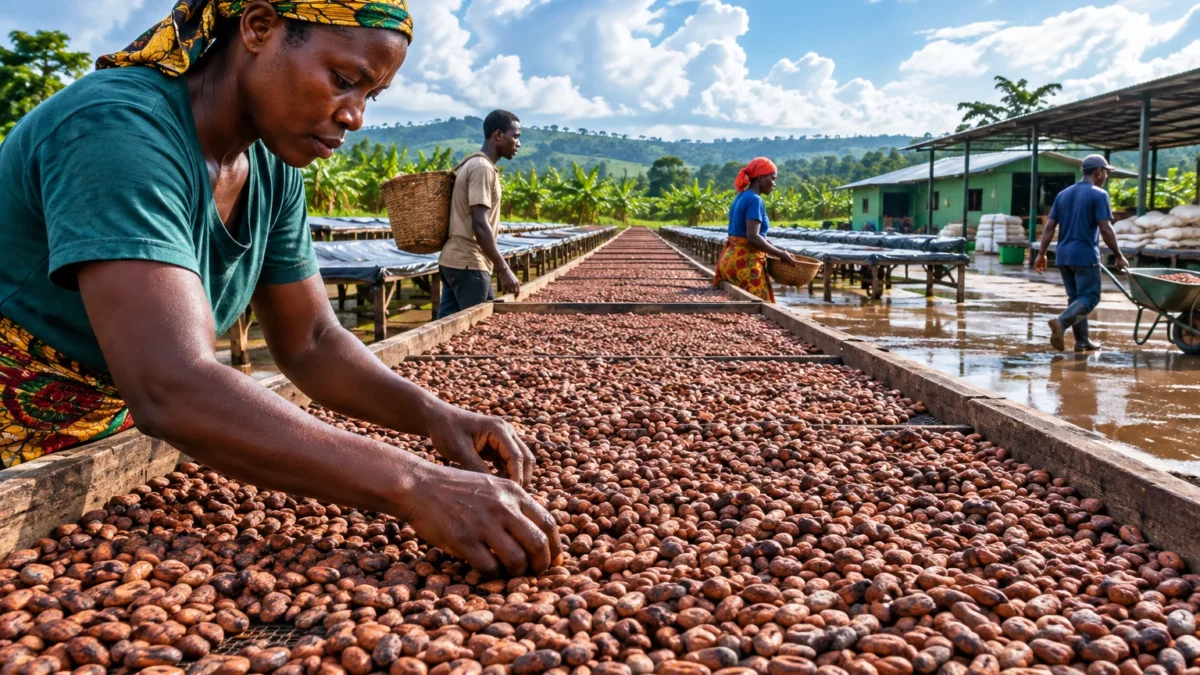
For cocoa producers, increasing harvests is not enough. Value also depends on bean quality, processing and the share of the final price that goes to farmers. In Uganda, Kenya and Tanzania, public announcements are multiplying. But stated ambitions will generate sustainable incomes only if they are matched by markets, infrastructure and concrete financing.
A sector still dominated by West Africa
The global centre of gravity for cocoa remains in West Africa. Côte d’Ivoire and Ghana are among the leading producers, while Nigeria also contributes to regional supply. This concentration gives East African initiatives strategic importance, but does not mean the countries concerned can quickly compete on volume.
Cocoa production depends on specific agricultural conditions. Trees take several years to produce, and yields vary according to varieties, soil quality, diseases and rainfall. Post-harvest stages also matter: fermentation, drying, storage and quality control. Expanding cultivated areas alone therefore guarantees neither exportable beans nor higher farm incomes.
Markets are also uncertain. High prices in recent years have been driven by supply pressures, particularly in West Africa. They are no guarantee of stable revenue: the International Cocoa Organization highlights the market’s sensitivity to changes in demand, weather conditions and production risks.
Uganda bets on yields and processing
On 19 November 2026, Ugandan authorities unveiled a decade-long strategy for 2026-2036. The plan targets annual production of 500,000 tonnes by 2036, up from a baseline of about 72,000 tonnes. It also aims to raise average yields from 530 to 1,000 kilograms per hectare.
The government also wants to increase local processing. Its aim is to raise the share of cocoa processed in the country from less than 5% to 30%. Annual export revenue is targeted at $3 billion, compared with about $620 million in the 2024-2025 financial year. Ugandan agriculture ministry statistics put exports in that period at 72,545 tonnes, worth $620.76 million. The finance ministry reports a similar figure of $620.4 million. These figures relate to exports and should not be confused with agricultural production.
The programme envisages about $221.19 million in public investment and financing intended to unlock further contributions. It relies on improved seedlings, post-harvest equipment and practices adapted to climate risks. According to Uganda’s public broadcaster, the strategy is also intended to coordinate interventions across the entire value chain. However, the projected leap from current levels to the 2036 target is considerable. Its feasibility will depend on the pace of financing, the availability of seedlings and the ability of agricultural services to support farms.
For farming households, the difference will hinge in particular on access to quality seedlings, agricultural advice and drying facilities. Exporters and processors will need to secure regular volumes that meet buyers’ requirements. Rapid expansion without quality control could undermine the commercial reputation Uganda is seeking to build.
Kenya and Tanzania move at different speeds
In Kenya, cocoa remains an emerging crop. In October 2026, President William Ruto announced an initiative to promote the sector. Other government announcements, reported in August, referred to the distribution of seedlings, particularly in Meru County. Available information does not, however, allow independent confirmation of the figure of two million seedlings planned before the end of the year. It is therefore better to distinguish agricultural diversification announcements from a national programme with established volumes and a defined timetable.
Kenya will first need to establish where the crop can succeed and organise the supply chain before targeting significant exports. Agronomic research, seedling production and access to buyers will be crucial. For farmers, a new crop offers an opportunity to diversify, but also entails costs and a wait before the first harvests.
Tanzania already has a more established sector, particularly in its southern producing regions. The country is targeting more than 80,000 tonnes a year by 2030, up from less than 16,000 tonnes according to recent data reported by the Tanzanian press. In March, authorities presented measures covering access to seedlings, area expansion, drying, organic farming and links between producers and buyers. The Tanzania Agricultural and Cereals Regulatory Authority confirms the 80,000-tonne target.
Processing remains a central challenge. According to data attributed to the regulator and reported by The Citizen, about 90% of Tanzania’s harvest is not processed locally. Developing the drying and treatment of beans could improve their quality and create more activity in the country. But this requires equipment, energy, skills and buyers able to pay more for higher-value production.
Market growth does not guarantee higher incomes
Commercial prospects are encouraging governments to invest. A Daedal Research study estimates the value of the global cocoa bean market at $21.4 billion in 2026 and $26.3 billion in 2030. This is an estimate of value linked to grindings and benchmark prices, not a guarantee of an equivalent increase in growers’ incomes. The same study attributes some recent fluctuations to prices, while global volumes have followed a different path.
For the three countries, the equation is therefore broader than production. They must preserve soil fertility, limit post-harvest losses and ensure that contracts between producers and buyers are clear. They must also prevent export growth from benefiting mainly traders and processing companies. Cooperatives, farmers’ organisations and small local processing units can influence how value is distributed, provided they have access to finance and infrastructure.
At regional level, these strategies could diversify the origins of African cocoa and strengthen processing on the continent. They do not yet shift the leadership away from West Africa. The next indicator to watch will be less the number of announcements than their implementation: seedlings actually distributed, investment secured, volumes harvested, the share processed locally and prices paid to producers. These results will show whether the announced expansion is creating a sustainable sector rather than simply increasing export volumes.