Algeria
 Egypt
 Libya
 Morocco
 Sudan
 Benin
 Burkina Faso
 Cabo Verde
 Côte d'Ivoire
 Ghana
 Guinea
 Guinea-Bissau
 Liberia
 Mali
 Mauritania
 Niger
 Nigeria
 Senegal
 Sierra Leone
 The Gambia
 Togo
 Cameroon
 Central African Republic
 Chad
 DR Congo
 Equatorial Guinea
 Gabon
 Republic of the Congo
 São Tomé and Príncipe
 Burundi
 Comoros
 Djibouti
 Eritrea
 Ethiopia
 Kenya
 Madagascar
 Malawi
 Mauritius
 Mozambique
 Rwanda
 Seychelles
 Somalia
 South Sudan
 Tanzania
 Uganda
 Angola
 Botswana
 Eswatini
 Lesotho
 Namibia
 South Africa
 Zambia
 Zimbabwe
In Tunisia, judicial independence remains at the heart of the political standoff
In Tunis, the judiciary is no longer a technical subject for legal specialists. It shows, in very concrete terms, how far the executive can go as checks and balances weaken. Five years after the turning point of 25 July 2021, the question of justice has become one of the most sensitive barometers of Tunisia’s trajectory.
The debate extends beyond courthouses. It affects citizens’ trust, the protection of lawyers, businesses’ legal security and the state’s ability to be held to account by institutions other than itself. In North Africa, where constitutional balances remain fragile, Tunisia thus offers a textbook case: a country that long claimed to have achieved an advanced institutional transition, but where the separation of powers has narrowed markedly since 2021.
The turning point of 2021, followed by the gradual takeover of institutions
On 25 July 2021, Kaïs Saïed suspended parliament and concentrated most executive power in his hands. The shift was subsequently consolidated through several legal acts. On 19 January 2022, a decree-law changed the structure of the High Judicial Council. Then, on 12 February 2022, another text created a Provisional High Judicial Council, placed under a new form of supervision.
This shift in the institutional balance did not affect judges alone. The authorities also dissolved the Assembly of the Representatives of the People on 30 March 2022. In other words, the judiciary was caught up in a broader process of reorganising the state, in which the executive dominated institutions that had previously served as counterweights, however imperfectly.
In this context, Kaïs Saïed’s re-election in October 2024 confirmed his political position. Tunisia’s electoral authority announced his first-round victory with 90.69% of the vote and turnout of 28.8%. The president was then sworn in for a second term in Tunis on 21 October 2024.
Dismissals, legal challenges and pressure on judges
It is against this backdrop that the report presented on 28 July 2026 by the Intersection association should be seen. The organisation describes a judiciary weakened by the dissolution of the former judicial governance body, dismissals, arbitrary transfers, disciplinary sanctions and smear campaigns. According to the report, the issue is no longer simply reforming the judicial system, but whether it can act without direct or indirect political orders.
One episode left a deep mark: the dismissal of 57 judges in June 2022. The president accused them, among other things, of corruption and of protecting people linked to terrorism. But the administrative court later suspended the decision for most of them, a ruling that was not effectively implemented, according to several legal and media monitoring sources. The episode established the notion of a lasting power struggle between the executive and judges.
The significance of this case is not limited to the number of judges involved. It calls into question the very principle of an effective remedy. When an administrative court ruling is not enforced, the problem is no longer merely disciplinary. It becomes institutional. It signals that a legal decision can be neutralised by the ruler’s will, or by the ability to dictate the administrative timetable. This is precisely the shift that Intersection says it sees unfolding.
What this means for citizens, lawyers and the country’s economy
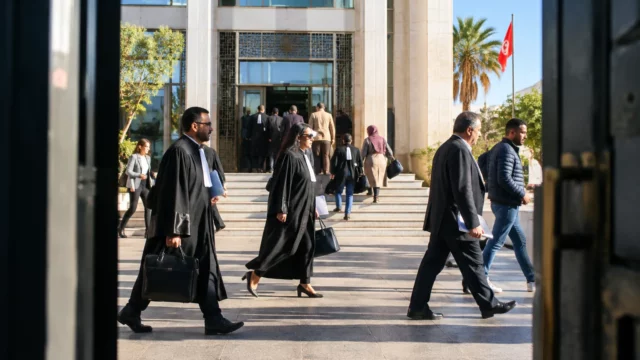
For Tunisian citizens, the issue is simple: a trial is only worthwhile if the judge is seen to be independent. Otherwise, justice becomes a rubber stamp, not a forum for arbitration. For lawyers, the tension is even more direct. Since 2024, and especially in the first half of 2026, several organisations have denounced repeated attacks on the profession, prosecutions targeting prominent members of the bar and a climate of mounting tensions around the defence of rights. In June 2026, a lawyers’ strike even brought this breakdown in trust into the open.
For businesses and investors, the issue is less visible, but just as real. A judiciary perceived as dependent complicates commercial disputes, undermines contractual predictability and fuels the perception that disputes may be settled less by rules than by access to power. In a country seeking to stabilise its economy and maintain ties with regional partners, this uncertainty weighs on the business environment as much as on civil liberties.
Tunisian civil society, meanwhile, is trying to continue documenting events despite shrinking space. Several NGOs and associations have recently reported dissolution proceedings, administrative warnings or prosecutions affecting both human rights defenders and independent media. The political message is clear: the state no longer wants merely to govern; it also wants to control the places where it is criticised.
A Tunisian episode with implications for all of North Africa
Tunisia is not an isolated case, but it remains a powerful signal for the region. Across North Africa, states that rely on exceptional reforms to reshape institutions often face the same dilemma: promise efficiency by reducing checks and balances, then discover that concentrating power undermines the legitimacy of decisions. This debate resonates far beyond Tunis, from Rabat to Algiers, and as far as continental discussions on the rule of law and constitutional governance.
The next question to watch is not simply whether another NGO report will be published. It concerns the practical enforcement of court rulings, the role of the Ministry of Justice in appointments and sanctions, and whether professional groups can continue to exist without being absorbed into the executive machinery. In Tunisia, this is where, in the coming months, the difference will emerge between a judiciary that exists in form and one that is genuinely independent.