Algeria
 Egypt
 Libya
 Morocco
 Sudan
 Tunisia
 Benin
 Burkina Faso
 Cabo Verde
 Ghana
 Guinea
 Guinea-Bissau
 Liberia
 Mali
 Mauritania
 Niger
 Nigeria
 Senegal
 Sierra Leone
 The Gambia
 Togo
 Cameroon
 Central African Republic
 Chad
 DR Congo
 Equatorial Guinea
 Gabon
 Republic of the Congo
 São Tomé and Príncipe
 Burundi
 Comoros
 Djibouti
 Eritrea
 Ethiopia
 Kenya
 Madagascar
 Malawi
 Mauritius
 Mozambique
 Rwanda
 Seychelles
 Somalia
 South Sudan
 Tanzania
 Uganda
 Angola
 Botswana
 Eswatini
 Lesotho
 Namibia
 South Africa
 Zambia
 Zimbabwe
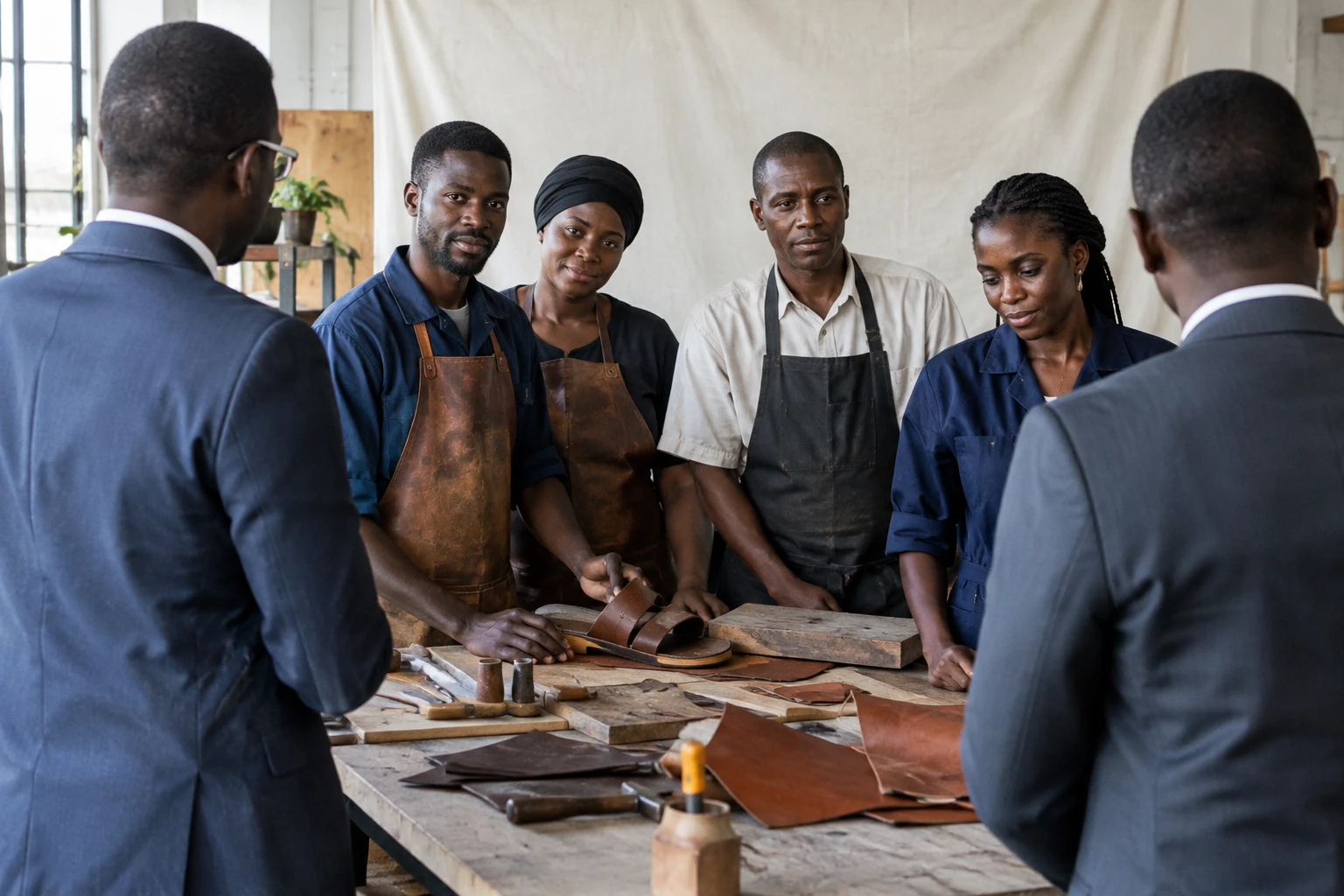
A sandal inspired by a style worn by nomadic peoples, made in Dakar from leather and redesigned for the contemporary market: behind the product lies an industrial challenge, too. For Senegalese brands to grow, they need to train artisans, organise production and find outlets beyond the domestic market.
From artisanal expertise to structured production
Maraz, a Senegalese brand founded by Moustapha Sy Ndiaye, is built around leather shoes, bags and accessories. Its signature product, the Padam sandal, is based on a style associated with nomadic peoples. The brand says it has adapted the design by working on comfort, shapes and colours, among other things. This evolution reflects a broader approach: combining local references with the demands of a contemporary product.
The move to higher production volumes rests on two pillars: an equipped workshop and training. Maraz’s manufacturing facility, in Dakar’s Mermoz district, has been presented as having a capacity of 150 pairs a day. This figure describes stated capacity, not the number of pairs actually produced each day. The company also makes hand-patinated shoes, trainers and women’s styles.
The brand says it has nearly 50 employees and around 30 contractors. These figures offer a glimpse of its organisation, but do not in themselves measure net job creation or the stability of positions. For artisans paid by the piece or working as contractors, regular access to orders and remuneration remain decisive.
Training to meet the workshop’s needs
M-Academy, an initiative linked to Maraz, offers training in leatherwork and leather goods. Its programme covers cutting, pattern-making, assembly and finishing, as well as skills related to managing a fashion business. On its website, the academy describes its mission as strengthening professional skills and structuring Senegal’s sector.
Jean-Marie Baraille, a 42-year-old bootmaker, says he learned to construct shoes, work on designs and use machinery during his training. His experience shows the value of further training for already experienced artisans: it can help improve techniques, consistency and the ability to work on production runs. But access to equipment and markets is just as important.
GIZ, the German agency for international cooperation, confirms a training partnership between Maraz Academy and a German institute specialising in leather. The cooperation is part of the Invest for Jobs programme, which supports vocational training linked to businesses’ needs. The initiative can provide methods and technical exchanges; its impact will depend on the continuity of training and the job opportunities available to those trained.
A value chain still to be strengthened
Shoe production does not begin and end in the workshop. It depends on the availability and cost of leather, tools, design, distribution and after-sales service. A local production unit can help coordinate certain stages and bring manufacturing closer to customers. However, increasing output does not automatically mean that inputs are locally sourced or that the value created remains in Senegal.
This question matters in a country where crafts and small businesses play an important role in economic activity, but large-scale production requires investment, technical skills and reliable commercial channels. For a brand targeting the high-end market, quality must remain consistent from one pair to the next. That requires checks, controlled lead times and teams able both to maintain machinery and pass on skills.
Training can also open up prospects beyond a single employer. M-Academy’s website sets out aims for training and integration into the sector. These are stated ambitions: assessing them will require data tracked over time on the number of people trained, jobs secured, their duration and the role of women in the occupations concerned.
From Dakar to regional markets
Maraz says it sells its products in Senegal, Côte d’Ivoire and Kenya, and plans to expand its presence across the continent. This ambition puts the company in several markets, each with different purchasing habits and distribution networks. It must also contend with logistics, export costs and competition from imported goods.
For West Africa, the development of brands able to produce locally raises a practical question: how can recognised expertise be turned into a sustainable business, with skilled jobs and regular sales? ECOWAS, the Economic Community of West African States, aims in part to facilitate regional trade. But effective access to markets also depends on trade rules, infrastructure and the partnerships companies establish.
The project therefore goes beyond one brand’s commercial success. It puts to the test a model in which training, manufacturing and distribution advance together. Maraz has spoken of expanding into other African countries and opening a shop in Paris. These plans have yet to be realised. The clearest indicators will be actual sales volumes, job stability and the ability to maintain quality while expanding market access.
For Senegal, the challenge is to grow a sector without reducing craftwork to a display. If the skills acquired benefit several workshops and businesses, training could strengthen an entire sector. If they remain concentrated in a single organisation, their impact will be more limited. The future will depend as much on passing on skills as on sales in Senegal and across African markets.