
 Algeria
 Egypt
 Libya
 Morocco
 Sudan
 Tunisia
 Benin
 Burkina Faso
 Cabo Verde
 Côte d'Ivoire
 Ghana
 Guinea
 Guinea-Bissau
 Liberia
 Mauritania
 Niger
 Nigeria
 Senegal
 Sierra Leone
 The Gambia
 Togo
 Cameroon
 Central African Republic
 Chad
 DR Congo
 Equatorial Guinea
 Gabon
 Republic of the Congo
 São Tomé and Príncipe
 Burundi
 Comoros
 Djibouti
 Eritrea
 Ethiopia
 Kenya
 Madagascar
 Malawi
 Mauritius
 Mozambique
 Rwanda
 Seychelles
 Somalia
 South Sudan
 Tanzania
 Uganda
 Angola
 Botswana
 Eswatini
 Lesotho
 Namibia
 South Africa
 Zambia
 Zimbabwe
A Malian city that is more than a name
In Timbuktu, in northern Mali, desert dust does not cover only earthen walls. It also blankets a political, religious and scholarly memory that still links Bamako to the long history of West Africa. In a region marked by insecurity and shifts in power, the city remains a landmark. It speaks of what Mali has lost, but also of what it continues to defend.
The city is part of a group of Malian sites that matter to the country, the West African sub-region and world heritage. Timbuktu has been on the World Heritage List since 1988 and remains, alongside Djenné, the Bandiagara Escarpment and the Tomb of Askia in Gao, one of Mali’s major cultural landmarks south of the Sahara. This listing is not decorative. It places a public responsibility on a fragile heritage that is central to national identity.
At the heart of a heritage that has outlasted empires
The ancient city of Timbuktu grew at the crossroads of caravan routes linking the Maghreb and sub-Saharan Africa. Its history is tied to the great West African empires and the spread of Islamic learning in the region. The three best-known mosques, Djingareyber, Sankoré and Sidi Yahia, still shape the urban landscape. They are not merely monuments. They are places of worship, transmission and social continuity.
The description “city of 333 saints” refers to a deeply rooted spiritual memory. It also recalls that Timbuktu’s reputation comes not from a single monument, but from a fabric of knowledge, scholarly lineages and religious practices. The historic centre has preserved traces of this former urban life, even as successive crises have weakened family libraries, traditional houses and cultural networks.
The manuscripts are the most visible evidence. They cover theology, law, astronomy, medicine, trade and history. Several sources refer to tens of thousands of documents, with older local estimates sometimes putting the number at more than 100,000. Their value lies not only in their age. It lies in what they show: a literate, connected Africa that produced ideas, rather than serving merely as a peripheral conduit for knowledge.
2012 exposed the site’s vulnerability
The rupture came with the occupation of northern Mali by armed groups in 2012. According to UNESCO, 14 of the 16 mausoleums that make up the listed site were destroyed amid the conflict and civil unrest. The organisation also says that about 4,203 manuscripts held at the Ahmed Baba Institute were burned or stolen, while other collections were hidden or moved to save them. The figures do not tell the whole story, but they measure the scale of the shock.
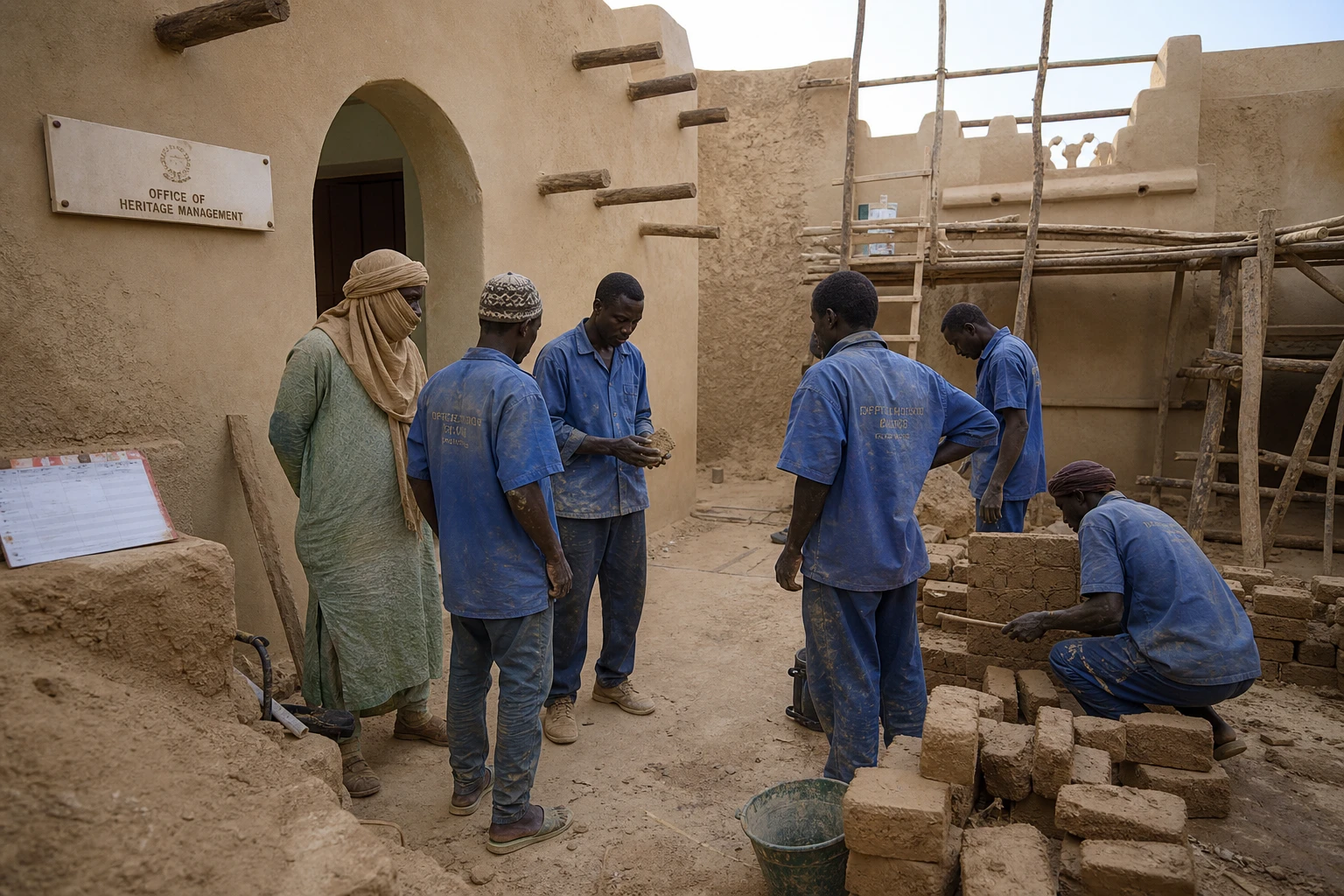
The response was swift, because the stakes went far beyond preserving an ancient site. Following a request from the Malian government, an action plan was put in place to rehabilitate damaged heritage and protect the manuscripts. Reconstruction was later carried out with local masons, under the supervision of Malian cultural authorities, site managers and international partners. UNESCO presented this mobilisation as a concrete response to the deliberate destruction of heritage.
This work had particular significance for the people of Timbuktu. The task was not simply to rebuild mausoleums. It was also to bring places of memory back into use, preserve private libraries, revive the transmission of craft skills and prevent an entire chapter of Malian history from disappearing under violence. In a city far from Bamako, the challenge was twofold: to restore stonework and maintain a civic bond.
What Timbuktu says about Mali today
Heritage remains bound up with security. In Mali, the state is still seeking to reassert its authority in the north, while the Sahel is seeing armed groups move, local tensions rise and the effects of the 2012-2013 crisis persist. For Bamako, Timbuktu is therefore not an open-air museum. It is a marker of cultural and territorial sovereignty. When the site trembles, the very image of the state wavers.
For the population, the effects are even more tangible. Cultural tourism remains fragile. Not all the libraries have returned to their former pace. Heritage routes operate intermittently. The families entrusted with the manuscripts, religious leaders, earthen-building artisans and heritage workers bear part of the burden. At the same time, preservation creates local jobs, strengthens skills and sustains a modest but real service economy around the old centre.
Regionally, Timbuktu speaks to all of West Africa. The city is a reminder that heritage is not a luxury reserved for times of stability. It becomes a political issue as soon as conflict takes hold. For ECOWAS, the African Union and Sahelian states, the case shows that a monument, mosque or library can become a symbolic frontline. Safeguarding these places also means preserving evidence of historical continuity in a region too often reduced to its crises alone.
What happens next will depend on three fronts: lasting security in northern Mali, the restoration of manuscript collections and the maintenance of the site’s international listing. As long as these three tasks remain connected, Timbuktu will matter far beyond its earthen ramparts. It will remain a test for Mali, and for how the continent protects its memories when the news turns grim.



