Algeria
 Libya
 Morocco
 Sudan
 Tunisia
 Benin
 Burkina Faso
 Cabo Verde
 Côte d'Ivoire
 Ghana
 Guinea
 Guinea-Bissau
 Liberia
 Mali
 Mauritania
 Niger
 Nigeria
 Senegal
 Sierra Leone
 The Gambia
 Togo
 Cameroon
 Central African Republic
 Chad
 DR Congo
 Equatorial Guinea
 Gabon
 Republic of the Congo
 São Tomé and Príncipe
 Burundi
 Comoros
 Djibouti
 Eritrea
 Ethiopia
 Kenya
 Madagascar
 Malawi
 Mauritius
 Mozambique
 Rwanda
 Seychelles
 Somalia
 South Sudan
 Tanzania
 Uganda
 Angola
 Botswana
 Eswatini
 Lesotho
 Namibia
 South Africa
 Zambia
 Zimbabwe
Trade, energy and human capital
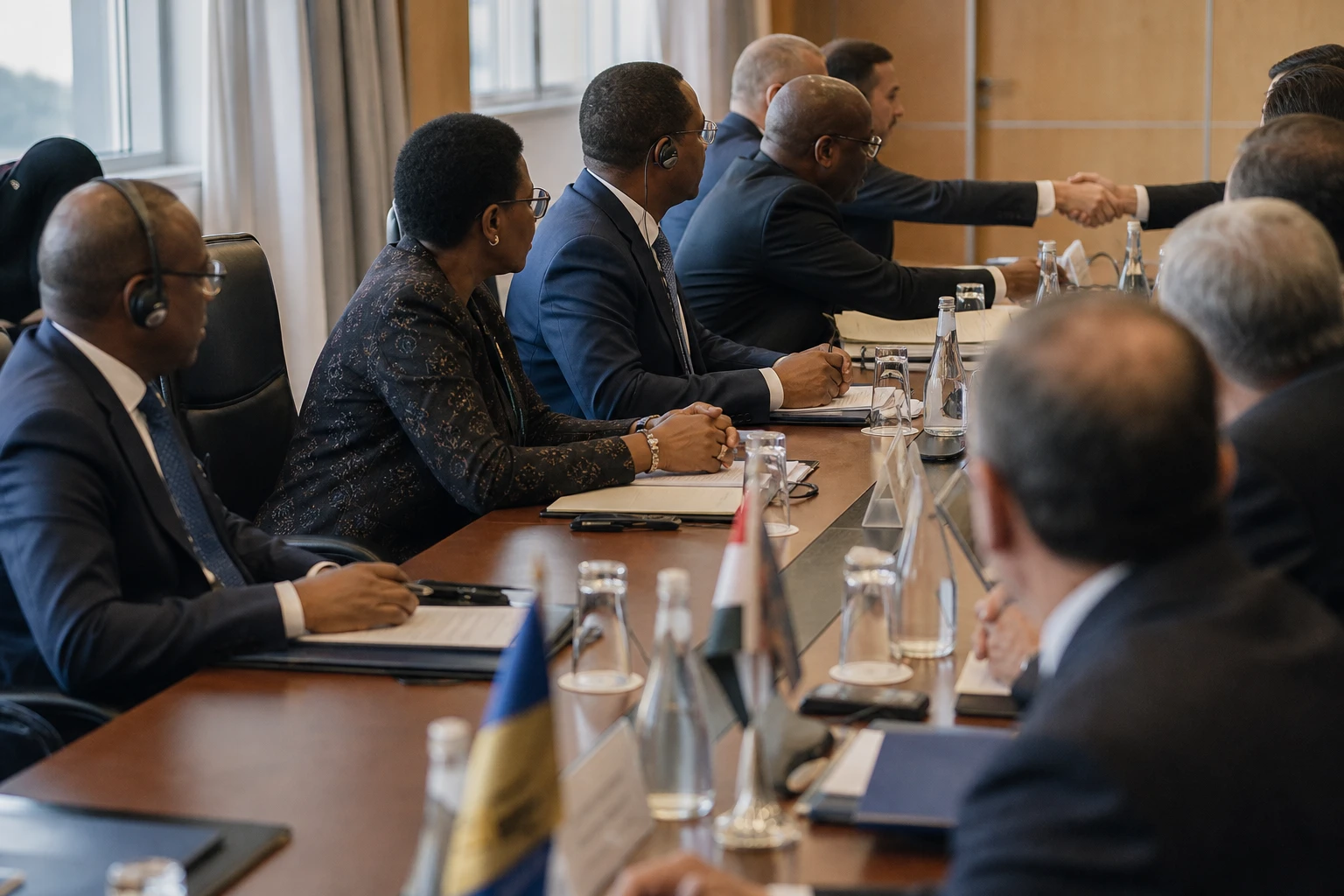
When two African capitals discuss electricity, transport and training, it is about more than diplomatic niceties. Above all, it is about access to financing, concrete projects and the movement of goods, skills and businesses. It was in this spirit that Tanzania and Egypt advanced their cooperation during President Abdel Fattah El-Sissi’s official visit to Dar es Salaam, with a strong focus on the private sector and “bankable” projects, meaning those that can be financed by banks and investors.
The visit is part of a broader strategy pursued by both countries. Tanzania is seeking to consolidate its position as a trade hub in East Africa, while Egypt is expanding its engagement across the continent, including in East Africa, to strengthen its economic and political ties. In both cases, business forums are becoming instruments of economic diplomacy, going well beyond formal communiqués.
What Dar es Salaam and Cairo agreed
At the end of talks on Saturday 18 July 2026, the two countries signed two memorandums of understanding: one on electricity and renewable energy, the other on transport. Discussions also covered ports, agriculture, water, industry, health and education. The stated aim is clear: to turn longstanding political ties into stronger economic partnerships, with projects led by businesses rather than governments alone.
The education component was highlighted with scholarships announced under the Samia Scholarship programme, in fields such as science, medicine, artificial intelligence, ICT and cybersecurity. The message is important for Tanzania, where skills development remains central to industrialisation, as well as for Egypt, which is seeking to export its university, medical and technical expertise across the continent.
Politically, the two capitals already have a structured channel for dialogue. Egypt’s Ministry of Foreign Affairs confirmed discussions with its Tanzanian counterpart on strengthening bilateral relations and cooperation across the African continent. This continuity helps explain how quickly the presidential visit produced concrete agreements.
Modest figures, but real potential
Trade between the two countries remains limited relative to the size of their economies. The Observatory of Economic Complexity put it at $97.7 million in 2024, with flows dominated by raw sugar, raw tobacco, prefabricated buildings and groundnuts. The figure is low given the size of both countries, but it points to an established trade base on which the new agreements can build.
This gap between potential and reality explains why both heads of state emphasised infrastructure and value chains. Tanzania wants to attract more investment in energy, industry and transport. Egypt, for its part, is seeking markets for its businesses and a more visible presence in East Africa. In this kind of relationship, the benefits are not the same for everyone: governments see a lever of influence, businesses see access to new markets, and people see jobs, services and better-connected roads.
Energy is a particularly sensitive issue. In Tanzania, access to more reliable electricity is key to industrialisation and the competitiveness of small and medium-sized businesses. For Egypt, energy cooperation also provides a way to showcase its expertise in sectors where Cairo wants to be more than a political partner: a provider of technical solutions, training and financing.
A signal for East Africa and beyond
This rapprochement goes beyond a simple meeting between Dar es Salaam and Cairo. It speaks to a broader shift in the geography of intra-African relations: states are less focused on piling up declarations and more on securing projects, logistics corridors and skills. In this context, regional economic communities and African integration mechanisms are becoming more important, even when they are not at the forefront of official announcements.
For East Africa, the issue is also one of diversifying partnerships. Tanzania engages with countries in the Gulf, Asia and Europe, and is now stepping up its engagement with Egypt. This widening range of ties could strengthen Dodoma’s room for manoeuvre, provided promises turn into measurable projects. The next test will therefore be implementation: project timetables, financing arrangements and the role actually given to the private sector.
On a broader scale, the visit confirms that some African diplomacy is now playing out in the field of productive investment. States that want to wield influence must not only sign agreements, but also bring them to life in ports, schools, hospitals and energy networks. That is where the real impact of the rapprochement between Tanzania and Egypt will be measured in the months ahead.