Algeria
 Egypt
 Libya
 Morocco
 Tunisia
 Benin
 Burkina Faso
 Cabo Verde
 Côte d'Ivoire
 Ghana
 Guinea
 Guinea-Bissau
 Liberia
 Mali
 Mauritania
 Niger
 Nigeria
 Senegal
 Sierra Leone
 The Gambia
 Togo
 Cameroon
 Central African Republic
 Chad
 DR Congo
 Equatorial Guinea
 Gabon
 Republic of the Congo
 São Tomé and Príncipe
 Burundi
 Comoros
 Djibouti
 Eritrea
 Ethiopia
 Kenya
 Madagascar
 Malawi
 Mauritius
 Mozambique
 Rwanda
 Seychelles
 Somalia
 South Sudan
 Tanzania
 Uganda
 Angola
 Botswana
 Eswatini
 Lesotho
 Namibia
 South Africa
 Zambia
 Zimbabwe
A war sustained by external support
In Sudan, the war is no longer being fought solely between two military forces. It is also being fuelled by air corridors, recruitment networks and arms routes crossing borders. A UN report published on 2 September 2026 sheds light on this mechanism, which has become central to the conflict’s expansion.
Since 15 April 2023, fighting in Khartoum and several regions of the country has pitted the Sudanese Armed Forces, led by General Abdel Fattah al-Burhan, against the Rapid Support Forces, commanded by Mohamed Hamdan Dagalo, known as Hemedti. The war has shattered the political transition promised after the 2019 revolution and triggered a regional crisis affecting Chad, Libya, the Central African Republic, South Sudan and, more broadly, the Horn of Africa.
Fighters from abroad, routes familiar to traffickers
The report by UN experts describes multifaceted external support. It refers to the recruitment of mercenaries, arms deliveries, logistical services and military training organised outside Sudan. According to the report, the Rapid Support Forces are believed to have benefited from the most structured support, with networks operating from the United Arab Emirates, Chad, Libya and Somalia.
The experts cite the transit of foreign fighters through southern Libya and along routes including Benghazi, Kufra and Bosaso. They also refer to recruiters based in the United Arab Emirates, as well as private companies that are alleged to have facilitated the transport of personnel and weapons to the RSF. A cross-reading of UN sources and press investigations confirms that these routes are not improvised. They rely on existing infrastructure already used for arms trafficking and proxy wars in the Sahel-Sudan region.
The report also mentions Colombian mercenaries. Their number could reach 2,000, according to the estimates cited. The authors link them to the capture of El Fasher, the capital of North Darfur, where the humanitarian and military situation remains among the most severe in the country. Other evidence, already documented by the UN and the international press, indicates that Colombians have been recruited, trained and redeployed in the Sudanese conflict since 2024.
Sudan is not alone in this configuration. The report also refers to Sudanese, Chadian, South Sudanese and Ethiopian fighters trained in camps in southern Libya. This movement of armed personnel shows that the war in Sudan is now embedded in a porous regional space, where political borders are not enough to block military and commercial routes.
The regular army is also part of the picture
The report does not target only one side. It also notes that the regular army has received external support, particularly for the acquisition of drones. The United Nations has been warning for months that the intensification of air strikes and drone attacks has profoundly changed the nature of the war. In June 2026, a UN official said drone attacks had killed more than 1,000 civilians in the first five months of the year.
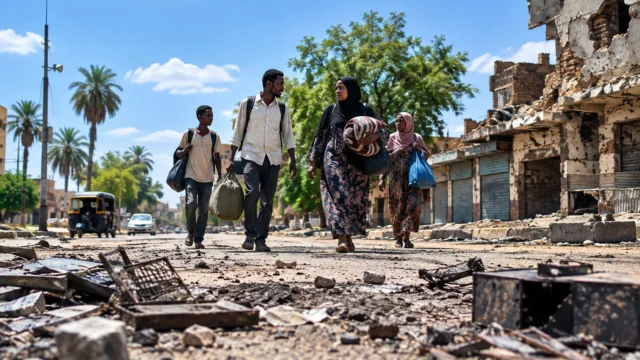
This technological escalation is taking a heavy toll on civilians. When light aircraft, commercial drones and arms stockpiles circulate more easily than humanitarian aid, urban areas, markets, evacuation routes and displacement camps become vulnerable targets. In practice, the war is spilling beyond the front lines and drawing closer to residential neighbourhoods, supply routes and towns in Darfur and Kordofan.
This is also what the African Union has warned about. In a statement on 22 June 2026, the AU Commission called on all parties and their external supporters to cease any action that could exacerbate the conflict, while reaffirming Sudan’s territorial integrity and the need for an inclusive political process. The issue is therefore not only humanitarian. It also concerns Sudanese sovereignty and the stability of the Red Sea-Sahel-Horn of Africa axis.
What the report means for Khartoum, Darfur and the region
Politically, the report increases pressure on the actors fuelling the war from afar. It calls for an end to all military support for the warring parties, the extension of the arms embargo already in force in Darfur to all of Sudan, and investigations and sanctions against the individuals and entities involved. The Security Council’s embargo, initially focused on Darfur, therefore remains central to the debate over the effectiveness of UN sanctions.
For the authorities in Khartoum, the message is twofold. On the one hand, they are seeking to show that responsibility for the violence does not rest solely with the Sudanese armed forces. On the other, they have long been calling for a tougher international response against the networks that, they say, support the RSF. The diplomatic debate thus centres on the origins of deliveries, the chain of intermediaries and the degree of involvement of states or private companies.
For the population, the consequence is simpler and harsher. The more the war becomes internationalised, the further away a swift end recedes. Displaced people remain trapped in a massive crisis. Available figures point to a catastrophe on a very large scale: the UN speaks of a displacement crisis involving more than 12 million people, while several recent humanitarian assessments put the total number of people forced to flee since the conflict began at nearly 13 million.
The war is also affecting neighbouring countries. Chad, Libya, South Sudan and Ethiopia are already experiencing the effects of fighter movements, trafficking and refugee arrivals. In several border areas, local authorities must manage both humanitarian pressure and security risks. In other words, the conflict in Sudan is no longer contained by the country’s borders; it is reshaping the balance across its neighbourhood.
A Sudanese crisis with repercussions across Africa
The continental significance is clear. Sudan lies at the crossroads of several African and Arab regions, in an area where IGAD, the African Union and immediate neighbours are trying to contain the conflagration. When mercenaries, drones and private networks become routine tools of war, the entire regional security architecture is put to the test.
The next key areas to watch are clear: the effective implementation of sanctions, the traceability of flights and cargoes, and the possible extension of the arms embargo to all of Sudan. Until these issues receive concrete answers, the war will continue to be financed, spread and inflict damage beyond the front lines alone.