Algeria
 Egypt
 Libya
 Morocco
 Tunisia
 Benin
 Burkina Faso
 Cabo Verde
 Côte d'Ivoire
 Ghana
 Guinea
 Guinea-Bissau
 Liberia
 Mali
 Mauritania
 Niger
 Nigeria
 Senegal
 Sierra Leone
 The Gambia
 Togo
 Cameroon
 Central African Republic
 Chad
 DR Congo
 Equatorial Guinea
 Gabon
 Republic of the Congo
 São Tomé and Príncipe
 Burundi
 Comoros
 Djibouti
 Eritrea
 Ethiopia
 Kenya
 Madagascar
 Malawi
 Mauritius
 Mozambique
 Rwanda
 Seychelles
 Somalia
 South Sudan
 Tanzania
 Uganda
 Angola
 Botswana
 Eswatini
 Lesotho
 Namibia
 South Africa
 Zambia
 Zimbabwe

In Khartoum, gold remains both a resource and a front line
In war-torn Sudan, gold does more than generate export wealth. It funds networks, feeds parallel channels and prolongs a conflict that has pushed the economy into survival mode. That is why the European ban on trade in Sudanese gold, adopted by Switzerland on 9 September 2026, targets not so much a metal as a chain of financing.
The problem, however, extends far beyond the relationship between Khartoum and European markets. African gold often changes hands before reaching a refinery. Once melted down, relabelled or re-exported via a third country, its origin becomes difficult to establish. This is where the real effectiveness of sanctions is decided.
A Sudanese context shaped by war and the informal economy
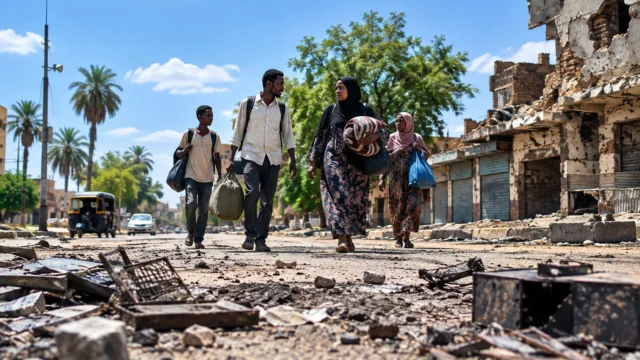
Since April 2023, the Sudanese Armed Forces and the Rapid Support Forces have been fighting a conflict that has fractured the country, displaced millions of people and weakened the state’s ability to control its resources. In this context, the gold sector has become strategically important. The United States has already described several companies linked to the conflict as funding channels, including Al Junaid, a holding company controlled by Mohamed Hamdan Dagalo, known as Hemedti, a central figure in the RSF.
The Sudanese perspective on the issue is more nuanced than a simple narrative of a blockade. According to data reported by the Sudanese press and figures from the Central Bank, the country produced around 70.15 tonnes of gold in 2025, but officially exported only around 14.7 tonnes, worth $1.536 billion. This gap does not in itself prove smuggling, but it clearly indicates that a significant share of the metal still escapes declared channels.
Another defining factor is that artisanal mining still dominates the sector. In practice, this means thousands of scattered operators, multiple exit routes and weak state oversight, especially outside major centres. In a country where institutions are operating under strain, this fragmentation makes traceability far more difficult than in a conventional industrial supply chain.
What Brussels and Bern say
On 13 July 2026, the Council of the European Union strengthened its sanctions regime on Sudan by adding a ban on the purchase, import or transfer of gold originating in Sudan, including when the metal has transited through a third country. The measure also prohibits the export of certain goods that could be used for gold extraction or mining. The stated aim is clear: to cut off a resource considered essential to the warring parties’ financial stability.
Switzerland aligned itself with the measure in September 2026. The Federal Council announced a ban on buying and importing gold of Sudanese origin. Bern thus joined the European tightening of restrictions, while stressing the need to target channels that conceal the metal’s true origin. It is a politically forceful measure, but a technically demanding one.
The heart of the problem lies in the value chain. Swiss and European documents themselves note that gold can be refined in a third country before being exported to another market, obscuring its original mining provenance. In other words, a consignment mined in Sudan may appear to originate from a refining or trading hub. Until this step is better documented, the sanction remains vulnerable to commercial relabelling.
The weakness in transit routes
Global figures show the scale of the challenge. SWISSAID estimates that more than 435 tonnes of gold left Africa undeclared in 2022, or more than a tonne a day. The study attributes a major share of these flows to the United Arab Emirates, ahead of Switzerland and India. This is not a minor logistical detail: when the metal passes through a hub, the traceability required by sanctions becomes much more fragile.
Switzerland, in particular, occupies a distinctive position in this economy. It remains one of the world’s leading gold refining and trading centres. The country imported 420 tonnes of gold from the United Arab Emirates in 2025, according to customs data reported by SWISSAID. This volume shows the central role of intermediary hubs in gold flows, including those involving commodities linked to conflict zones.
Sudan’s case is part of a wider issue, already documented by Washington: African gold can be used to evade sanctions, fund armed actors or feed transnational networks. US authorities have already sanctioned companies linked to Sudan’s war economy, particularly where gold revenues benefited the RSF or intermediary companies based outside the country.
What this decision changes — and what it does not
For Khartoum, the immediate stakes are not merely diplomatic. If official exports remain low and smuggling continues to dominate, the impact of sanctions will depend on the ability of transit states and refineries to verify the metal’s true origin. Without detailed traceability, Sudanese gold can continue to circulate under a different label without disappearing from the market.
For the Sudanese population, the question is even more concrete. Gold could fund vital imports, support public finances and ease monetary strangulation. But in a country torn apart, mining revenues too often benefit private, military or para-state channels. This imbalance turns national wealth into a source of fragmentation.
For Africa, finally, the issue goes beyond Sudan alone. It speaks to resource governance, the role of refining hubs and the ability of states to retain control over their exports. It also shows that a sanction is effective only if it follows the goods through to their final transformation, not merely to the first country visible on a trade document. In the coming weeks, attention will remain focused on the practical implementation of European and Swiss measures, as well as on the ability of Sudanese authorities to reorganise a mining sector that has become a matter of sovereignty.