Algeria
 Egypt
 Libya
 Morocco
 Tunisia
 Benin
 Burkina Faso
 Cabo Verde
 Côte d'Ivoire
 Ghana
 Guinea
 Guinea-Bissau
 Liberia
 Mali
 Mauritania
 Niger
 Nigeria
 Senegal
 Sierra Leone
 The Gambia
 Togo
 Cameroon
 Central African Republic
 Chad
 DR Congo
 Equatorial Guinea
 Gabon
 Republic of the Congo
 São Tomé and Príncipe
 Burundi
 Comoros
 Djibouti
 Eritrea
 Ethiopia
 Kenya
 Madagascar
 Malawi
 Mauritius
 Mozambique
 Rwanda
 Seychelles
 Somalia
 South Sudan
 Tanzania
 Uganda
 Angola
 Botswana
 Eswatini
 Lesotho
 Namibia
 South Africa
 Zambia
 Zimbabwe
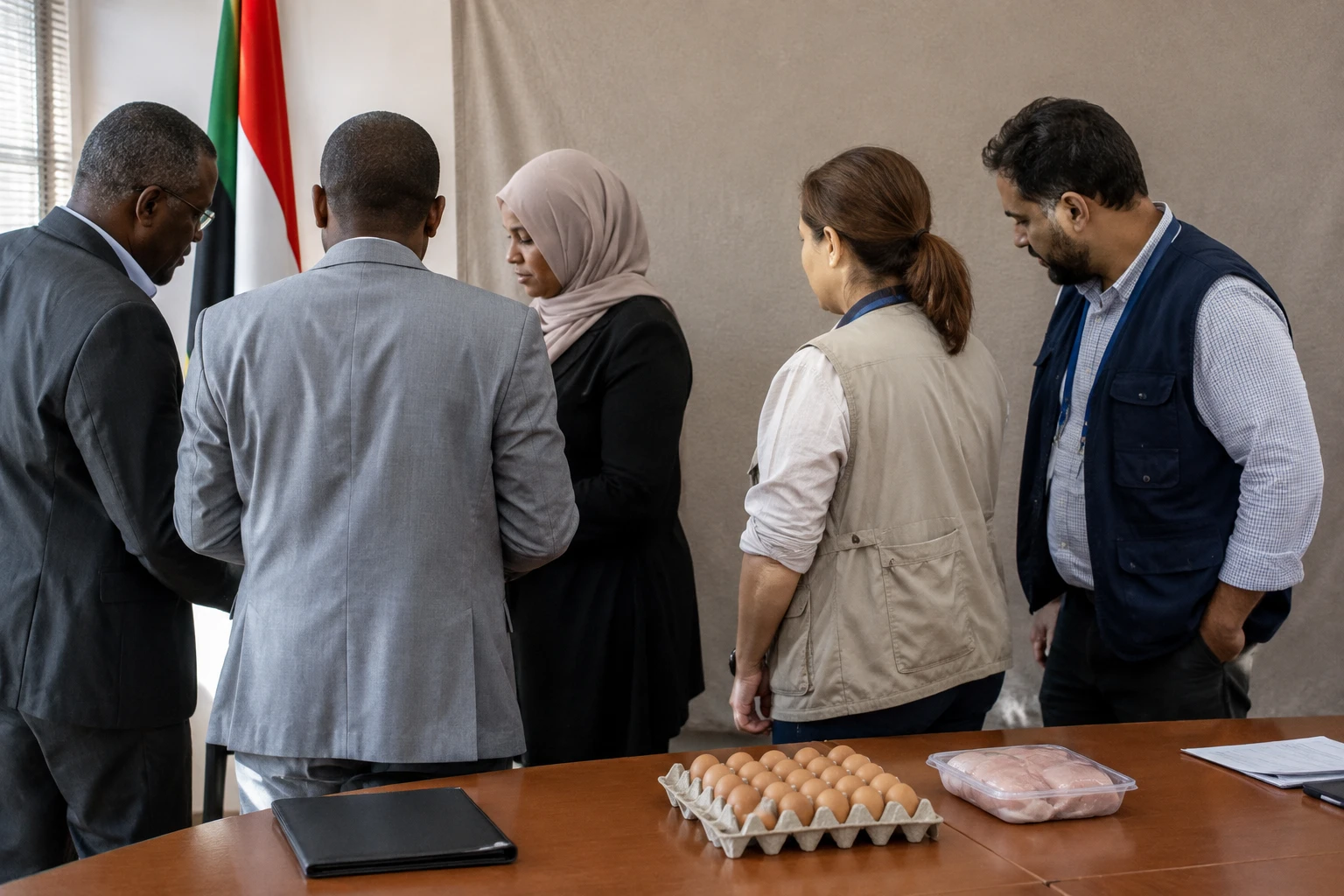
Health approval opens a door to trade. It guarantees neither the arrival of goods nor their access to consumers. In Sudan, where war has weakened food supply chains, this distinction is essential to measuring the significance of the decision announced on 21 October 2026.
A new market in a country whose trade has been disrupted
Since April 2023, fighting between the Sudanese army and the Rapid Support Forces has disrupted agriculture, transport and markets. The capital, Khartoum, remains scarred by destruction and in need of reconstruction, while supply conditions vary sharply between regions. The United Nations Food and Agriculture Organization (FAO) reports exceptionally high cereal prices and difficulties accessing food. It also estimates that the country’s financial and logistical capacity limits its ability to meet its import needs. The FAO’s update on food security in Sudan highlights these constraints.
The conflict has also weakened local production chains, from the supply of inputs to transport and sales. In this context, authorisation to import chicks or hatching eggs concerns livestock-rearing capacity as well as meat supply. But their use will depend on practical conditions: the availability of animal feed, infrastructure, the security of routes and household purchasing power.
Sudan is a member of the Intergovernmental Authority on Development (IGAD), a regional organisation in East Africa. The conflict and trade disruptions therefore extend beyond the national context, particularly through their effects on displacement, cross-border trade and humanitarian access. Regional diplomatic initiatives have not so far produced a lasting ceasefire.
What Sudan’s authorisation covers
Sudanese health authorities have approved imports of several Brazilian agricultural products. The list includes day-old chicks, fertilised eggs for incubation, as well as poultry, bovine and caprine meat, meat products and offal. It also includes breeding animals and bovine and buffalo embryos. These categories are detailed in the Brazilian Ministry of Agriculture’s statement. Brazilian news agency ANBA also reported the opening on 22 October.
The decision recognises the health acceptability of specific products. It does not confirm that an initial shipment has been dispatched or that any commercial volume has been agreed. Operators will still need to arrange contracts, inspections, transport and payments. In a country where roads and infrastructure have been affected by war, these steps may weigh as heavily as the authorisation itself.
For Brazil, the opening adds to other market access secured on the continent in 2026. Namibia authorised imports of Brazilian chicken offal in September, while Ethiopia opened its market to several agricultural products in April. The move expands the potential presence of Brazilian exporters in different African regions, but does not make these markets interchangeable: their rules, needs and purchasing power differ.
African volumes rise, but markets remain uneven
Africa is already an important destination for Brazilian poultry. According to the Brazilian Association of Animal Protein, African countries bought about 1.16 million tonnes in 2025, up 20.3% year on year. The figure has been cited by African media and appears in data from Brazil’s industry. Ivorian news outlet Informateur says South Africa remains the continent’s leading destination. The ABPA’s annual report provides access to Brazilian export data. The ABPA’s 2025 annual report.
This aggregate growth does not mean that every country is importing more, or that households automatically benefit from lower prices. The final cost depends in particular on freight, exchange rates, taxes, distribution and margins. Imports can supplement available supply, but they also expose markets to international fluctuations and supplier concentration. For local producers, the impact will depend on their ability to compete on price and access inputs.
In Sudan, the stakes are particularly tangible. Authorisations covering chicks and hatching eggs could interest businesses seeking to revive livestock-rearing capacity. However, a poultry industry cannot be restored through a single market opening. It requires feed, veterinary care, energy and functioning distribution networks. Meat imports, meanwhile, could add to supply, but their availability will depend on security and the cost of transport to markets.
Global competition remains decisive
Brazil’s strategy also comes amid uncertainty with the European Union. Since 3 September 2026, access to the European market for some Brazilian animal products has been suspended because of guarantees required on the use of antimicrobials in livestock farming. On 21 October, the European Commission announced its intention to propose restoring access for poultry and honey. The proposal must still go through the EU procedure. Reuters reports the Commission’s announcement, while the European Commission sets out the applicable health rules.
A resumption of sales to Europe could alter Brazilian exporters’ decisions. Conversely, prolonged uncertainty would increase the appeal of alternative markets, including some in Africa. It would nevertheless be premature to conclude that volumes destined for Sudan will rise: health approval provides no information about negotiated prices, logistical capacity or effective demand.
The next step will therefore be less diplomatic than commercial and logistical: to establish whether actual trade follows the authorisation, and on what terms. For Sudanese people, the decisive indicator will remain real access to food in markets profoundly differentiated by security and infrastructure. At regional level, the development of these trade flows will be a reminder that African integration depends as much on market-access decisions as on passable roads, workable payments and local industries capable of holding up.