
 Algeria
 Egypt
 Libya
 Morocco
 Sudan
 Tunisia
 Benin
 Burkina Faso
 Cabo Verde
 Côte d'Ivoire
 Ghana
 Guinea
 Guinea-Bissau
 Liberia
 Mali
 Mauritania
 Niger
 Nigeria
 Senegal
 Sierra Leone
 The Gambia
 Togo
 Cameroon
 Central African Republic
 Chad
 DR Congo
 Equatorial Guinea
 Gabon
 Republic of the Congo
 São Tomé and Príncipe
 Burundi
 Comoros
 Djibouti
 Eritrea
 Ethiopia
 Kenya
 Madagascar
 Malawi
 Mauritius
 Mozambique
 Rwanda
 Seychelles
 Somalia
 South Sudan
 Tanzania
 Uganda
 Angola
 Botswana
 Eswatini
 Lesotho
 Namibia
 Zambia
 Zimbabwe
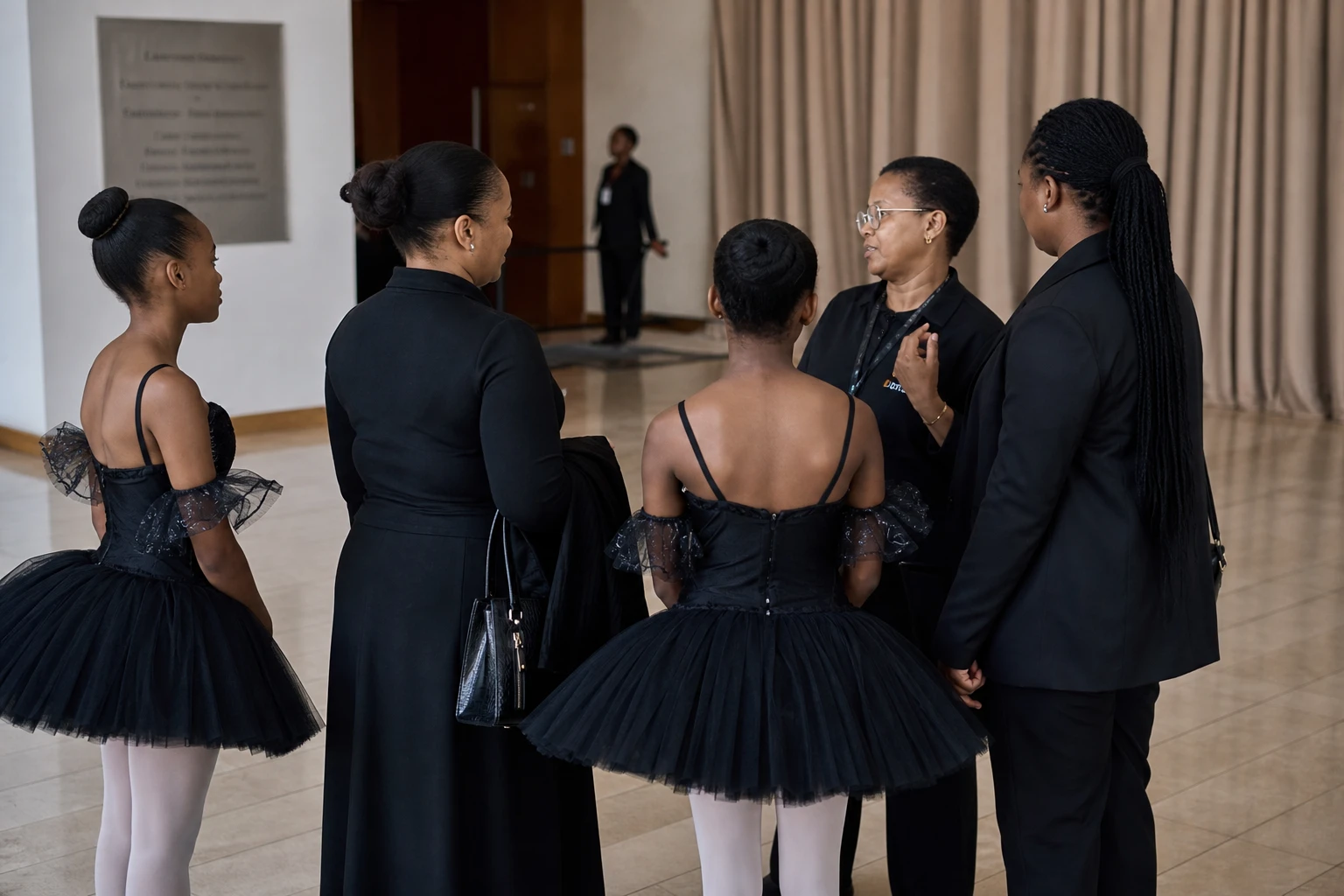
When the stage opens up, an entire system comes into view
In Cape Town, a ballet competition showcases more than pointe work and arabesques. It also reveals who has access to training, who can keep up and who can still find a place in an art long perceived as closed off. The 13th edition of the South African International Ballet Competition takes place from 4 to 6 August 2026 at the Artscape Opera House, with dancers competing in three age groups and events in classical ballet, contemporary dance, duets and groups.
In a country where culture is also seen as a way to foster cohesion and access to opportunities, this kind of event goes beyond the simple ranking of competitors. In February 2026, South Africa’s Department of Sport, Arts and Culture reiterated that supported projects should promote inclusion, social cohesion and access to marginalised arts. The department’s 2026/27 budget was set at 6.617 billion rand.
Founded in Johannesburg, the competition is now a continental showcase
The South African International Ballet Competition was founded in 2008 by Dirk Badenhorst, initially as a biennial event. Since 2021, it has been held annually, following the shift to digital prompted by the pandemic. The competition’s official website now describes it as the continent’s leading classical ballet competition, attracting dancers from South Africa and beyond.
This year, the age groups in Cape Town range from 9 to 12 for the Scholar category, 13 to 16 for Juniors and 17 to 22 for Seniors. The event is also linked to a network of regional competitions held in Johannesburg, Polokwane, Durban and Gqeberha to select finalists. This gives the competition a practical role: identifying and selecting young talent, then bringing it to a national and subsequently international stage.
The host country is not isolated. South Africa is a member of the Southern African Development Community (SADC), which has 16 member states. In the region, cultural exchanges, touring, training partnerships and artistic cooperation matter as much as major political summits. Ballet may not be in the spotlight, but it is part of the same drive for integration through skills and mobility.
Young dancers, and families bearing the cost of the discipline
At 15, Johannesburg-born Jayden Samuels is presenting the fruits of long hours of training. At 13, Oratile Mpitso says she discovered ballet after seeing other children dance at nursery school, before it became her passion. Their stories make the same point: talent emerges early in ballet, but consistent training, access to instruction and family stability remain decisive.
Oratile Mpitso’s case highlights a frequently overlooked issue: infrastructure. Her mother says the child sometimes trains outdoors because there is no studio or barre. This is no mere curiosity. It shows that for some young South Africans, artistic practice still depends on makeshift solutions, far from the standard facilities the discipline requires.
The competition therefore serves as a stepping stone. It brings young people from different backgrounds together, while also offering public recognition to those who may not have the material means to attend the most prominent schools. In a sector where transport, costumes, rehearsals and coaching come at a high cost, the challenge is not simply to win a medal. It is to stay in the running.
Transformation, representation and the cultural economy: what the event says about South Africa
The competition’s director describes the event as a way to widen access. The SAIBC website says a dance-teacher training programme has been launched in townships to strengthen local skills and support the teaching of classical ballet. It also says the competition offers African categories at adjusted rates, with an stated aim of including more Black and mixed-race dancers.
This approach is part of a broader movement. In 2026, South Africa’s Department of Arts explicitly linked public funding to the goals of social cohesion, inclusion and the development of less visible communities. Meanwhile, the Western Cape province highlighted culture’s economic role, with a budget exceeding 1 billion rand for the first time and an allocation of 21 million rand for annual funding of arts, culture and heritage.
Ballet thus sits at the intersection of several forces. For institutions, it can become a symbol of successful transformation. For families, it remains a financial and logistical effort. For young dancers, it represents a rare chance to turn a pursuit often confined to a handful of schools into a possible career. And for Cape Town, it also supports activity for venues, technicians, transport providers and services connected with major cultural events.
A South African reach, with wider African resonance
Beyond the competition itself, the 2026 edition says something about South Africa’s cultural moment. The country continues to use its arts institutions to project an image of expertise, diversity and international exchange. The SAIBC says judges are coming from several countries, including South Korea, the United States, Romania, Germany, Belarus, the United Kingdom, Austria, Australia and Russia. This diversity of judges reinforces the idea of a local scene connected to global standards.
For Southern Africa, the stakes are broader still. SADC seeks to promote economic integration and regional cooperation. In this context, arts competitions, exchanges between trainers and cross-border career paths help skills circulate without waiting for major infrastructure projects. It is a quiet but real form of continental integration through culture.
The central question remains: who will benefit from this momentum in the long term? The Cape Town event shows that a more inclusive ballet scene is possible in South Africa. It also reminds us that even a prestigious competition cannot replace studios, teachers or sustained support. The next step will therefore depend less on the podium than on the continuity of training, scholarships and pathways into the profession.



