
 Algeria
 Egypt
 Libya
 Morocco
 Sudan
 Tunisia
 Benin
 Burkina Faso
 Cabo Verde
 Côte d'Ivoire
 Ghana
 Guinea
 Guinea-Bissau
 Liberia
 Mali
 Mauritania
 Niger
 Nigeria
 Senegal
 Sierra Leone
 The Gambia
 Togo
 Cameroon
 Central African Republic
 Chad
 DR Congo
 Equatorial Guinea
 Gabon
 Republic of the Congo
 São Tomé and Príncipe
 Burundi
 Comoros
 Djibouti
 Eritrea
 Ethiopia
 Kenya
 Madagascar
 Malawi
 Mauritius
 Mozambique
 Rwanda
 Seychelles
 Somalia
 South Sudan
 Tanzania
 Uganda
 Angola
 Botswana
 Eswatini
 Lesotho
 Namibia
 Zambia
 Zimbabwe
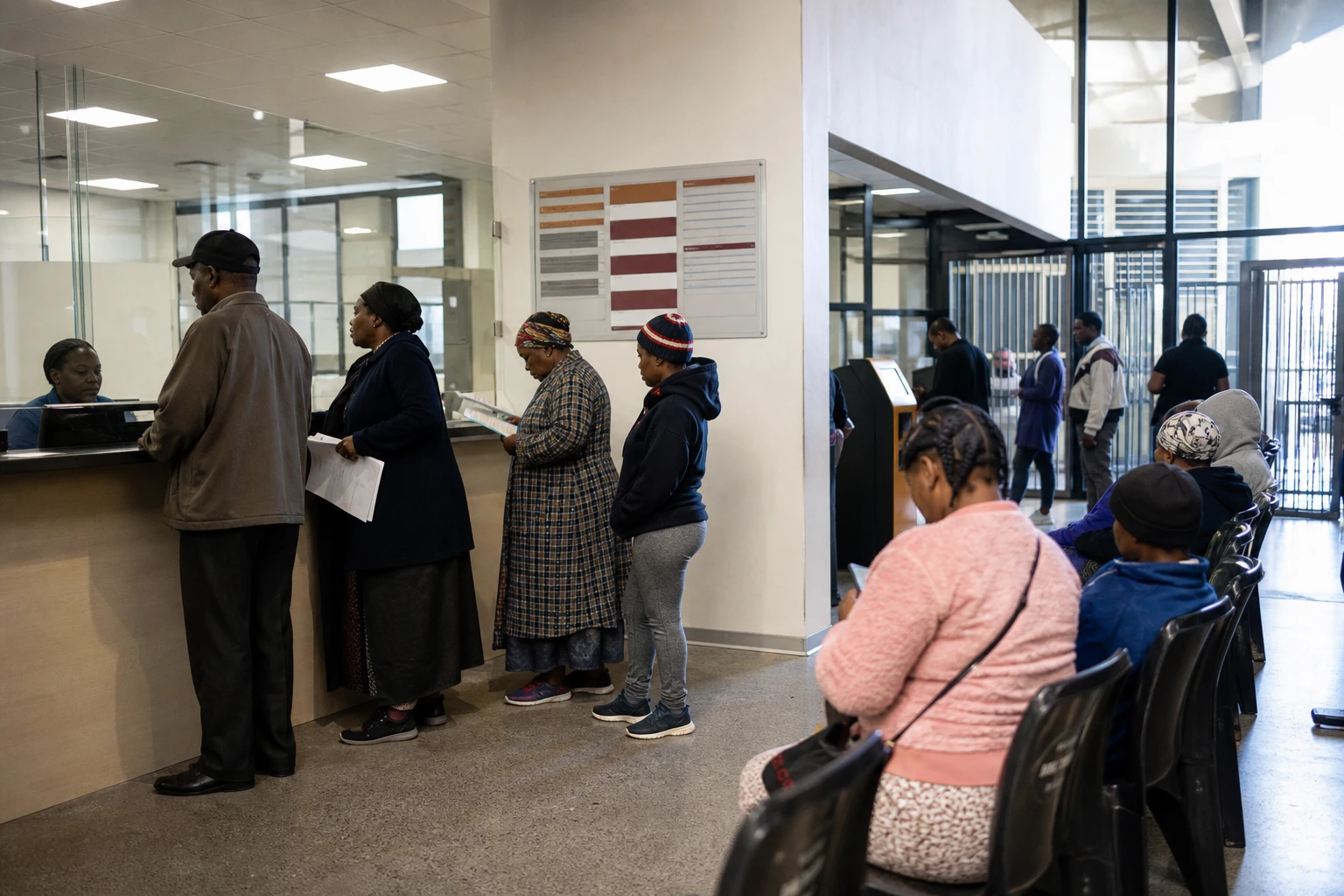
When social assistance also becomes a test of credibility
In Pretoria, social protection is more than a budget line. It is a safety net for millions of households, but also a sensitive arena where poverty, suspected fraud, administrative delays and public trust intersect. In a country where social assistance now reaches nearly 19 million people, every tightening of checks has very tangible effects on daily life.
South Africa, a member of SADC — the Southern African Development Community —, faces a broader regional challenge: how to sustainably fund a vast social transfer system without penalising eligible beneficiaries. In an economy still marked by high unemployment and deep inequality, the answer weighs as heavily on public finances as on social stability.
What Pretoria wants to check
On 21 July 2026, the South African government announced that it would review more than 350,000 social grants during the 2026-2027 financial year. Its stated aim is twofold: to ensure benefits go to people who remain eligible and to generate savings of about 1.5 billion rand for the public budget. The government presents the exercise as a normal application of the Social Assistance Act, which requires regular reviews of cases.
At the same time, the authorities say the system is better connected to other government departments and financial institutions, which should help identify anomalies more quickly. Biometric checks, already linked in real time to the Home Affairs Department’s databases, are also to be strengthened to curb identity-related fraud. On paper, the logic is clear: pay the right benefit to the right person at the right time.
The government’s position comes as checks have already become more visible. Since the start of the 2025-2026 financial year, SASSA, the agency responsible for paying social grants, has stepped up case reviews. In February 2026, it had already reminded beneficiaries not to ignore appointment SMS messages, warning that their grant could otherwise be suspended.
Between tackling fraud and pressure on queues
The issue is not limited to whether records comply with the rules. It also affects the day-to-day operation of SASSA offices. Pretoria acknowledges that queues remain long at many sites. In response, the government has announced the recruitment of more than 1,000 contract staff and longer opening hours. This is an important signal for cities as well as rural areas, where travelling to an agency can cost time and money, and sometimes a whole day of informal work.
Digitalisation should also ease the pressure. The administration wants to expand the use of its online platforms, a mobile app and WhatsApp. It is also extending e-Life Certification, a remote confirmation procedure intended mainly for older people, people living with disabilities and residents far from administrative centres. The challenge is simple: reduce travel without excluding those who lack a stable connection or the skills to use digital tools.
The issue is all the more sensitive because SASSA has also had to deal with fraud scandals. On 16 July 2026, the agency confirmed the dismissal of four staff members at the Nebo office in Limpopo province following a case estimated at 33 million rand. The case bolsters the government’s argument that stronger checks are not merely an accounting measure, but also an attempt to protect the integrity of the system.
A social safety net that has become structural
Social grants now occupy a central place in South Africa’s social framework. The government says the programme has grown from about 2.7 million beneficiaries in 1994 to nearly 19 million today. This growth reflects something of the country’s transformation since the end of apartheid: social protection has become an instrument of redress, but also an economic buffer for households exposed to unemployment and hardship.
But the larger the system grows, the more delicate its governance becomes. Case reviews protect the budget, certainly. They can also create administrative friction for older beneficiaries, families far from urban centres and people whose incomes change irregularly. The balance is precarious: verify without discouraging, correct without wrongly suspending, digitise without excluding.
For the government, the issue is also political. The new Minister of Social Development, Dina Pule, was appointed in late June 2026 and tasked with presenting the reorganisation a few weeks later. Her department must show that it can both uphold budget discipline and preserve grant recipients’ dignity, a balance being closely scrutinised in a country where the quality of public services remains a major subject of debate.
What the continent is watching
Beyond South Africa, this development is of interest across Southern Africa. Several SADC states are also grappling with social transfer systems under budgetary pressure, incomplete databases and high social expectations. Pretoria is testing an approach: cross-checking information more effectively, speeding up checks and modernising the relationship between the state and beneficiaries. If it works, it could become a regional model. If it fails, it will mainly serve as a reminder that a large social safety net cannot be managed through rules alone, but also requires access, clarity and service points able to keep pace.
In the short term, the key concern is implementation. The coming weeks will show whether the announced 350,000 reviews lead to orderly checks or further local bottlenecks. They will also show whether SASSA’s promising digitalisation genuinely reduces queues or adds another layer for the most vulnerable users. In a country where social assistance has become basic infrastructure, the quality of administration matters almost as much as the value of the benefits.



