Algeria
 Egypt
 Libya
 Morocco
 Sudan
 Tunisia
 Benin
 Burkina Faso
 Cabo Verde
 Côte d'Ivoire
 Ghana
 Guinea
 Guinea-Bissau
 Liberia
 Mali
 Mauritania
 Niger
 Nigeria
 Senegal
 Sierra Leone
 The Gambia
 Togo
 Cameroon
 Central African Republic
 Chad
 DR Congo
 Equatorial Guinea
 Gabon
 Republic of the Congo
 São Tomé and Príncipe
 Burundi
 Comoros
 Djibouti
 Eritrea
 Ethiopia
 Kenya
 Madagascar
 Malawi
 Mauritius
 Mozambique
 Rwanda
 Seychelles
 Somalia
 South Sudan
 Tanzania
 Uganda
 Angola
 Botswana
 Eswatini
 Lesotho
 Namibia
 Zambia
 Zimbabwe
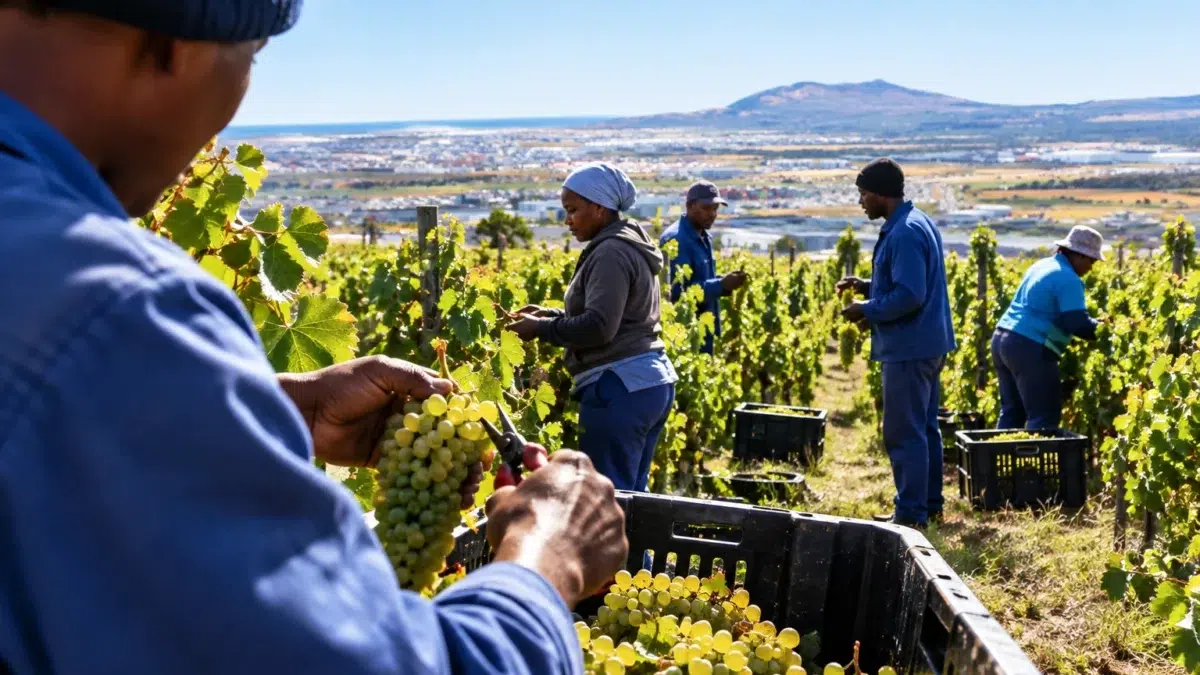
A large harvest can strengthen a country’s position on global markets without resolving the vulnerabilities of an entire industry. In South Africa, initial estimates for 2026 point both to an exceptional year in the vineyards and to an economic challenge that goes beyond the volume produced.
A vintage reshuffles the Southern Hemisphere rankings
South Africa is estimated to have produced 11.3 million hectolitres of wine in 2026. According to initial estimates published on 18 November by the International Organisation of Vine and Wine (OIV), this volume exceeds those of Argentina and Australia. The country thus becomes the leading producer in the Southern Hemisphere and the world’s fifth-largest.
The forecast represents an increase of 10% compared with 2025 and is 14% above the average of the past five years. The OIV describes it as South Africa’s largest harvest in ten years. It attributes the result to favourable conditions at the start of the season, followed by rains in February that eased water stress in several regions.
The figure remains provisional, however. The OIV says its initial estimates are based on data covering countries that account for 95% of global production. They are still to be revised and updated in May 2027. The ranking announced is therefore a strong forecast, but not yet a definitive result.
The Cape at the heart of a national industry
South African viticulture is largely concentrated in the Western Cape province, in the south-west of the country. It brings together grape growers, wineries, export businesses and tourism activities. The sector is therefore not limited to bottles sold abroad: it also contributes to the economies of several areas and to seasonal employment around the harvest.
Industry data published by Wines of South Africa (WOSA), based on SAWIS statistics, nevertheless show that the sector is under pressure. In 2025, the country had 2,176 primary grape producers, down from 2,255 in 2024, as well as 507 wineries that process the harvest. These figures describe a well-structured industry, but also a decline in the number of producers to monitor in the coming years.
The 2026 rebound should therefore not obscure questions about how the gains are distributed. A larger harvest can benefit farms and businesses able to produce, store and market more. For smaller producers, the outcome also depends on the prices paid for grapes, access to water and equipment, and the markets available. Production figures alone cannot show how the value created is shared among these players.
A production record does not guarantee sales
The distinction between producing and selling is essential. In 2025, South African exports of bottled still wine reached 264 million litres, a 13.8% decrease in volume from the previous year, according to WOSA. The total value of wine exports stood at 9.8 billion rand. The industry therefore entered the new vintage with overseas markets that were not growing at the same pace as harvests.
These results are a reminder not to confuse producer rankings with commercial health. A more abundant supply can support sales if buyers keep pace. But it can also increase storage needs and put pressure on prices if markets slow. The OIV also estimates that global production in 2026 will remain close to 2025 levels, at around 225 million hectolitres, and below its five-year average. The global context therefore remains constrained, despite South Africa’s performance.
For vineyard and winery workers, the size of the harvest may mean more activity during the season. It does not automatically indicate stable jobs or higher incomes over the longer term. Nor are the benefits the same in the Western Cape’s wine-growing areas, the commercial headquarters of major cities and among producers who depend on intermediary buyers.
A regional signal, with limitations
The comparison with Argentina and Australia shows that the Southern Hemisphere ranking also shifts according to each season’s harvests. In 2026, the OIV estimates Argentina’s production at 9.7 million hectolitres, down 10% year on year. Across the Southern Hemisphere as a whole, it forecasts around 47 million hectolitres, 3% less than in 2025 and 7% below the average of the past five years. South Africa’s increase is therefore taking place in a wine-producing region that is generally in decline.
For southern Africa, the result highlights an industry geared towards international markets and facing the same challenges of climate, demand and competitiveness as its rivals. It does not erase differences between economies, nor does it allow the South African experience to be generalised to the region as a whole. The Southern African Development Community (SADC), a regional co-operation organisation, is not responsible for these estimates: the ranking is based on production volumes compared by the OIV.
What happens next will depend on confirmation of the figures, expected in the May 2027 update, as well as companies’ ability to sell the vintage. For players in the Western Cape, the challenge is twofold: turn a good harvest into sustained sales and preserve a sufficiently strong base of producers for the seasons ahead. The announced record is an important indicator. On its own, it is not a verdict on the industry’s future.
Background sources: OIV’s initial global estimates for 2026, OIV report on production prospects and South African industry statistics published by WOSA and SAWIS.