
 Algeria
 Egypt
 Libya
 Morocco
 Sudan
 Tunisia
 Benin
 Burkina Faso
 Cabo Verde
 Côte d'Ivoire
 Ghana
 Guinea
 Guinea-Bissau
 Liberia
 Mali
 Mauritania
 Niger
 Nigeria
 Senegal
 Sierra Leone
 The Gambia
 Togo
 Cameroon
 Central African Republic
 Chad
 DR Congo
 Equatorial Guinea
 Gabon
 Republic of the Congo
 São Tomé and Príncipe
 Burundi
 Comoros
 Djibouti
 Eritrea
 Ethiopia
 Kenya
 Madagascar
 Malawi
 Mauritius
 Mozambique
 Rwanda
 Seychelles
 Somalia
 South Sudan
 Tanzania
 Uganda
 Angola
 Botswana
 Eswatini
 Lesotho
 Namibia
 Zambia
 Zimbabwe
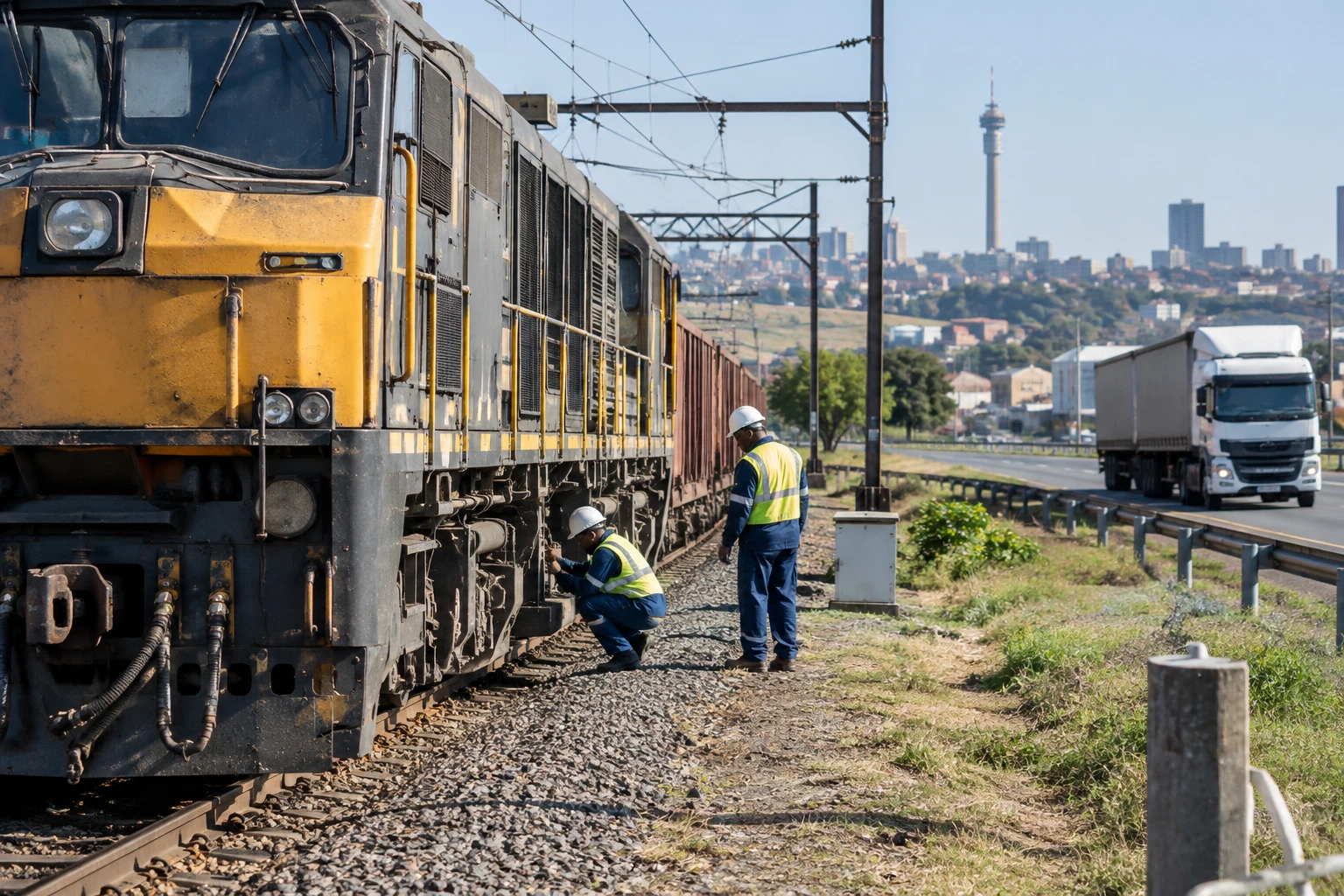
When a locomotive breaks down, the consequences extend beyond the tracks. Minerals and goods reach ports less reliably, while businesses may switch to road transport. In South Africa, the recovery of rail freight therefore depends as much on train availability as on the network they run on.
Better-supported locomotives, but a network in need of repair
On 15 October 2026, Transnet Engineering, the engineering arm of state-owned operator Transnet, signed a material and technical support agreement with Wabtec in Pretoria. The contract, valued at about 6.6 billion rand, covers Class 43D and 44D locomotives. The signing and the amount were reported by South African news service SAnews and the local trade press. SAnews report on the Transnet-Wabtec agreement.
Wabtec is to provide parts, technical assistance and digital predictive maintenance tools. These tools monitor the condition of locomotives and can flag anomalies before they cause a breakdown. The agreement also provides for skills transfer and local production initiatives. Their scope will, however, depend on the practical arrangements for implementation: the announced amount alone is not enough to gauge the expected industrial benefits.
Predictive maintenance uses data from equipment to identify signs of wear and intervene before failure. It can help reduce downtime. But it is no substitute for available parts, trained teams or maintenance of tracks, signalling and electrical installations.
Freight matters for exports and trade
Transnet manages an essential part of South Africa’s logistics chain, including rail freight and ports. For mining, agricultural and manufacturing companies, train regularity affects delivery times and costs. When rail lacks capacity or reliability, some shippers turn increasingly to trucks. This shift adds to road traffic and can raise the cost of transporting goods.
The South African government has set a target of transporting 250 million tonnes of freight by rail by 2030. In the 2023-24 financial year, Transnet moved about 150 million tonnes, according to figures cited by the Department of Transport. The gap indicates the scale of the recovery required. These figures describe a national target and a past volume: they do not guarantee that growth will follow a steady timetable. Rail priorities set out by South Africa’s Department of Transport.
The challenges are multiple. Locomotives out of service and maintenance delays limit operations. Cable theft and vandalism also disrupt services. Finally, the network needs upgrading and better management. The Wabtec agreement therefore targets one specific link — rolling stock — in a chain where infrastructure failures or port constraints can also hold up goods.
Reform also opens the network to other operators
South Africa’s strategy does not rely solely on renewing locomotives. The country has embarked on a freight reform intended to allow private operators to use some of the rail network’s capacity. In March 2026, the government announced approval for the first 11 operators, with operations due to begin from 1 April 2027. Their entry is intended to complement Transnet’s operations, subject to effective access to the tracks and available capacity. Government update on opening up the rail network.
This opening raises a question of governance as much as competition: who allocates train slots, under what rules, and how can preferential access to public infrastructure for one operator be prevented? The ministry presents the reform as a way to attract expertise and increase volumes. For shippers, its value will be judged above all by service quality, predictable delivery times and transport costs.
The context also calls for caution in assessing the partnership. In April 2025, the Gauteng High Court set aside an earlier locomotive supply contract signed by Transnet and Wabtec in 2014, as part of a settlement linked to proceedings to recover funds. That ruling does not concern the new support agreement. It nevertheless serves as a reminder that contracts awarded by a state-owned operator must be monitored transparently and that promises of local benefits must be verifiable. Official statement on the ruling concerning the earlier contract.
A regional issue beyond South Africa’s borders
The reliability of South African rail also matters for trade with neighbouring countries. South Africa is a member of the Southern African Development Community (SADC), which brings together states in the region around economic cooperation goals. South African rail and port corridors can serve national exports as well as regional flows. Conversely, delays and additional costs can affect businesses that rely on these routes.
For port cities, exporters and workers involved in rail operations, a lasting recovery could support economic activity. Road hauliers, meanwhile, could see demand shift if more goods return to rail. But the impact will be neither uniform nor immediate: routes, goods carried and access to infrastructure vary by region and business.
The test over the coming months will therefore be operational. It will be necessary to see whether the locomotives concerned spend less time out of service, whether parts arrive on time and whether the announced skills are developed locally. It will also be important to check that opening the network to new operators is accompanied by clear access rules and investment in the tracks. The contract could contribute to the recovery of South African freight; it cannot, on its own, repair the entire logistics system.



