Algeria
 Egypt
 Libya
 Morocco
 Sudan
 Tunisia
 Benin
 Burkina Faso
 Cabo Verde
 Côte d'Ivoire
 Ghana
 Guinea
 Guinea-Bissau
 Liberia
 Mali
 Mauritania
 Niger
 Nigeria
 Senegal
 Sierra Leone
 The Gambia
 Togo
 Cameroon
 Central African Republic
 Chad
 DR Congo
 Equatorial Guinea
 Gabon
 Republic of the Congo
 São Tomé and Príncipe
 Burundi
 Comoros
 Djibouti
 Eritrea
 Ethiopia
 Kenya
 Madagascar
 Malawi
 Mauritius
 Mozambique
 Rwanda
 Seychelles
 Somalia
 South Sudan
 Tanzania
 Uganda
 Angola
 Botswana
 Eswatini
 Lesotho
 Namibia
 Zambia
 Zimbabwe
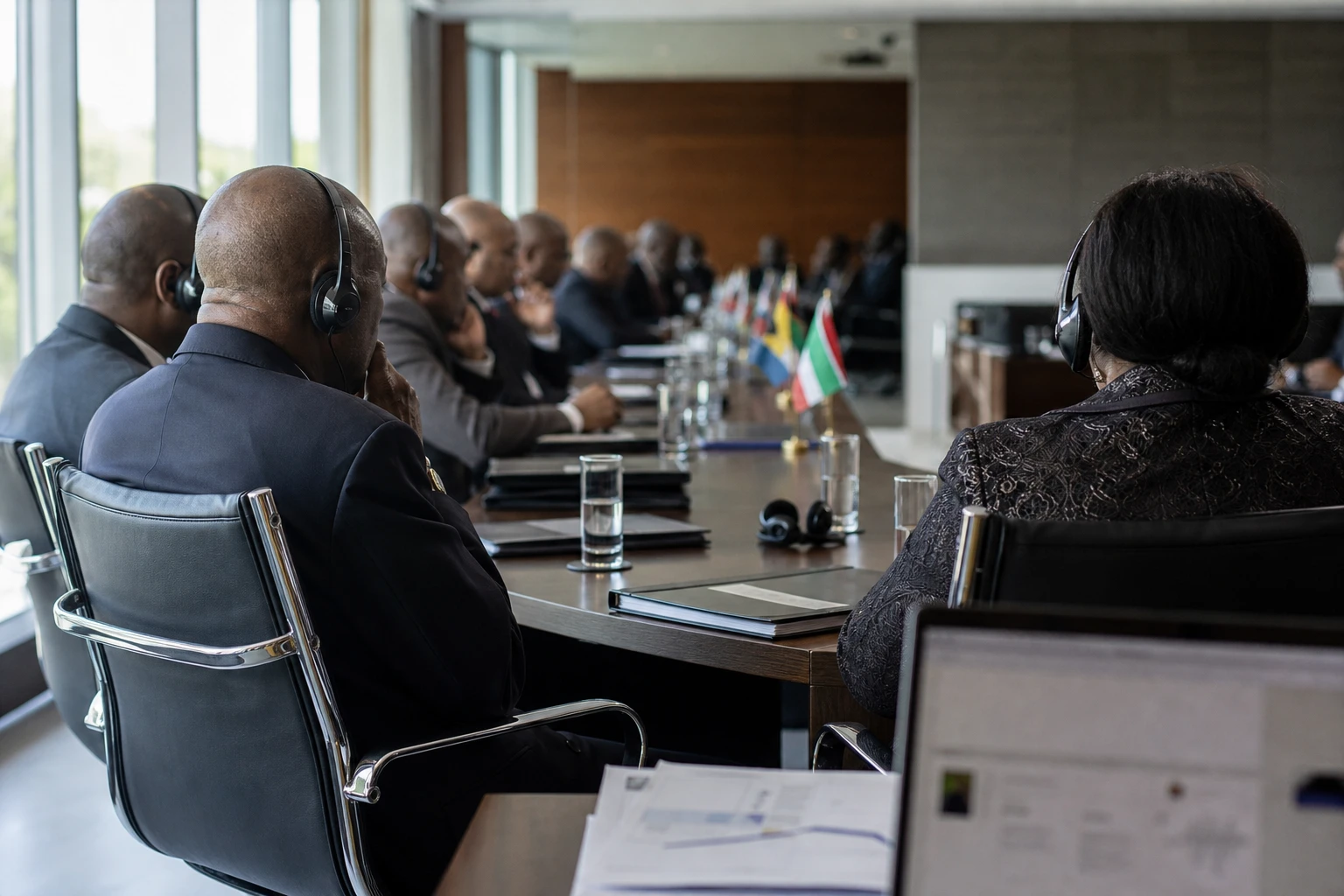
At the border, the fight against trafficking takes on a new dimension
In Musina, in Limpopo province, a raid on a clandestine methamphetamine laboratory is a reminder of a reality South African authorities are struggling to contain: organised crime routes adapt faster than controls. In this border area of South Africa, traffickers are no longer simply trying to move goods across the border. They are also setting up production sites, out of sight and close to routes leading out of the region.
The operation, carried out on Thursday, led to the seizure of chemicals and equipment valued at about 600 million rand, or nearly $37 million. Five people were arrested: two Mexicans, two Zimbabweans and one Malawian. Authorities described an industrial-scale operation set up on a farm near the border town of Musina, in northern South Africa.
A transit country, but also a market
This case has not emerged in a vacuum. For several years, South Africa has been a hub for synthetic drugs, serving as a transit country and a place of consumption and, increasingly, production. The Global Initiative Against Transnational Organized Crime notes that the methamphetamine market is significant there, as it is in neighbouring countries and across the rest of southern Africa.
The regional context matters as much as the incident itself. Limpopo borders Zimbabwe, Botswana and Mozambique. It is a busy frontier, crossed by trade flows, seasonal migration and irregular crossings. South African agencies see it as a vulnerable area where criminal groups can rely on local contacts for logistics, accommodation or surveillance of sites.
At institutional level, Pretoria has strengthened its response through the Border Management Authority, the Hawks, the national police and K9 units. In May 2026, South African authorities again announced the interception of a consignment of methaqualone, an ingredient used to make Mandrax, near Beitbridge on the Zimbabwean border. The official message is clear: pressure at the border remains constant.
Mexicans, but not only Mexicans
The presence of Mexican nationals in this network has attracted attention because it confirms a trend already observed by South African police. In July 2024, a laboratory in Groblersdal, in Limpopo, led to the arrest of four suspects, including two Mexicans, and the seizure of assets valued at 2 billion rand. In November 2024, another site was dismantled in Rietfontein, near Pretoria, and a Mexican national was arrested. In September 2025, an operation in Volksrust, in Mpumalanga, led to further arrests involving Mexicans.
This cluster of evidence has fuelled investigators’ hypothesis that groups linked to Latin America have established a broader presence in Africa. In July 2025, the Global Initiative reported a worldwide increase in “Mexican meth” laboratories and said recent raids in South Africa and Mozambique illustrated the expansion of Latin American cartels on the continent, in co-operation with local groups and other foreign intermediaries. This is an assessment of a trend, not a judicial classification of each case, but it sheds light on the series of operations seen in southern Africa.
For Pretoria, the question is therefore not simply the nationality of one group of suspects. It concerns the ability of South African territory to be used as a production base. If this role takes hold, the country will no longer merely absorb part of the regional trafficking trade: it will become an industrial foothold for transnational networks.
What this means for the region
The consequences are immediate. For the authorities, every laboratory dismantled requires substantial resources: intelligence, financial investigations, border checks, forensic police work and, sometimes, cross-border co-operation. For local residents, the risk is more diffuse but long-lasting: the circulation of highly addictive substances, exposure of young consumers, the weakening of local economies and threats to the security of rural areas where farms can serve as cover.
In southern Africa, SADC and the UN have already incorporated the fight against drug trafficking and transnational crime into broader co-operation frameworks. In February 2025, SADC and UNODC launched a 2024-2030 regional framework focused, among other things, on transnational crime, corruption and illicit financial flows. This is not simply a technical document. It recognises a political fact: no country in the sub-region can tackle alone networks operating across borders, ports, farms and urban areas.
The Musina case therefore resonates far beyond Limpopo. It says something about the new geography of methamphetamine trafficking, in which Africa is no longer just a corridor but is sometimes a place of production. It also highlights the vulnerability of borders when criminal groups have access to capital, chemical expertise and local alliances. And it confronts Pretoria with a broader challenge: turning spectacular raids into a lasting ability to dismantle networks, their financing and their distribution chains.