Algeria
 Egypt
 Libya
 Morocco
 Sudan
 Tunisia
 Benin
 Burkina Faso
 Cabo Verde
 Côte d'Ivoire
 Ghana
 Guinea
 Guinea-Bissau
 Liberia
 Mali
 Mauritania
 Niger
 Nigeria
 Senegal
 Sierra Leone
 The Gambia
 Togo
 Cameroon
 Central African Republic
 Chad
 DR Congo
 Equatorial Guinea
 Gabon
 Republic of the Congo
 São Tomé and Príncipe
 Burundi
 Comoros
 Djibouti
 Eritrea
 Ethiopia
 Kenya
 Madagascar
 Malawi
 Mauritius
 Mozambique
 Rwanda
 Seychelles
 Somalia
 South Sudan
 Tanzania
 Uganda
 Angola
 Botswana
 Eswatini
 Lesotho
 Namibia
 Zambia
 Zimbabwe

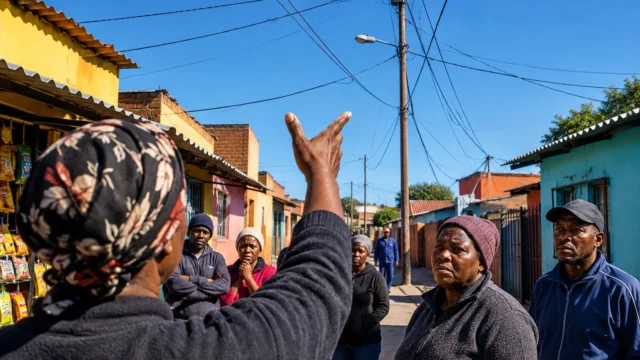
In Soweto and Durban, protests over asylum applications have moved from queues at public offices into the streets. In South Africa, the withdrawal of an administrative directive has not eased tensions; it has instead left one practical question unanswered: how people seeking protection can access the procedure.
A court ruling at the heart of the dispute
The disagreement comes against a national backdrop of several months of protests against irregular immigration. Demonstrators are calling for deportations and denouncing what they see as pressure on public services and jobs. These concerns exist in a country where economic hardship and access to services fuel political debate. They do not, however, prove that migrants are responsible for these problems.
The immediate issue concerns a ruling delivered on 7 July 2026 by the Constitutional Court. In a case brought in part by the Scalabrini Centre of Cape Town, the court invalidated provisions that could have excluded an asylum application on procedural grounds before the substance of the case was examined. This could, for example, apply to irregular entry into the country or a delay in presenting oneself at a reception centre. The official summary from South Africa’s Constitutional Court states that every application must be eligible for an individual assessment.
The ruling does not automatically make applicants refugees. Nor does it grant them a permanent right to remain. It requires their circumstances to be assessed in accordance with the law. The principle of non-refoulement — not returning someone to a country where they face persecution or serious harm — is central to this requirement.
Withdrawing a directive does not resolve the impasse
On 28 September, the director-general of South Africa’s Department of Home Affairs had issued a directive to the offices responsible for receiving asylum applications. The measure was intended to implement the July ruling. But the offices were quickly overwhelmed by the influx of people seeking to file applications. The government also cited risks to staff and security concerns.
On 9 October, the department withdrew the directive. It said it was seeking another way to implement the court ruling. This timeline is confirmed by the South African government’s statement. The withdrawal does not suspend the Constitutional Court ruling: it ends an administrative measure, while the obligation to process applications remains.
Protests on 8 and 9 October showed how much the implementation has become a flashpoint. In Soweto, in the Johannesburg area, and Durban, in KwaZulu-Natal province, vehicles were set alight and shops looted. The Associated Press reported at least 24 vehicles burned, a figure attributed to the police, and three arrests in Durban. In its initial report, the police had not confirmed any injuries in Soweto. The Associated Press report also describes conflicting accounts of the gunfire said to have preceded some of the fires: its origin had not been established.
South African outlet Eyewitness News also reported violence in Soweto and Durban, and police cases opened over property damage, assaults and public violence. It reported that the authorities intend to consult the parties concerned before setting out a new procedure. Its coverage of the department’s announcements and the police response confirms that the administrative withdrawal has not brought the debate to a close.
Balancing service capacity and legal safeguards
For staff at reception centres, the issue is immediate: receiving applications, checking identities and processing claims with sufficient resources. Overcrowded counters delay procedures and make teams’ work more difficult. For people seeking asylum, uncertainty can make it harder to have their circumstances assessed. Local businesses, particularly those targeted in the looting, are directly bearing the consequences of the violence.
The government says it wants to increase processing capacity, strengthen identity checks and tackle fraud. It also notes that people who do not meet the legal criteria may face measures provided for by law. The challenge is to distinguish this aim of managing migration from the assessment of protection claims. Border controls do not replace the individual assessment required by asylum law.
South Africa’s parliament has asked the department to present an operational plan and deadlines for reforming legislation on citizenship, immigration and refugees. The relevant parliamentary committee also plans to hear from several departments, bodies responsible for borders and appeals, and civil society organisations. It stresses that refugee status is never granted automatically. The parliament’s 10 October statement therefore puts service capacity and respect for the Constitution at the centre of the next steps.
An issue that extends beyond South Africa’s borders
South Africa occupies a central place in migration across southern Africa. Within SADC, the Southern African Development Community, cross-border movements involve workers, families, businesses and people fleeing persecution. Decisions taken in Pretoria are therefore being watched in neighbouring countries, some of whose nationals live or work in South Africa. When migrants’ safety is threatened, diplomatic relations and regional trade can also come under strain.
The current crisis is therefore about more than a withdrawn directive or protests. It is testing three responsibilities of the South African state: enforcing its migration rules, maintaining services capable of processing applications, and protecting the rights guaranteed by the courts. The next step will be to publish administrative arrangements that comply with the July ruling and are workable enough to prevent applicants, officials and residents from being caught up in another escalation.