
 Algeria
 Egypt
 Libya
 Morocco
 Sudan
 Tunisia
 Benin
 Burkina Faso
 Cabo Verde
 Côte d'Ivoire
 Ghana
 Guinea
 Guinea-Bissau
 Liberia
 Mali
 Mauritania
 Niger
 Nigeria
 Senegal
 Sierra Leone
 The Gambia
 Togo
 Cameroon
 Central African Republic
 Chad
 DR Congo
 Equatorial Guinea
 Gabon
 Republic of the Congo
 São Tomé and Príncipe
 Burundi
 Comoros
 Djibouti
 Eritrea
 Ethiopia
 Kenya
 Madagascar
 Malawi
 Mauritius
 Mozambique
 Rwanda
 Seychelles
 Somalia
 South Sudan
 Tanzania
 Uganda
 Angola
 Botswana
 Eswatini
 Lesotho
 Namibia
 Zambia
 Zimbabwe
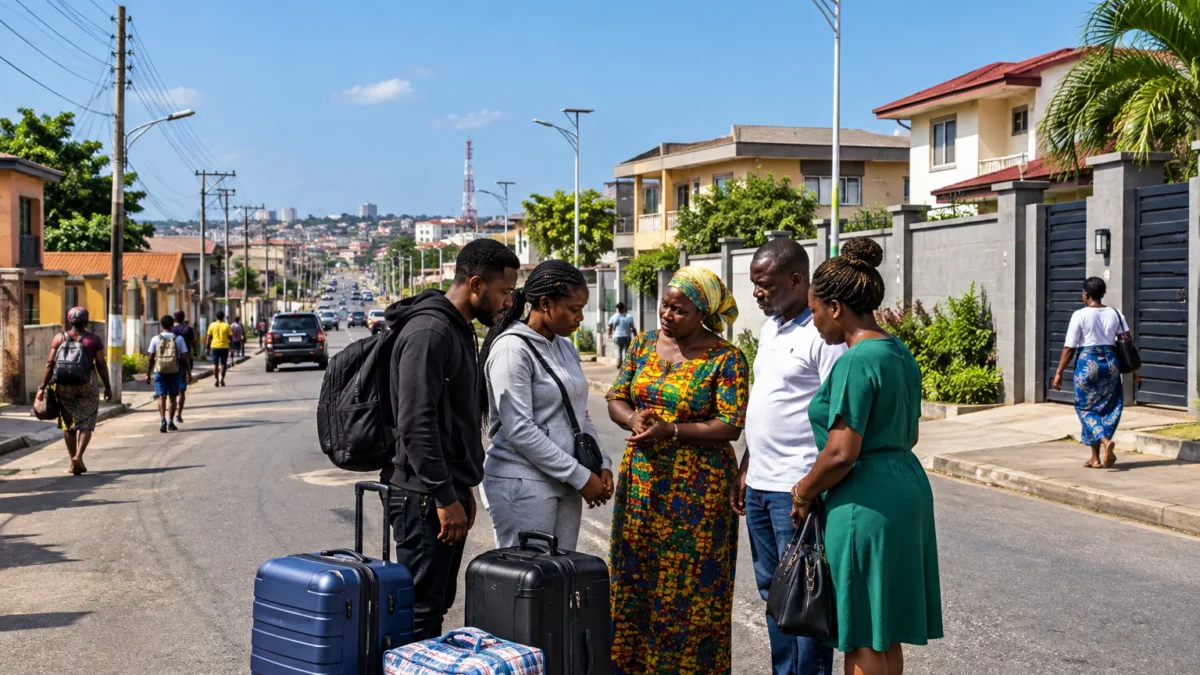
Returning to Ghana is not always enough to rebuild a life. For Ghanaians who left South Africa after the violence and intimidation of 2019, returning brought an immediate end to their fears. It also ushered in a period of insecurity, in which one-off assistance could not replace a salary or a home.
A hasty return after the violence
In September 2019, attacks targeting foreign nationals in South Africa prompted Accra to organise the return of Ghanaians who wished to leave. The violence reignited longstanding tensions over the presence of African migrants in the country. In Ghana’s parliament, an MP cited around 1,000 compatriots who had already been repatriated and several hundred more still waiting. Figures reported at the time varied depending on the stage of the operation and the people registered.
The situation unfolded in a region where labour mobility and family ties cross borders. Ghana and South Africa are both members of the African Union, but not of the same regional economic community: Ghana belongs to ECOWAS, which brings together West African countries. These frameworks facilitate exchanges and cooperation, but do not in themselves guarantee the safety or rights of migrants abroad.
South Africa’s history also shapes how events are viewed. The country has experienced several episodes of xenophobic violence, notably in 2008, and again in 2015 and 2019. The tensions are rooted in local debates over jobs, public services and immigration. These difficulties do not justify attacks on foreigners. They do, however, help explain why crises can recur and why one-off responses do not address their causes.
Immediate assistance, then the challenge of resettlement
Among those who returned was Niinii Armah Armarh, a teacher who had lived in South Africa for 15 years. In his account, he says he kept his identity papers on him for fear of being stopped. After several months without pay and in the face of intimidation, he chose to return to Ghana. He says he lost his income and accommodation, and could no longer support his children as he had before.
His experience does not sum up the journey of every returnee. It does, however, show the gap between the safety of the return journey and the chance to get back on one’s feet. The assistance announced on arrival, amounting to 5,500 cedis according to information published at the time, was intended to cover immediate needs. But a one-off payment cannot guarantee a steady job, a roof over one’s head or the chance to resume a professional activity.
In early October, an official from Ghana’s foreign ministry acknowledged that some returnees were still looking for work. Niinii had found a part-time job at a school, but the income did not allow him to pay for accommodation. This gap is crucial: someone can find work without earning enough to live independently.
The return also affects families. Relatives may have relied on money sent from abroad. When that income stops abruptly, expectations and responsibilities change. In Niinii’s case, losing the ability to help his children has left him feeling guilty. His account also describes psychological support on arrival and depression since his return. It is a reminder that resettlement is as much about mental health and family ties as access to work.
Beyond the plane ticket, long-term support
The political question is therefore not limited to the cost of repatriation or the organisation of flights. It also concerns what happens next: how can the skills of returnees be identified, their access to work facilitated and their continued dependence on emergency assistance prevented? The debate over transparency in public spending deserves precise answers. But it should not eclipse the challenge of resettlement, which calls for tailored programmes and sustained follow-up.
The impact varies from one situation to another. A teacher may seek a post that matches their training, while a trader or self-employed worker will need to rebuild a customer base and raise capital. In Accra, the cost of housing and competition for some jobs can make settling in difficult. Opportunities and access to services differ in secondary cities and rural areas. A one-size-fits-all policy therefore risks overlooking specific needs.
Nor should returning be portrayed as an individual failure. People who come home after violence, job losses or a period of insecurity do not control all the circumstances of their departure. Treating them solely as recipients of emergency aid would overlook their qualifications and experience. Effective support can link training, employment, health and family assistance, rather than being limited to a payment on arrival.
A Ghanaian and regional responsibility
For Ghana, this episode involves a consular responsibility — protecting and assisting its nationals abroad — as well as a return policy. The authorities must inform citizens, coordinate evacuations when safety demands it and account for how funds are used. Once people have returned, continuity between immediate assistance and public services becomes crucial.
Across Africa, these departures are a reminder that free movement and economic integration cannot be separated from the protection of people. ECOWAS can facilitate mobility in West Africa, while relations between Accra and Pretoria fall within a broader framework of bilateral and continental cooperation. The next step to watch is concrete: do returnees have access to regular incomes, housing and appropriate support several months after their arrival? That is the measure of whether returning has truly opened up a new possibility for life.



