
 Algeria
 Egypt
 Libya
 Morocco
 Sudan
 Tunisia
 Benin
 Burkina Faso
 Cabo Verde
 Côte d'Ivoire
 Ghana
 Guinea
 Guinea-Bissau
 Liberia
 Mali
 Mauritania
 Niger
 Nigeria
 Sierra Leone
 The Gambia
 Togo
 Cameroon
 Central African Republic
 Chad
 DR Congo
 Equatorial Guinea
 Gabon
 Republic of the Congo
 São Tomé and Príncipe
 Burundi
 Comoros
 Djibouti
 Eritrea
 Ethiopia
 Kenya
 Madagascar
 Malawi
 Mauritius
 Mozambique
 Rwanda
 Seychelles
 Somalia
 South Sudan
 Tanzania
 Uganda
 Angola
 Botswana
 Eswatini
 Lesotho
 Namibia
 South Africa
 Zambia
 Zimbabwe
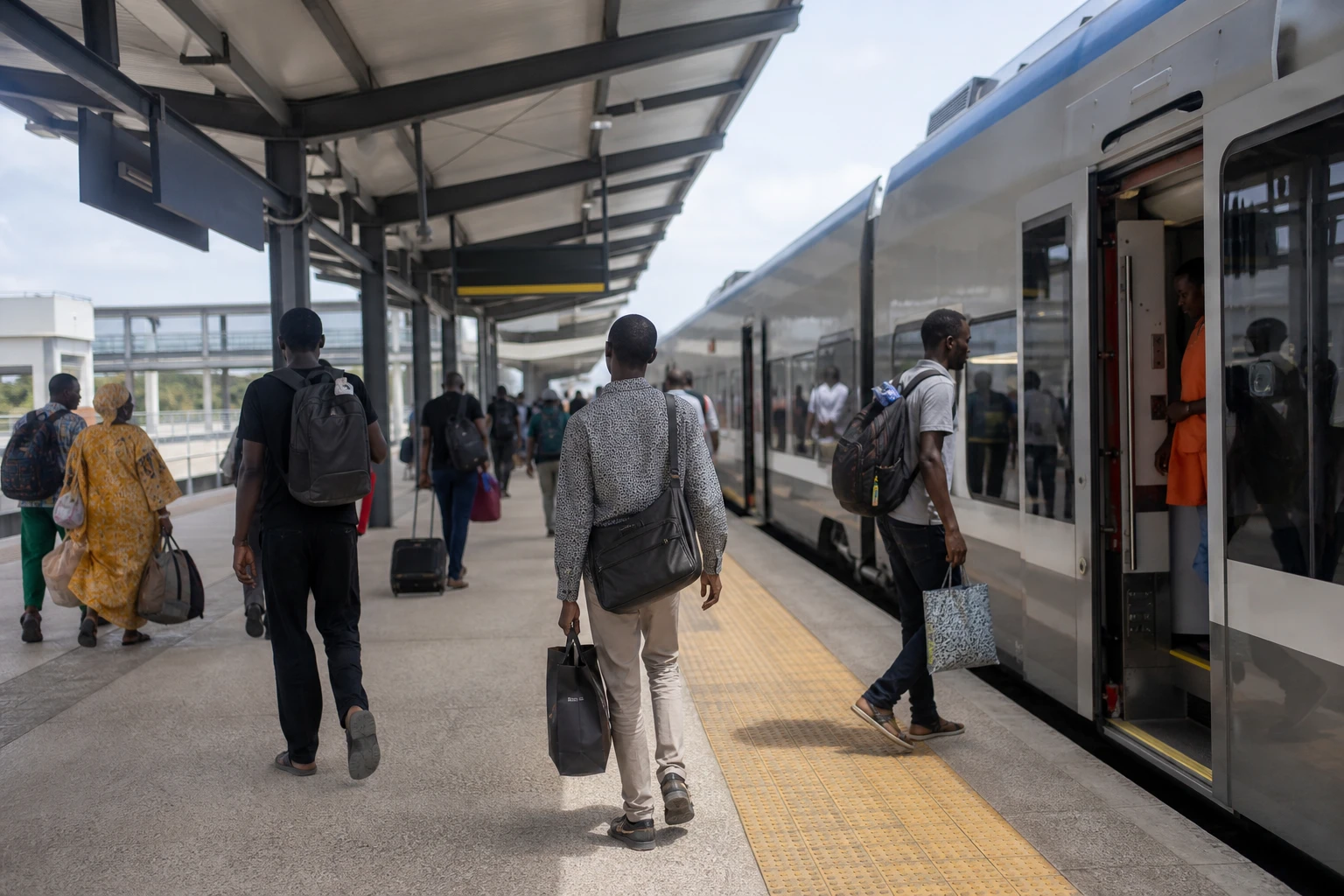
Less than five weeks before the opening of the Youth Olympic Games, Senegal has reached a long-awaited milestone. Since Monday 28 September 2026, the Regional Express Train has linked Dakar directly to Blaise Diagne International Airport via Diamniadio. For delegations, visitors and daily commuters, the connection changes the practical geography of the metropolitan area.
A rail link bringing Dakar closer to its airport
The new section of the TER links Diamniadio to Blaise Diagne International Airport, around 50 kilometres from Dakar. It adds 19 kilometres of electrified double track to the existing network. The line now stretches for approximately 55 kilometres, according to the Senegalese Press Agency and the Ministry of Land and Air Transport.
A station has been built at the airport. The service is intended to allow travellers to continue their journey by train after arriving in Senegal, without having to rely immediately on taxis or road shuttles. For residents of the capital, it also offers a new option for reaching AIBD from the various areas served by the TER.
Commercial services began on 28 September, following an inauguration held the same day. The government had previously set the end of September as the operational deadline. The date fell within the overall preparations for the Youth Olympic Games, for which transport is one of the main logistical components.
The announced cost of this second phase exceeds 300 billion CFA francs. Figures previously released had varied, partly because of additional work relating to the airport station, associated infrastructure and changes to the scope of the project.
The Youth Olympic Games accelerate a project already under way
The connection to AIBD is not infrastructure designed solely for the sporting event. The TER was already intended to improve travel across the Dakar metropolitan area and support the growth of the Diamniadio urban hub. Its first phase, between Dakar and Diamniadio, has been in operation since December 2021.
The extension to the airport, however, has faced several delays. It was initially expected to enter service earlier. Financing difficulties and a slowdown in some contracts pushed back the schedule. The Youth Olympic Games then provided a firm deadline for a project whose value extends well beyond the two weeks of competition.
The Youth Olympic Games will take place from 31 October to 13 November 2026 in Dakar, Diamniadio and Saly. They will be the first Olympic event held on the African continent. The programme includes events at several venues spread across the capital, the new urban hub and the seaside resort of Saly, as outlined in the schedule published by the Senegalese Press Agency.
Diamniadio has a central role in the organisation. The site is home to the Olympic Village and several sporting facilities. Some delegations arriving via AIBD will therefore need to reach this area before continuing, if necessary, to Dakar or Saly.
Increased capacity, but a service that must prove reliable
To support the extension, seven additional dual-mode trainsets have been acquired. The TER fleet has thus grown from 15 to 22 trains. The operating plan provides for more frequent services between Dakar and Diamniadio, with trains every eight minutes, compared with every ten minutes previously. Airport services are expected to run approximately every 24 minutes.
These timetables will have to be tested in practice. The success of the link will depend on more than the opening of the line. It will also hinge on train punctuality, coordination with flights, passenger information and stations’ ability to handle arrivals during periods of heavy traffic.
The issue concerns foreign visitors first and foremost, but is not limited to them. Airport workers, residents of Diamniadio, students and travellers from elsewhere in the country can also benefit from the connection. In a metropolitan area marked by traffic jams and urban sprawl, each improvement in reliability can change travel habits.
Fares will also be a challenge. A fast connection is only truly accessible if its price remains compatible with the incomes of regular users. The needs of Olympic delegations and those of daily travellers are not the same. The service will therefore have to balance the demands of a major event with everyday use.
Beyond the competition, the question of legacy
Senegal is already planning the next stages of the network. Studies are under way on an extension to Thiès and then to Mbour. An additional station is also planned at Sébikotane. These projects show that the TER is part of a broader development strategy linking the capital to new residential, economic and tourist centres in the west of the country.
This prospect matters if infrastructure is not to be judged solely by an international event. The Youth Olympic Games can serve as a proving ground. They will test the network’s ability to operate under pressure, as well as its usefulness in everyday life after November 2026.
The service launch also comes amid efforts by major West African cities to modernise their transport systems. Dakar retains a particular position within the Economic Community of West African States, ECOWAS, which brings together countries in the region and facilitates economic and human exchanges. A better connection between the airport, the capital and urban centres could strengthen Senegal’s appeal while improving residents’ mobility.
The next test will come immediately. From 31 October, passenger flows will converge on three host cities and several competition venues. The TER will then have to show that the Olympic deadline has delivered more than an inauguration: a reliable, user-friendly and lasting service for Senegalese people and visitors from across the continent.



