Algeria
 Egypt
 Libya
 Morocco
 Sudan
 Tunisia
 Benin
 Burkina Faso
 Cabo Verde
 Côte d'Ivoire
 Ghana
 Guinea
 Guinea-Bissau
 Liberia
 Mali
 Mauritania
 Niger
 Nigeria
 Sierra Leone
 The Gambia
 Togo
 Cameroon
 Central African Republic
 Chad
 DR Congo
 Equatorial Guinea
 Gabon
 Republic of the Congo
 São Tomé and Príncipe
 Burundi
 Comoros
 Djibouti
 Eritrea
 Ethiopia
 Kenya
 Madagascar
 Malawi
 Mauritius
 Mozambique
 Rwanda
 Seychelles
 Somalia
 South Sudan
 Tanzania
 Uganda
 Angola
 Botswana
 Eswatini
 Lesotho
 Namibia
 South Africa
 Zambia
 Zimbabwe
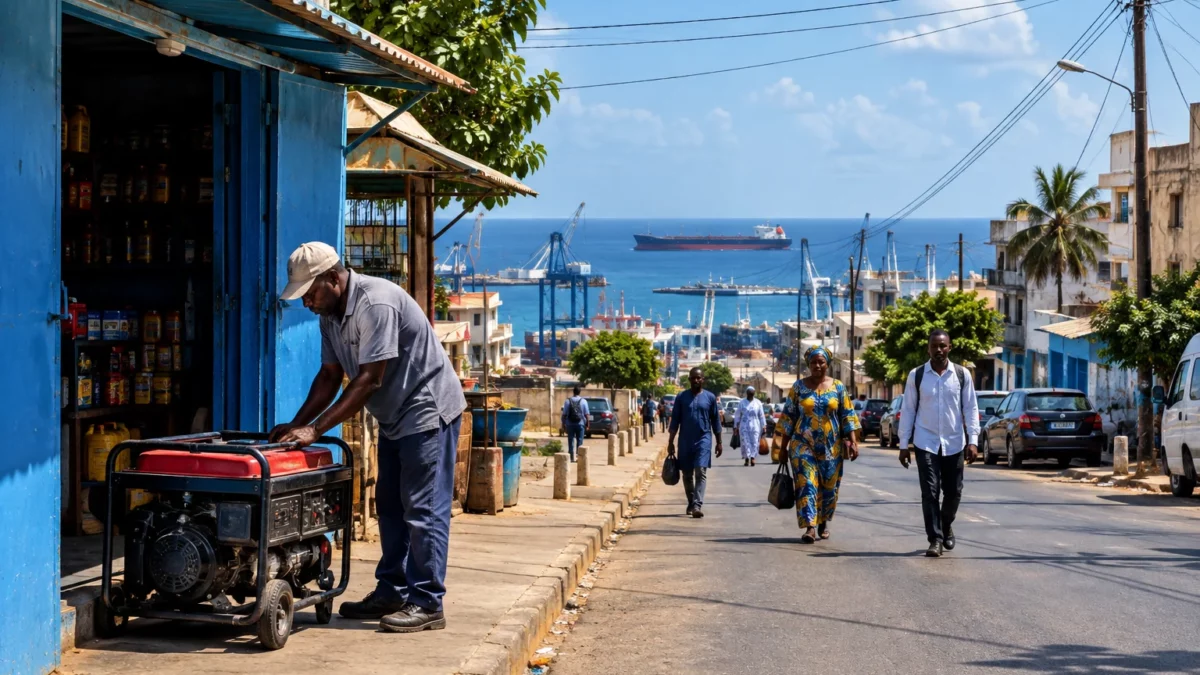
In Senegal, the arrival of oil has not ended power cuts or made domestic gas cheaper. The contrast raises a practical question: how can a resource exported off the coast of Dakar improve households’ daily lives? The first figures show new revenues, but also the gap between producing crude and turning that wealth into accessible energy.
Rising output, returns still to be assessed
Senegal joined the ranks of oil-producing countries on 11 June 2024, when the offshore Sangomar field began production. Located about 100 kilometres off the coast, it is operated by Woodside Energy alongside the national company Petrosen. Its announced nameplate capacity is 100,000 barrels per day. Senegal’s energy ministry provides details on Sangomar production.
The ramp-up exceeded initial forecasts. Sangomar produced 16.9 million barrels in 2024, of which 16.4 million were sold internationally, according to ministry data. For 2025, the announced target was 30 million barrels; production reached 36 million. These volumes confirm the field’s operational performance. On their own, they do not show what share of the value will accrue sustainably to the public budget or households.
The 2024 report of the Extractive Industries Transparency Initiative (EITI), which reconciles company payments with public revenues, offers an initial benchmark. Hydrocarbon sector revenues paid into the Treasury totalled CFA francs 76.58 billion in 2024, compared with CFA francs 25.51 billion in 2023. The report also records 16.9 million barrels produced at Sangomar. The EITI Senegal report sets out declared revenues and volumes.
The increase is significant, but it does not represent the full value of exports. Public revenues depend in particular on production-sharing rules, royalties, taxation and the recovery of investments provided for in the contracts. It is therefore necessary to distinguish the turnover from cargoes sold, revenues received by the state and sums actually available to fund public services.
From exported crude to energy used in Senegal
The oil extracted does not automatically reach the tanks of Senegalese power stations or vehicles. Sangomar produces crude destined largely for the international market. The country must then buy the refined products it needs, while its refining capacity remains below the field’s output. Starting domestic production therefore does not guarantee an immediate fall in pump prices or energy costs.
The same distinction applies to electricity. Senegalese power stations remain exposed to fuel requirements, breakdowns, plant availability and rising demand. In September 2026, power cuts affected Dakar and other areas. Senelec cited temporarily unavailable capacity, supply difficulties and high consumption. Senegalese daily Le Soleil reported the state-owned company’s explanation.
These interruptions have different effects on different activities. In Dakar, they disrupt businesses, services and equipment that depend on a continuous power supply. In rural areas, access to the grid and the quality of supply present particular challenges. For workers in the informal economy, who often have fewer backup options, an outage can directly mean lost sales or income. Offshore oil production does not solve these problems with the grid or electricity generation.
The price of butane gas, too, depends on the supply chain, costs and pricing decisions. The material provided refers to its high cost, but gives neither a specific price nor a statistical series with which to measure changes. It would therefore be unwise to claim that oil has made household bills rise or fall. What is established is that oil revenues and the cost of domestic gas are governed by separate mechanisms.
Contracts, transparency and revenue sharing
The debate over the distribution of oil wealth is part of Senegal’s recent political trajectory. Elected in 2024, President Bassirou Diomaye Faye and his government pledged to review contracts in strategic sectors. In March 2026, Prime Minister Ousmane Sonko presented the results of renegotiations covering several sectors. The Prime Minister’s Office notes, however, that the review of hydrocarbons follows existing contractual mechanisms. The official statement on renegotiations distinguishes the sectors and procedures involved.
This distinction matters. An announcement of expected gains is not the same as revenue already received. Likewise, an audit or review of a contract does not in itself prove that an agreement has been changed. To assess pledges of economic sovereignty, announcements will need to be compared with amounts paid, public spending funded and obligations actually imposed on operators.
The EITI provides a means of oversight by publishing payments declared by companies and sums received by the state. But financial transparency alone does not answer development questions: which investments should be prioritised, what share should benefit producing regions, and how can revenues be protected when production or prices fall? Revenue management, refining capacity and reliable access to electricity will be more meaningful indicators than the number of barrels exported alone.
A Senegalese issue with regional implications
Senegal is a member of ECOWAS, the Economic Community of West African States, where energy needs and trade in petroleum products extend beyond national borders. If the country develops refining and suitable infrastructure, it could strengthen its role in regional supply. But this will depend on investment, competitive costs and commercial choices; it does not follow automatically from the development of Sangomar.
The Grand Tortue Ahmeyim gas project, developed off the coasts of Senegal and Mauritania, is also a reminder that offshore resources can involve several countries and require lasting co-operation. For Senegal, the immediate challenge is to turn extractive revenues into verifiable results without conflating exports with domestic benefits. The next step to watch is the regular publication of reconciled data on revenues, their budget allocation and tangible progress on energy projects.