Algeria
 Egypt
 Libya
 Morocco
 Sudan
 Tunisia
 Benin
 Burkina Faso
 Cabo Verde
 Côte d'Ivoire
 Ghana
 Guinea
 Guinea-Bissau
 Liberia
 Mali
 Mauritania
 Niger
 Nigeria
 Sierra Leone
 The Gambia
 Togo
 Cameroon
 Central African Republic
 Chad
 DR Congo
 Equatorial Guinea
 Gabon
 Republic of the Congo
 São Tomé and Príncipe
 Burundi
 Comoros
 Djibouti
 Eritrea
 Ethiopia
 Kenya
 Madagascar
 Malawi
 Mauritius
 Mozambique
 Rwanda
 Seychelles
 Somalia
 South Sudan
 Tanzania
 Uganda
 Angola
 Botswana
 Eswatini
 Lesotho
 Namibia
 South Africa
 Zambia
 Zimbabwe
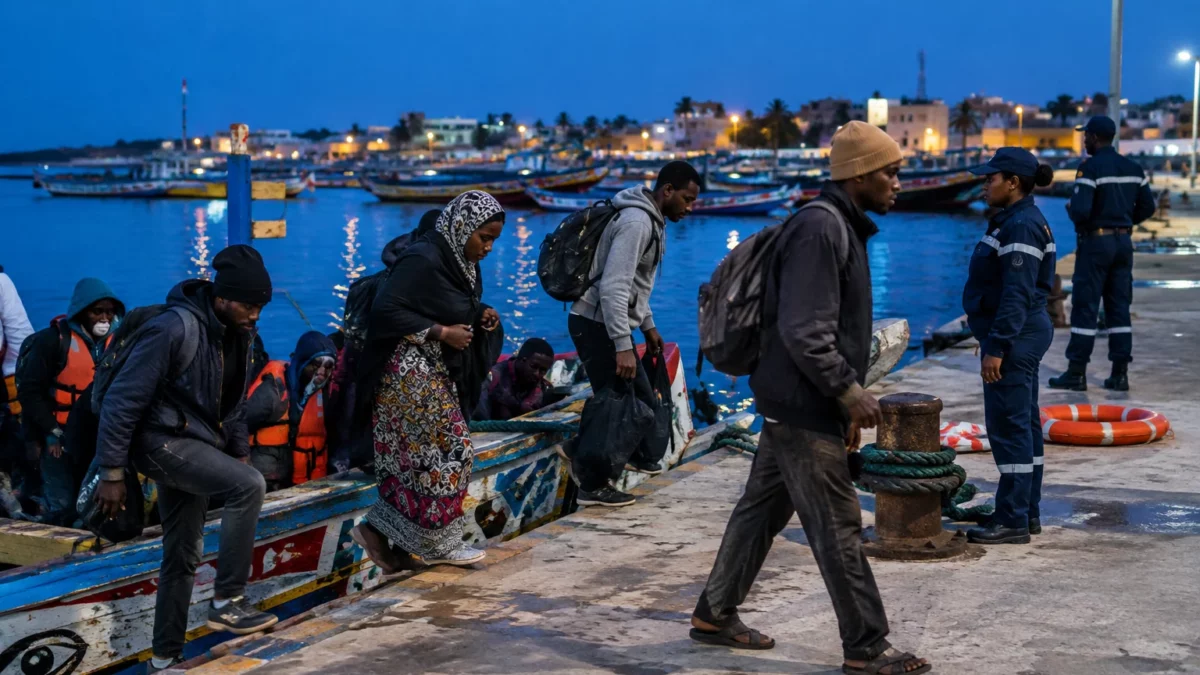
In Senegal, stepped-up sea patrols are now being measured in hundreds of people rescued in just a few days. But behind the interceptions, families are still waiting for news of relatives who set off for the Canary Islands, while two recent shipwrecks are a reminder of the human cost of these crossings.
Departures from several points along the coast
The sea route to Spain does not begin at a single port. Boats leave from different stretches of the Senegalese coast and may also take on passengers in neighbouring countries. This mobility complicates surveillance and gives smuggling networks several possible departure points.
The phenomenon affects the Dakar region as well as coastal areas in the north, centre and south. In Ziguinchor, in the south, the gendarmerie announced on 11 November that it had arrested 26 people near three pirogues. According to information reported by the Senegalese Press Agency (APS), the planned routes included travelling via Gambia or Thiaroye, in the Dakar suburbs. The operations reported in Ziguinchor illustrate the cross-border nature of some departures.
Senegal is a member of ECOWAS, the Economic Community of West African States. Co-operation between countries in the region is therefore important for tracking movements, embarkation points and the networks organising crossings. Sea routes extend beyond national borders, while rescue operations and investigations often rely on separate agencies.
More than 1,000 people rescued in three days
Between Thursday 19 and Saturday 21 November, the Senegalese navy rescued 1,007 people attempting irregular migration, according to a tally reported on 22 November by the Mauritanian news agency Madar. Three naval units are said to have assisted seven pirogues carrying 946 people on 20 and 21 November. The Northern Naval Base reportedly rescued another 61 during the same period. The account of the naval operations says those rescued were brought ashore and handed over to the relevant services.
This figure comes on top of other operations carried out during the month. On 18 November, APS reported the interception of 217 people off Dionewar, in the Saloum Delta. The passengers were of several West and Central African nationalities. On 19 November, the Associated Press (AP) reported a navy announcement that more than 1,400 people had been rescued in 48 hours. As the periods and operations were not identical, these figures should not be added together without caution. They nevertheless point to intense activity at sea.
Police and gendarmerie officials have described an operation combining a presence at identified sites, patrols and drones. Colonel Abdoulaye Camara said teams of six to ten people had been assigned to certain surveillance posts. The strategy aims to detect preparations before departure, but is not enough to stop boats from reaching open water.
Shipwrecks and relatives left without answers
The increase in interceptions comes after several tragedies. Off Lompoul, in the Louga region, a pirogue sank on 7 November. The toll changed as searches continued: APS reported 42 deaths and one survivor on 11 November, while an earlier update from the same agency put the death toll at 39. Rescuers were still searching and identifying victims at the time. The toll reported in Lompoul on 11 November remains attributed to the rescue authorities.
Another capsizing occurred off Yenne, south of Dakar, early on Wednesday 18 November, according to AP. A local council official told the agency that one body had been recovered and several people were missing. Survivors’ accounts pointed to about 100 passengers. The same source said two other bodies found in neighbouring villages had not been formally linked to the shipwreck. The toll should therefore be treated with caution.
In Yoff, in the Dakar region, mayor Seydina Issa Laye Sambe reported on 22 November that a pirogue which had left more than ten days earlier was missing. He estimated that about 175 young people from Yoff, Ouakam, Ngor and Cambérène were on board. The number and the passengers’ origins are information attributed to the mayor, who said he hoped they could be found. The searches and information available here do not make it possible to independently confirm all these details.
Monitoring departures does not address their causes
For the authorities, the immediate challenge is twofold: preventing dangerous departures and rescuing people already at sea. Surveillance can also support investigations into suspected organisers. In Yenne, the gendarmerie announced on 15 November that it had dismantled a suspected smuggling network, with 14 arrests and 12.5 million CFA francs seized. The operation reported by APS shows that investigations also target the financial and logistical means behind departures.
But local authorities do not necessarily have the resources to ensure coastal surveillance on their own or provide young people with economic opportunities. The mayor of Yoff himself described this limitation. For families, the urgency is more immediate: finding out who survived, identifying victims and getting news of those who remain missing.
President Bassirou Diomaye Faye has called for tighter control of the coastline and stressed policies aimed at young people, particularly education, training and employment, according to AP. This approach recognises that interceptions alone do not address the reasons some people attempt the crossing. The scale and diversity of the routes also point to the need for regional co-operation, without reducing those seeking to leave to figures or offenders.
In the coming days, developments in the searches around Yoff and Yenne, as well as consolidated figures for operations at sea, will provide a clearer picture of the situation. For Dakar and coastal municipalities, the challenge is to bring prevention, rescue, action against networks and lasting responses to residents’ needs together.