Algeria
 Egypt
 Libya
 Morocco
 Sudan
 Tunisia
 Benin
 Burkina Faso
 Cabo Verde
 Côte d'Ivoire
 Ghana
 Guinea
 Guinea-Bissau
 Liberia
 Mali
 Mauritania
 Niger
 Nigeria
 Sierra Leone
 The Gambia
 Togo
 Cameroon
 Central African Republic
 Chad
 DR Congo
 Equatorial Guinea
 Gabon
 Republic of the Congo
 São Tomé and Príncipe
 Burundi
 Comoros
 Djibouti
 Eritrea
 Ethiopia
 Kenya
 Madagascar
 Malawi
 Mauritius
 Mozambique
 Rwanda
 Seychelles
 Somalia
 South Sudan
 Tanzania
 Uganda
 Angola
 Botswana
 Eswatini
 Lesotho
 Namibia
 South Africa
 Zambia
 Zimbabwe
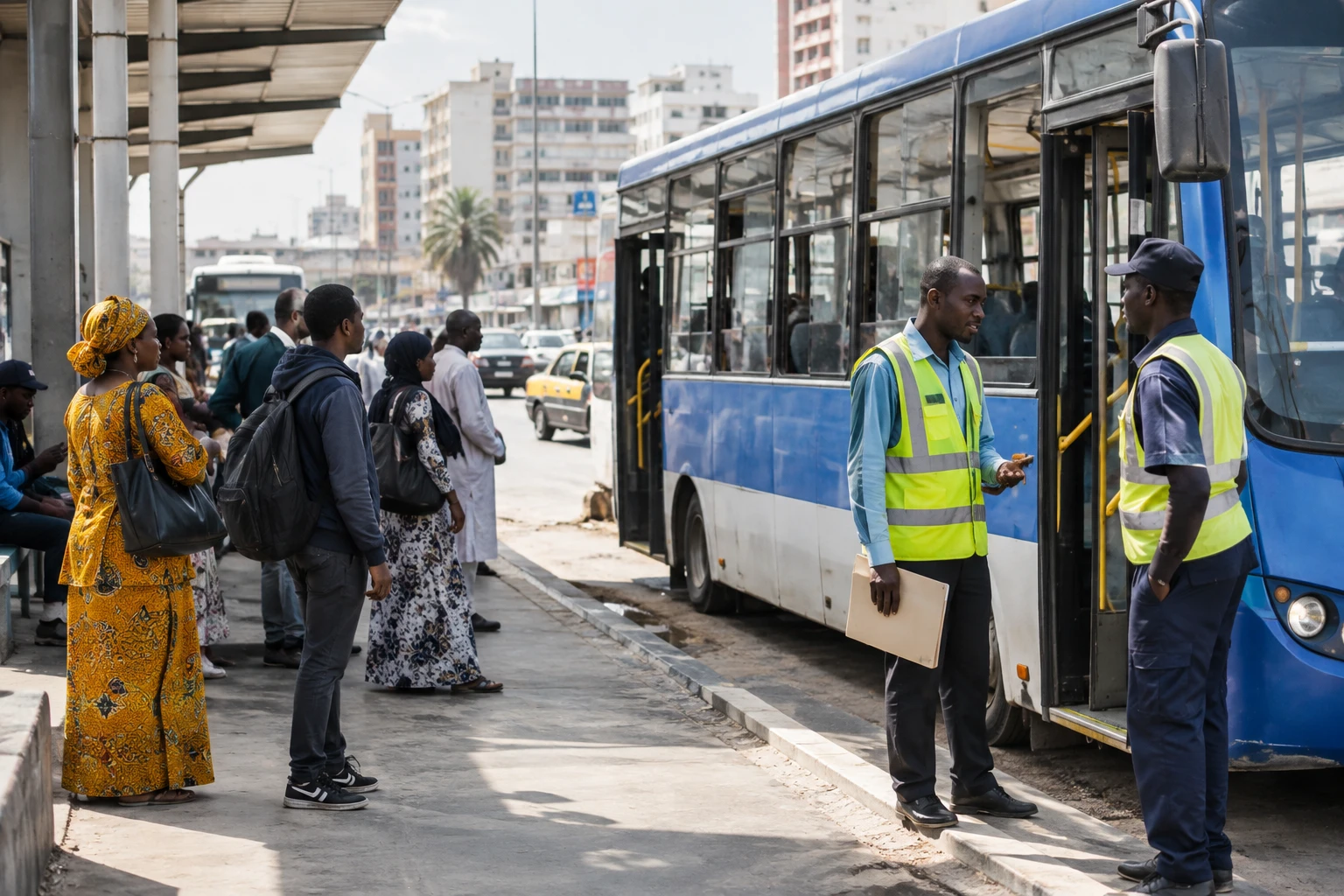
In Dakar, wage demands and labour-law reform are colliding with a highly visible deadline: the Youth Olympic Games, due to begin on 31 October. For Senegalese unions, the stakes go beyond a day of action. They concern the role of workers in decisions governing their employment and social protection.
Strike called amid opposition to new laws
On Tuesday 20 October, about 150 people demonstrated in the capital at the call of trade unions, according to reports from the scene. The Trade Union Front for the Defence of Workers (FSDT) has called for a three-day work stoppage, from Wednesday 21 to Friday 23 October, across the public, private and informal sectors. The Senegalese Press Agency announced the dates as early as September.
The action is aimed in particular at the new Labour Code and Social Security Code. The two texts, promulgated on 3 September, were published in the Official Gazette in September. Unions dispute their adoption and denounce what they consider inadequate consultation. Among their concerns is the extension to four years of the possible term of a fixed-term contract (CDD), an employment arrangement that ends on the date specified in the contract. Union leaders fear this provision will make workers more vulnerable.
These disagreements are compounded by concerns about purchasing power and the cost of living. Sara Konaré, secretary-general of the National Union of Petroleum and Gas Workers of Senegal, says organisations are no longer involved in discussions. She describes growing difficulty in making ends meet. These comments reflect the unions’ interpretation of the dispute; on their own, they do not constitute a statistical measure of income trends.
Social dialogue put to the test by reforms
The dispute forms part of a longer sequence. Trade union confederations had already put forward demands on wages, social protection and reform of the Labour Code on International Workers’ Day, 1 May 2026. President Bassirou Diomaye Faye had then spoken of progress on reforms and the need to take economic constraints into account. The Senegalese presidency also said that an agreement had been signed with education unions on 16 April.
This backdrop highlights a familiar challenge in social dialogue: an agreement in one sector does not resolve disagreements in other industries, and prior consultation does not guarantee that the final texts will win the support of social partners. Unions portray the new laws as a step backwards from earlier discussions. The government, for its part, is calling for dialogue. The information available here does not detail the government’s specific proposals or what action has been taken on each demand.
The reform affects different interests. For employees, the Code sets practical rules on contracts and protection. For employers, the changes could alter their obligations and staff management. For the state, the task is to enforce national legislation while preventing the dispute from spreading. The debate is therefore not simply a stand-off between unions and the government: it also concerns job security and how the new rules will be applied in businesses.
Essential services face possible disruption
The strike could also affect members of the public, particularly if health services are hit. Ndeye Seck Fall, head of a dialysis centre, warns that interruptions to care would have consequences for patients unable to turn to the private sector. Her warning highlights an immediate concern: people who need regular treatment often have less scope to postpone care. However, the actual scale of disruption will depend on participation in the call and the arrangements made for any minimum services.
The effects of a national strike are not the same for everyone. Employees in the formal sector can take part in a stoppage organised by their unions; workers in the informal economy may see activity fall without having the same protections. In Dakar, where government departments and major services are concentrated, disruption is more visible. In the regions, its scale will depend on which sectors take part and on the presence of trade union organisations.
Youth Olympics a test of coordination for Senegal
The proximity of the Youth Olympic Games adds to the political and logistical significance of the action, without accounting for its demands. Dakar is due to host the competition from 31 October to 13 November 2026. The event, the first edition of the YOG to be held on the African continent, will involve public services, transport and infrastructure. The timing therefore makes the coming days sensitive for both the authorities and unions.
But the coincidence does not mean that the strike call is aimed at the Games. The demands centre first and foremost on labour law, purchasing power and union participation. The question is whether the dialogue initiated by the government can produce answers before the dispute drags on, and whether the sectors concerned will maintain essential services during the stoppage.
Across West Africa, the episode is a reminder that social stability also depends on trust between states, employers and workers’ organisations. Senegal is a member of ECOWAS, the regional organisation bringing together West African countries; this strike remains a national dispute, but debates over job security and social protection concern the whole region. In the short term, the course of the action from 21 to 23 October and any progress on the texts will offer an initial indication of the parties’ ability to resume dialogue.