Algeria
 Egypt
 Libya
 Morocco
 Sudan
 Tunisia
 Benin
 Burkina Faso
 Cabo Verde
 Côte d'Ivoire
 Ghana
 Guinea
 Guinea-Bissau
 Liberia
 Mali
 Mauritania
 Niger
 Nigeria
 Sierra Leone
 The Gambia
 Togo
 Cameroon
 Central African Republic
 Chad
 DR Congo
 Equatorial Guinea
 Gabon
 Republic of the Congo
 São Tomé and Príncipe
 Burundi
 Comoros
 Djibouti
 Eritrea
 Ethiopia
 Kenya
 Madagascar
 Malawi
 Mauritius
 Mozambique
 Rwanda
 Seychelles
 Somalia
 South Sudan
 Tanzania
 Uganda
 Angola
 Botswana
 Eswatini
 Lesotho
 Namibia
 South Africa
 Zambia
 Zimbabwe
A deal that eases the pressure on the public finances, but not the concerns
In Dakar, Senegal’s return to an IMF programme looks more like a reprieve than an end to the crisis. For the government, the technical agreement reached after the mission conducted from 19 August to 1 September 2026 should reopen access to 36 months of financing. For some in the governing majority, it remains above all a step that will force the state to choose who to protect first: the public purse, local banks or household purchasing power.
The issue goes beyond a budget line. Since the revelation in 2024 that public debt was heavier than previously reported, Senegal has sought to restore the confidence of lenders, investors and regional markets. The IMF says the new programme aims to secure macroeconomic stability, debt sustainability and higher social spending. But in Senegalese public opinion, the word “reforms” remains immediately associated with the very concrete question of the cost of living.
What the agreement between Dakar and the IMF provides for
The agreement announced on 1 September 2026 concerns an extended credit facility worth about $2.2 billion, or around CFA francs 1,240 billion to 1,243 billion, depending on the conversions published by the sources consulted. It still needs approval from the IMF’s executive board. The Fund says the programme would support the Senegalese authorities’ economic and financial reforms for the 2026-2029 period.
The official framework highlights several goals: restoring macroeconomic stability, reducing fiscal and external vulnerabilities, improving transparency in public finances, increasing social spending and supporting growth led by the private sector. Senegal’s finance ministry, for its part, has stressed debt management and caution in handling public liabilities. In other words, the issue is not just a loan. It also sets out a method for recovery.
The sensitive point remains the hidden debt revealed following an audit commissioned by the new authorities in 2024. Reuters notes that Senegal subsequently suspended its previous IMF programme, while the Fund referred to “misreporting” and the need for corrective measures. In its 2026-2031 country strategy paper, the AfDB estimates that the debt burden and repayments will continue to weigh heavily on public finances between 2025 and 2027.
Why Pastef is seeking clarification
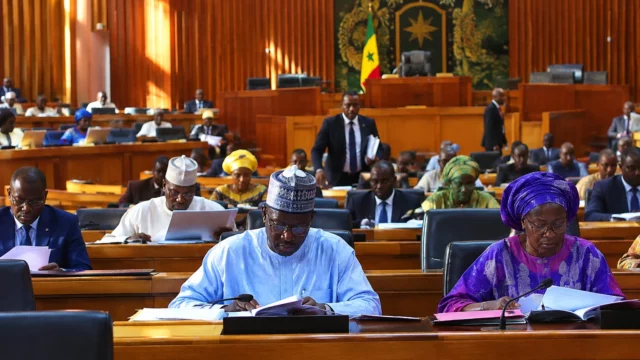
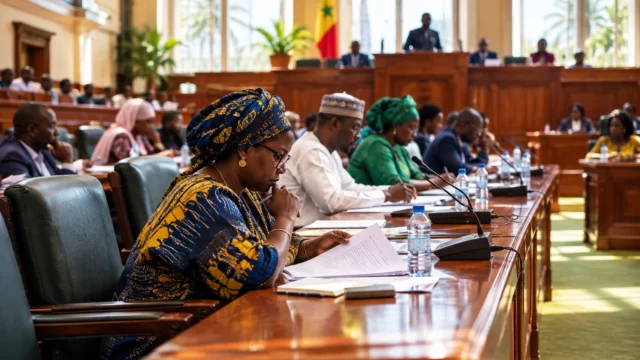
Pastef, the majority party in the National Assembly, is not merely challenging the existence of an agreement. Above all, it wants the contours of the restructuring to be made clear. At a press conference in Dakar on 3 September 2026, its leadership said it feared the burden of adjustment would be shifted on to households, businesses and the banking sector. Senegalese media reported the same position: a call for “absolute transparency” on the terms negotiated with the IMF.
The concern is political, but it is also social. The government has already asked its ministers to speed up the targeting of subsidies for vulnerable households, while announcing that family security allowance payments would be resumed by the end of September 2026. These signals show that the executive is preparing a more targeted phase of social protection. They also indicate that fiscal reform without a safety net would be difficult to sustain in a country where food inflation, urban transport and access to credit can quickly weigh on household budgets.
The debate is therefore not simply between those “for” and “against” the IMF. It brings two interpretations of economic recovery into conflict. On one side is the case for financial credibility: without debt clarification and fiscal discipline, Dakar would remain dependent on costly financing in the regional market. On the other is the fear of an excessively abrupt adjustment that would weaken households, small businesses, domestic investment and banks exposed to sovereign debt. Reuters also notes that the treatment of Senegalese debt could affect the regional financial system.
A test for Dakar, ECOWAS and West African markets
Senegal is not an isolated case in West Africa. As an ECOWAS member, it is part of a region where governments are simultaneously seeking to finance their budgets, preserve the stability of their banks and defend their economic sovereignty. When Dakar negotiates with the IMF, it also sends a signal to Abidjan, Bamako, Ouagadougou, Lomé and Cotonou: debt sustainability is no longer an abstract debate, but an almost daily condition for securing financing.
The continental significance is clear. Several African countries have already held difficult discussions with the Fund over the real level of their debt, the transparency of public accounts and the place of social spending in adjustment programmes. In this context, Senegal’s case matters because it combines three unusual features: an economy considered relatively structured, the discovery of under-reported liabilities and a political majority that wants to retain control over the pace of social change. This combination could become a benchmark, or a cautionary example, for other African capitals.
What happens next will depend first on the IMF executive board’s review of the case, and then on how Dakar translates the agreement into concrete measures. The real test will not simply be the signing. It will be the Senegalese state’s ability to reduce the deficit without crushing domestic demand, clarify the debt without alarming markets, and preserve international credibility and social peace at the same time. That is now where the next phase of the mandate will be decided.