Algeria
 Egypt
 Libya
 Morocco
 Sudan
 Tunisia
 Benin
 Burkina Faso
 Cabo Verde
 Côte d'Ivoire
 Ghana
 Guinea
 Guinea-Bissau
 Liberia
 Mali
 Mauritania
 Niger
 Nigeria
 Sierra Leone
 The Gambia
 Togo
 Cameroon
 Central African Republic
 Chad
 DR Congo
 Equatorial Guinea
 Gabon
 Republic of the Congo
 São Tomé and Príncipe
 Burundi
 Comoros
 Djibouti
 Eritrea
 Ethiopia
 Kenya
 Madagascar
 Malawi
 Mauritius
 Mozambique
 Rwanda
 Seychelles
 Somalia
 South Sudan
 Tanzania
 Uganda
 Angola
 Botswana
 Eswatini
 Lesotho
 Namibia
 South Africa
 Zambia
 Zimbabwe
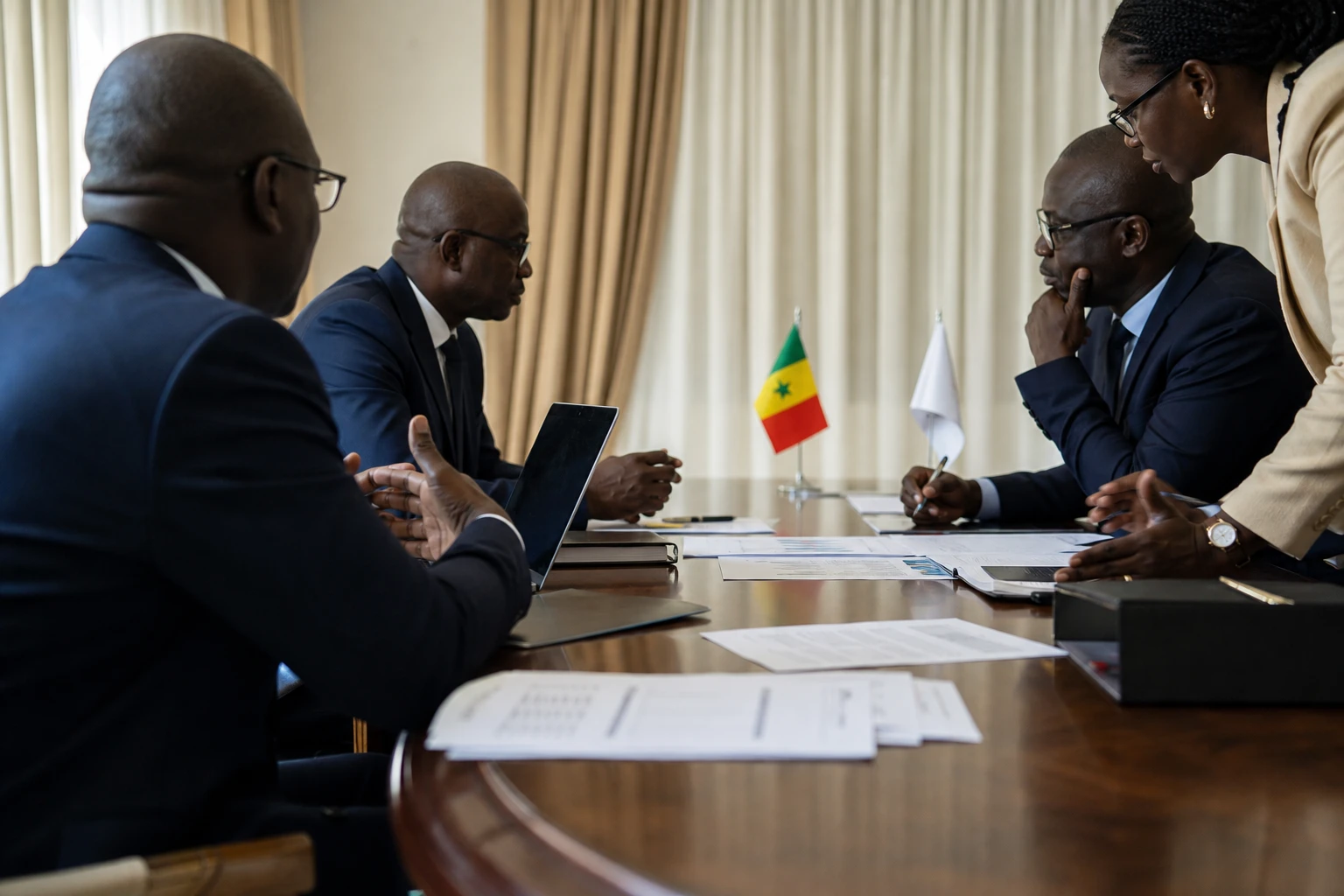
In Washington, Dakar seeks time and budgetary room
For a state, the real difficulty is not simply finding money. It is convincing others that it can still fund its priorities without undermining confidence. Senegal is at precisely this point, with talks with lenders hinging as much on budget credibility as on the ability to protect essential spending. President Bassirou Diomaye Faye’s visit to Washington from 14 to 15 September 2026 fits into this effort to secure financial breathing space and regain control.
The situation is familiar in Dakar, but has become more difficult in recent months. After irregularities were discovered in the public accounts, Senegal had to reopen intensive dialogue with the Bretton Woods institutions — the International Monetary Fund and the World Bank. The country remains an important player in the region’s ECOWAS, the Economic Community of West African States, although its room for manoeuvre now depends as much on regional balances as on domestic discipline.
Meeting with the IMF and World Bank
The Washington visit comes as no surprise. It follows a series of exchanges between the Senegalese authorities and IMF staff that have been under way for several months. On 1 September 2026, the two sides announced a staff-level agreement on a new 36-month programme under the Extended Credit Facility, worth around $2.2 billion. The agreement is still subject to approval by the IMF’s Executive Board, and no disbursement will be made before that stage.
On 21 January 2026, Bassirou Diomaye Faye had already received the IMF’s new mission chief for Senegal, Mercedes Vera Martin, in Dakar. Then, at the end of the summer, talks resumed in Dakar from 19 August to 1 September, before the technical agreement was announced. The meeting in Washington with Kristalina Georgieva is therefore intended to consolidate a political phase rather than initiate one. The Senegalese presidency says it wants to move quickly towards a new programme, indicating that Dakar wants to avoid any delay that would prolong financial uncertainty.
The Senegalese president also held talks with the World Bank. In June 2025, the institution had already approved $115 million in concessional financing to support debt sustainability, public financial management and domestic resource mobilisation. This continuity matters: it shows that multilateral partners are not closing the door on Senegal, provided reforms remain clear and are implemented.
Debt, budgetary discipline and structural reforms
Debt remains at the heart of the issue. The IMF estimates Senegal’s total public debt at 132% of GDP at the end of 2024. This level forces difficult trade-offs and explains why sustainability has returned to the forefront of all discussions with creditors. The new agreement with the IMF is specifically aimed at restoring macroeconomic stability, reducing fiscal and external vulnerabilities, and supporting private sector-led growth.
In practical terms, Dakar is seeking to widen its room for manoeuvre without sacrificing social spending. The IMF-backed programme emphasises boosting domestic revenue, rationalising expenditure and improving budget transparency. The government must also negotiate with its creditors to make the debt sustainable. These talks could take place under the G20 Common Framework, a restructuring mechanism launched in 2020 for countries in difficulty. The condition is clear: without an approved programme, there can be no first disbursement, and therefore no immediate budgetary relief.
This constraint affects different groups in different ways. For central government, it means revisiting priorities, keeping closer track of spending commitments and avoiding unfunded promises. For households, the stakes are more immediate: protecting social spending, cushioning the rising cost of living and ensuring that public services do not bear the brunt of the adjustment. For the private sector, by contrast, the desired signal is more predictable governance, capable of attracting financing and reviving productive investment.
Senegal is also trying to turn the exit from crisis into an opportunity for modernisation. The reform framework supported by the World Bank is aligned with the country’s Vision 2050 and a public finance transparency programme. At the same time, the presidency is emphasising digital transformation, cybersecurity and the protection of critical infrastructure. The announcement during the visit of a $300 million investment by US company Cybastion to fight cybercrime fits this direction: financial recovery is no longer limited to the budget, but also involves protecting economic and administrative systems.
The signal to West Africa
At the regional level, Senegal’s case goes beyond the national context. Across West Africa, several states are seeking at the same time to fund their needs, contain their debt and maintain market confidence. Senegal, which remains anchored in ECOWAS and the West African Economic and Monetary Union, shows that a country can retain access to multilateral financing if it negotiates quickly, communicates clearly and delivers verifiable reforms.
The continental significance is clear. The IMF says its programme could catalyse financing from the World Bank, the African Development Bank and other partners. In other words, Senegal’s case could serve as a test for a new generation of African financing: more closely tied to transparency, more attentive to sustainability and more connected to job-creating sectors. It is also a useful reminder for the African Union and regional institutions: debt is no longer merely an accounting issue; it now shapes economic sovereignty and states’ ability to invest in productive transformation.
Developments will be closely watched in Washington and Dakar. The timetable now depends on the IMF Executive Board’s review of the case, followed by any adjustments to the commitments made by the Senegalese authorities. In parallel, talks with the World Bank and other lenders will show whether the country can turn a technical agreement into sustained financial support. For Senegalese people, the issue remains simple: whether fiscal consolidation will finally create room for investment, jobs and public services, without trapping the country in prolonged austerity.