Algeria
 Egypt
 Libya
 Morocco
 Sudan
 Tunisia
 Benin
 Burkina Faso
 Cabo Verde
 Côte d'Ivoire
 Ghana
 Guinea
 Guinea-Bissau
 Liberia
 Mali
 Mauritania
 Niger
 Nigeria
 Senegal
 Sierra Leone
 The Gambia
 Togo
 Cameroon
 Central African Republic
 Chad
 DR Congo
 Equatorial Guinea
 Gabon
 Republic of the Congo
 São Tomé and Príncipe
 Burundi
 Comoros
 Djibouti
 Eritrea
 Ethiopia
 Kenya
 Madagascar
 Malawi
 Mauritius
 Mozambique
 Seychelles
 Somalia
 South Sudan
 Tanzania
 Uganda
 Angola
 Botswana
 Eswatini
 Lesotho
 Namibia
 South Africa
 Zambia
 Zimbabwe
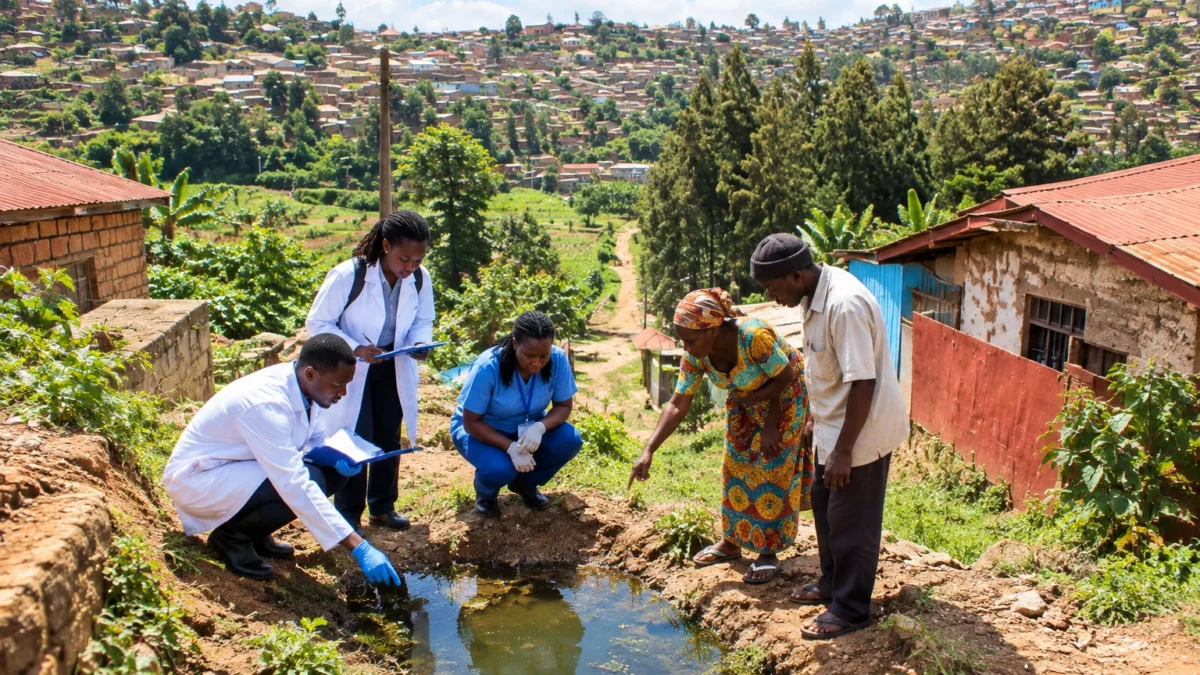
As malaria spreads in the highlands, the response is not confined to health centres. It also depends on the ability to identify areas where climate, the environment and living conditions favour transmission. In Rwanda, the disease is returning after several years of decline, but warming alone does not explain the resurgence.
A resurgence after years of decline
Rwanda sharply reduced malaria after a peak recorded in the mid-2010s. The annual incidence fell from 409 cases per 1,000 people in 2016-2017 to 45 in 2023-2024. But the trend has reversed: it reached 76 cases per 1,000 in 2024-2025, according to the national strategic plan for malaria control for 2026-2030.
The number of recorded cases confirms the resurgence. Rwandan health authorities reported 610,832 cases in 2023-2024, then more than 1.13 million in 2024-2025. The new national plan gives an incidence of 72 per 1,000 in 2025-2026: a slight decline, but still well above the 2023-2024 level. These data cover different reporting years and should not be confused with figures for a calendar year.
Severe cases have also increased. The national plan records 1,316 severe cases in 2022-2023, compared with 4,281 in 2024-2025 and then 4,504 in 2025-2026. Reported deaths rose from 51 to 87 between 2022-2023 and 2024-2025, before reaching 109 in 2025-2026. These official figures point to increased pressure on health services, even though overall incidence fell slightly in the latest reporting year.
Climate shifts the risk, but does not explain everything
Rwanda’s terrain creates very different conditions from one district to another. The cooler temperatures in high-altitude areas have long limited transmission. If they warm, some localities may become more favourable to mosquito vectors. Rainfall and stagnant water can also create more breeding sites, but their effect depends on how long and how heavily it rains.
A study published in the journal Communications Earth & Environment in 2024 modelled the risk of transmission in Rwanda. It projects a possible increase in the northern and western highlands, driven by a combination of rising temperatures and rainfall. This finding describes a probable geographical shift, not a uniform increase across the country or proof that climate change is the direct cause of every new infection.
Another analysis, based on Rwandan climate and health data from 2012 to 2021, highlights the complexity of the relationship between weather and malaria. In that study, an average temperature of about 18.5°C was associated with a higher risk, while temperatures above about 23.9°C were associated with a lower risk. Rainfall, season, altitude and transmission delays also matter. Climate therefore changes the conditions affecting risk, but does not replace other factors.
At continental level, a study published in Nature in 2026 also predicts that warming could redistribute malaria risk in Africa. Some areas of the Rift Valley could see an increase by the end of the century. This regional finding does not mean that risk will rise by 20% everywhere, or that this estimate applies directly to Rwanda. The projections are based on climate scenarios and relate in particular to prevalence among children.
A more targeted response, from district to village
For Rwandan authorities, the challenge is to focus resources where case numbers are highest, while maintaining rapid diagnosis and treatment in less affected areas. The 2026-2030 plan sets out a strategy combining epidemiological surveillance, mosquito monitoring, distribution of insecticide-treated nets and targeted indoor spraying.
Community health workers play an essential role. They can carry out tests, treat uncomplicated cases under national protocols and quickly refer patients with signs of severe illness. Yet the share of cases managed at community level fell to 46% in 2025-2026, from 60% during the period of greatest progress, according to the national plan. Restoring this capacity is particularly important for households far from health facilities.
The response must also take account of differences between areas. Climate projections draw attention to the western and northern highlands, while health data show significant hotspots elsewhere, including districts in the east and south. Local trends, the presence of insecticide-resistant mosquitoes, access to healthcare and use of mosquito nets determine where transmission intensifies in practice.
A shared challenge in the Great Lakes region
Rwanda is a member of the East African Community, which brings together neighbouring countries facing health and climate risks that cross borders. Monitoring the movement of vectors, sharing data and coordinating prevention can complement national systems. Regional co-operation, however, does not replace investment in health centres and community teams.
For Rwandans, the increase in cases means more testing, treatment and prevention, with particular concern for children and people living far from medical services. For the authorities, it puts a decade of progress in the fight to the test. The coming years will show whether the decline seen in 2025-2026 is sustained and whether surveillance can anticipate hotspots linked to climate shifts. The key will be to track health, weather and entomological data together, rather than attribute the resurgence to a single factor.
Rwanda’s National Strategic Plan for Malaria 2026-2030 · Study on projections of transmission in Rwanda’s highlands · Analysis of climate factors and malaria in Rwanda, 2012-2021 · Rwandan data on community health workers and malaria cases · Study on how malaria risk in Africa could change by 2100