Algeria
 Egypt
 Libya
 Morocco
 Sudan
 Tunisia
 Benin
 Burkina Faso
 Cabo Verde
 Côte d'Ivoire
 Ghana
 Guinea
 Guinea-Bissau
 Liberia
 Mali
 Mauritania
 Niger
 Nigeria
 Senegal
 Sierra Leone
 The Gambia
 Togo
 Cameroon
 Central African Republic
 Chad
 DR Congo
 Equatorial Guinea
 Gabon
 Republic of the Congo
 São Tomé and Príncipe
 Burundi
 Comoros
 Djibouti
 Eritrea
 Ethiopia
 Kenya
 Madagascar
 Malawi
 Mauritius
 Mozambique
 Seychelles
 Somalia
 South Sudan
 Tanzania
 Uganda
 Angola
 Botswana
 Eswatini
 Lesotho
 Namibia
 South Africa
 Zambia
 Zimbabwe
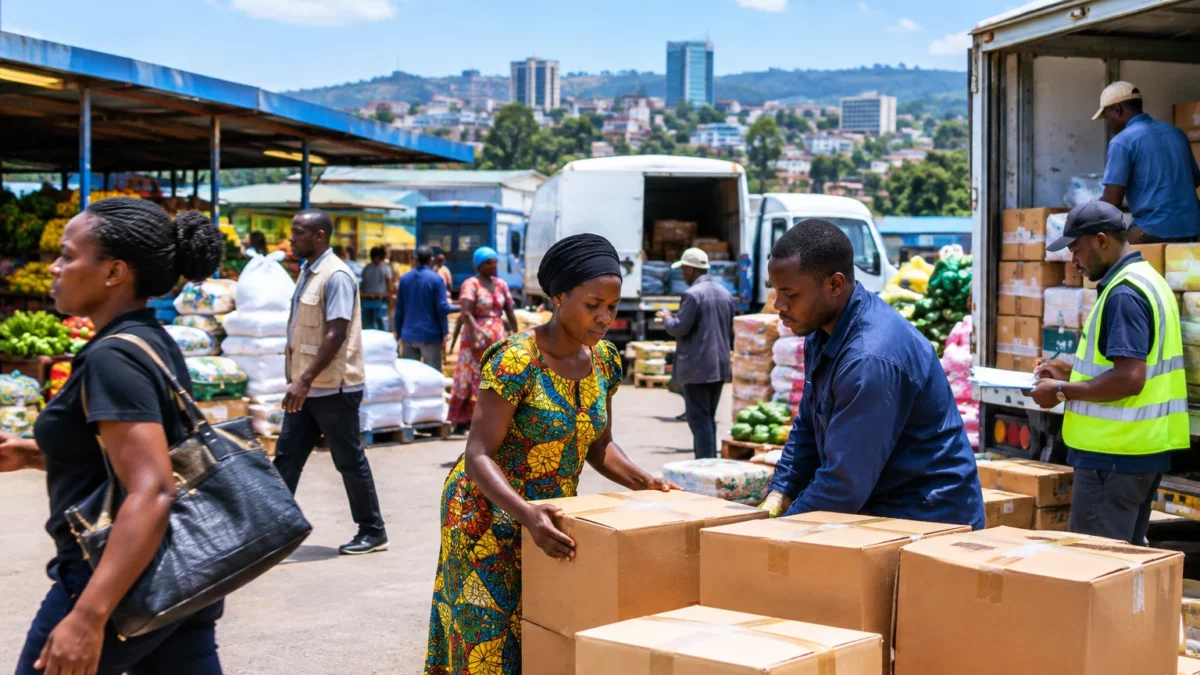
For Rwandan businesses, the challenge is not simply to sign a new diplomatic framework: it is to turn a still limited trading relationship into concrete opportunities. In Copenhagen, Kigali and Denmark set out tools for cooperation, as migration also gives their rapprochement a sensitive political dimension.
A broader partnership, but one still to translate into projects
On 23 November 2026, foreign ministers Olivier Nduhungirehe and Lars Løkke Rasmussen signed three bilateral instruments in the Danish capital. Rwanda’s Ministry of Foreign Affairs confirms the signing and the areas discussed during the visit, including trade, investment and institutional ties. A Rwandan media outlet also reported the announcement.
The first text establishes a general partnership framework. The second provides for facilitating access to paid employment for family members of diplomatic staff in their country of assignment. The third is a declaration of intent to open negotiations on a tax convention. It is therefore not yet an agreement that would eliminate double taxation: its rules remain to be discussed.
This distinction matters to businesses. If concluded, a tax convention can clarify which country taxes certain income and profits. It can therefore reduce uncertainty for companies operating in both markets. But it guarantees neither investment nor contracts. Those will also depend on costs, market opportunities and partners’ ability to finance projects.
The visit also covered education, research and innovation. The two governments discussed the partnership between the University of Rwanda and the University of Copenhagen. The first Rwandan students could begin master’s programmes in 2027. At this stage, this is an announced timetable, not a programme already under way.
Modest trade and closer diplomatic ties
Available trade data highlight the gap between political ambition and current flows. For 2024, they show about $3.57 million in Danish exports to Rwanda, compared with $68,200 in Rwandan exports to Denmark. A database drawing on customs data confirms these orders of magnitude. These figures cover recorded goods and do not, on their own, measure services, investment or jobs linked to trade.
For Kigali, the opportunities being highlighted for Danish businesses include energy, healthcare, infrastructure, agriculture and digital technology. The question is whether discussions lead to investment accessible to local businesses and benefits beyond the capital. Small exporters in particular will need clearly identified markets, understood standards and appropriate logistics solutions.
The rapprochement has taken shape in stages. Two memorandums signed in April 2021 already provided a framework for political consultations and cooperation on asylum and migration. Denmark then strengthened its presence in Kigali: its diplomatic office was upgraded to an embassy on 1 August 2025, and its official opening was marked on 16 February 2026. This presence can facilitate administrative and economic exchanges, without prejudging their outcomes.
Migration, an issue shaping the political significance
Economic cooperation is not taking place in a diplomatically neutral environment. On 16 November 2026, Denmark and four other European states announced that they were working with Rwanda on arrangements to host people whose asylum applications had been rejected in Europe. The Associated Press reported the announcement and questions raised about protection safeguards. This separate project gives particular significance to bilateral discussions on migration.
The three instruments signed on 23 November are not, in themselves, the agreement on these arrangements. The issues should not be conflated. However, the general partnership includes migration among its areas of cooperation and adds to exchanges already under way on asylum. The details of the European project, its safeguards and its timetable therefore remain to be followed separately.
For Rwanda, this relationship combines prospects for cooperation with choices that have prompted international debate about the responsibilities of host countries and the protection of people. For Denmark, it forms part of a strategy of partnerships with several African countries. The concrete terms of the agreements, their implementation and monitoring mechanisms will matter more than announcements alone.
An issue with regional significance for East Africa
Rwanda is a member of the East African Community (EAC), a regional organisation that aims, among other things, to facilitate economic integration among its member countries. An agreement with Denmark remains bilateral, but investment and supply chains can be part of a broader East African market. That will depend on the sectors concerned and the rules actually applied, not solely on the signing in Copenhagen.
The next step is now practical: to monitor the opening of tax negotiations, implementation of the partnership framework and the launch of the announced university programmes in 2027. It will also be important to see whether trade becomes more reciprocal and whether migration discussions progress within a separate, transparent framework with safeguards. For Kigali, the significance of the rapprochement will be measured by these results as much as by its diplomatic weight.