Algeria
 Egypt
 Libya
 Morocco
 Sudan
 Tunisia
 Benin
 Burkina Faso
 Cabo Verde
 Côte d'Ivoire
 Ghana
 Guinea
 Guinea-Bissau
 Liberia
 Mali
 Mauritania
 Niger
 Nigeria
 Senegal
 Sierra Leone
 The Gambia
 Togo
 Cameroon
 Central African Republic
 Chad
 DR Congo
 Equatorial Guinea
 Gabon
 Republic of the Congo
 São Tomé and Príncipe
 Burundi
 Comoros
 Djibouti
 Eritrea
 Ethiopia
 Kenya
 Madagascar
 Malawi
 Mauritius
 Mozambique
 Seychelles
 Somalia
 South Sudan
 Tanzania
 Uganda
 Angola
 Botswana
 Eswatini
 Lesotho
 Namibia
 South Africa
 Zambia
 Zimbabwe

A case that goes beyond a former officer
In Kigali, the death of a former member of Rwanda’s presidential guard cannot be read simply as a prison case. It raises a broader question: what becomes of figures who fall from favour in Rwanda after serving close to the seat of power? In a country where institutional discipline is often presented as a pillar of stability, the death in custody of a former senior officer also highlights the sensitive place prisons occupy in Rwanda’s public debate.
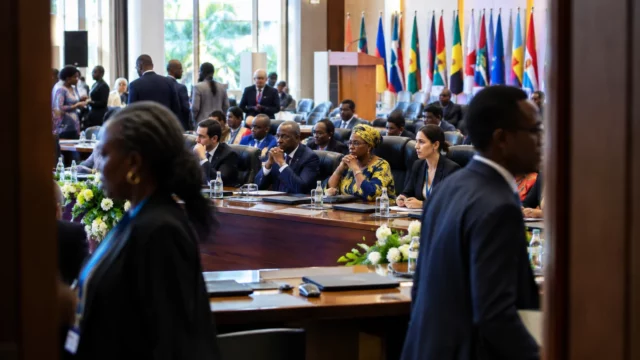
Rwanda is a member of the East African Community, the EAC, a regional organisation that now comprises eight states, including Rwanda since July 2007. This regional integration matters to Kigali because it affects mobility, trade and political cooperation. But it also leaves the country under constant regional scrutiny on rights, justice and criminal procedures.
What is known about Tom Byabagamba’s death
According to his relatives, Tom Byabagamba died in prison after nearly 12 years in detention. Born in 1967, the former colonel had held sensitive positions in Rwanda’s security apparatus, notably in the close protection of President Paul Kagame and the presidential guard. The precise circumstances of his death have not been made public in the information available.
He was arrested in August 2014. In March 2016, Kigali’s military court sentenced him alongside his brother-in-law, retired General Frank Rusagara, for offences described as “incitement to insurrection” and undermining the image of the state. The case unfolded at a time when the Rwandan authorities were further toughening their response to criticism from former civilian and military officials.
The case was subsequently examined by the United Nations Working Group on Arbitrary Detention. In its Opinion No. 85/2017, the UN body considered together the cases of Franck Kanyambo Rusagara, Tom Byabagamba and François Kabayiza. Human rights organisations also argued that the detention of the two former military officers amounted to punishment for expressing critical views. Kigali, for its part, challenged these interpretations before UN bodies.
A case touching on Rwanda’s security history
The accusations also referred to remarks made in front of officers, notably about the assassination of Patrick Karegeya, the former head of Rwandan intelligence who became an opposition figure in exile and was killed in South Africa in 2014. In the judicial and political accounts surrounding cases of this kind, the issue is not merely disciplinary. It touches on loyalty at the highest levels of the state, the handling of internal dissent and the way the Rwandan government protects its narrative of national cohesion.
Byabagamba’s case is not isolated in the country’s recent history. In March 2025, Frank Rusagara also died in prison after more than a decade behind bars, according to several sources cited by human rights organisations and regional media. This succession of deaths in custody has fuelled lasting concern about the health of long-term detainees and access to healthcare in prisons.
For the authorities, these cases fall within the national judicial framework. For their critics, they instead illustrate how the criminal justice system treats dissenting voices, including those of former state officials. Between these two interpretations, the point of contention remains the same: the boundary between national security, institutional discipline and freedom of expression.
What this death says about Rwanda and the region
In Rwanda, military justice has long played a central role in cases involving officers suspected of disloyalty or political treason. The debate, however, goes beyond the judicial system alone. It speaks to the relationship between a highly structured state and a society in which public expression of disagreement remains closely monitored, especially when it concerns the army, security or narratives linked to the 1994 war and genocide.
Across East Africa, the case is also of interest to Rwanda’s partners in the EAC, which is seeking to deepen economic and political integration. In a regional space where movement, security matters and relations between governments are closely linked, Kigali’s treatment of former senior officers affects the country’s institutional image, without calling its place in the bloc into question. The next point of attention will be the Rwandan authorities’ response, should they choose to provide information on the causes of death and conditions of long-term detention.
Finally, the case is a reminder of a wider reality across the continent: cases involving political detainees, former security officials or critics of the government continue to draw the attention of UN mechanisms, African NGOs and regional media. In Rwanda, as elsewhere, the question is not simply that a man died in prison. It is how a state treats its former pillars when they stop following the official narrative.