Algeria
 Egypt
 Libya
 Morocco
 Sudan
 Tunisia
 Benin
 Burkina Faso
 Cabo Verde
 Côte d'Ivoire
 Ghana
 Guinea
 Guinea-Bissau
 Liberia
 Mali
 Mauritania
 Niger
 Nigeria
 Senegal
 Sierra Leone
 The Gambia
 Togo
 Cameroon
 Central African Republic
 Chad
 DR Congo
 Equatorial Guinea
 Gabon
 Republic of the Congo
 São Tomé and Príncipe
 Burundi
 Comoros
 Djibouti
 Eritrea
 Ethiopia
 Kenya
 Madagascar
 Malawi
 Mauritius
 Mozambique
 Seychelles
 Somalia
 South Sudan
 Tanzania
 Uganda
 Angola
 Botswana
 Eswatini
 Lesotho
 Namibia
 South Africa
 Zambia
 Zimbabwe
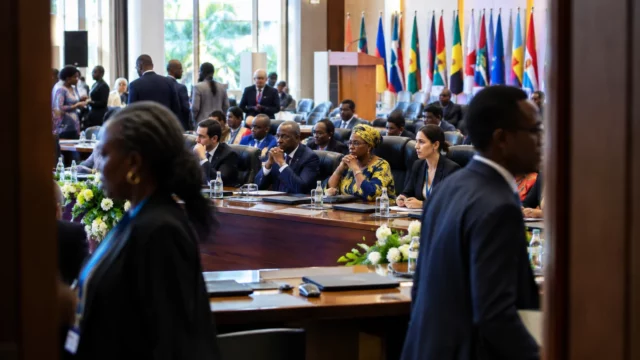
In Kigali as in Brussels, the resumption of diplomatic relations does not mean an end to the disagreement over the Democratic Republic of the Congo. Above all, it restores the channels needed to talk, negotiate and manage tensions without resorting directly to a rupture.
Rwanda and Belgium announced on 22 September 2026 that they had restored their diplomatic relations, which had been severed since March 2025. The decision comes as the conflict in eastern DR Congo continues to weigh on the balance of power in the Great Lakes region and on relations between Kigali, Kinshasa and several European partners.
A gradual return of diplomatic missions
The resumption was formalised in a joint statement signed by Olivier Nduhungirehe, Rwanda’s Minister of Foreign Affairs and International Co-operation, and Maxime Prévot, Belgium’s Deputy Prime Minister and Minister of Foreign Affairs. The document provides for the forthcoming reopening of the two countries’ embassies.
Initially, the missions will be headed by chargés d’affaires ad interim. They will be accompanied by a diplomat or consular official, as well as a small technical team. Ambassadors will be appointed later, following the agrément procedure, meaning the host country’s official approval.
Rwanda’s future ambassador to Belgium is also expected to be accredited to the European Union. This gives the resumption a significance that extends beyond bilateral relations. Brussels is one of the main centres of decision-making on European policy towards Central Africa and the Great Lakes region.
According to the statement published by Rwanda’s Ministry of Foreign Affairs, the decision follows several exchanges between the two ministers. The discussions reportedly allowed them to address differences and misunderstandings in what was described as a constructive climate.
Both governments say they want to maintain an “open, frank and transparent” dialogue. They also emphasise non-interference, mutual respect and the pursuit of constructive engagement. These principles do not amount to an agreement on the substance of the Congolese issue. Rather, they establish a framework to prevent a fresh diplomatic escalation.
A rupture triggered by the crisis in eastern DR Congo
The rupture took place on 17 March 2025, after the European Union adopted sanctions against several Rwandan officials in the context of the M23 offensive in eastern DR Congo. Kigali accused Belgium of taking Kinshasa’s side and waging a hostile campaign against Rwanda.
Rwandan authorities also denounced Belgium’s historic role in shaping political identities in Rwanda before independence. This remains a sensitive memory in Kigali, where the colonial period is regularly raised in debates about the responsibilities that contributed to the divisions preceding the 1994 genocide against the Tutsi.
Belgium responded with reciprocal measures. Rwandan diplomats on its territory were declared persona non grata, while Belgian representatives in Rwanda were ordered to leave the country. Government co-operation was also suspended.
The episode affected development programmes funded by Belgium. Kigali notably announced the suspension of co-operation with Belgian entities. The arrangements affected included programmes implemented by Enabel, Belgium’s development agency, with a combined value reported at the time to exceed €112 million.
The closure of diplomatic channels had not, however, removed the practical interests linking the two countries. Rwandan nationals live in Belgium. Families, businesses, civil society organisations and co-operation bodies depend on regular consular and administrative procedures.
The Congolese issue remains the main point of tension
The resumption of dialogue does not change Belgium’s position on DR Congo’s sovereignty. Maxime Prévot said Brussels would continue to defend the country’s territorial integrity. This position was reported by the Congolese Press Agency, which also stressed that the restoration of relations did not represent a change in Belgian policy.
In a statement carried by the Congolese Press Agency, Belgium’s foreign minister explained that renewing ties with Kigali did not mean abandoning Brussels’ positions. The aim is to establish structured channels for discussing persistent disagreements, particularly over eastern DR Congo.
Belgium also intends to support the mediation processes under way in Doha and Washington. These initiatives seek to bring the parties involved in the Congolese crisis closer together, although their implementation remains fragile. The question of the M23, the role attributed to Rwanda by Kinshasa and the security concerns expressed by Kigali remain at the heart of the discussions.
Rwanda regularly rejects accusations that portray it as the sole factor destabilising eastern DR Congo. Kigali points to the presence of armed groups hostile to it along its borders, the refugee issue and the lack of a lasting response to the regional causes of the conflict. Kinshasa, for its part, accuses Rwanda of supporting the M23 and violating its territorial integrity. These opposing interpretations continue to shape regional diplomacy.
A signal for East Africa and the Great Lakes
For Rwanda, the resumption of ties with Belgium comes at a time when Kigali is seeking to preserve its diplomatic room for manoeuvre. The country remains part of the East African Community, or EAC, a regional organisation that includes Rwanda and DR Congo, among others. This membership provides a framework for dialogue, but also exposes bilateral tensions to regional repercussions.
The effects of the crisis are not the same for everyone. Leaders have several political channels at their disposal. People living along the border, traders, transport operators and families separated by borders are more affected by restrictions and administrative suspensions. Formal businesses depend on stable rules. In the informal economy, disruption spreads more quickly through travel, trade and access to consular services.
The reopening of the embassies could therefore produce practical results even before ambassadors are appointed. It may facilitate consular procedures, restore regular contact between administrations and allow disputes to be managed more effectively. It will not, however, be enough to resolve the security crisis in eastern DR Congo.
The next step will be to see whether dialogue withstands military and political developments in the region. Diplomatic appointments, the possible resumption of some co-operation programmes and the European Union’s position will be important indicators. For Kigali, Brussels and the capitals of the Great Lakes region, the real test will be maintaining contact when disagreements become more visible again.