
 Algeria
 Egypt
 Libya
 Sudan
 Tunisia
 Benin
 Burkina Faso
 Cabo Verde
 Côte d'Ivoire
 Ghana
 Guinea
 Guinea-Bissau
 Liberia
 Mali
 Mauritania
 Niger
 Nigeria
 Senegal
 Sierra Leone
 The Gambia
 Togo
 Cameroon
 Central African Republic
 Chad
 DR Congo
 Equatorial Guinea
 Gabon
 Republic of the Congo
 São Tomé and Príncipe
 Burundi
 Comoros
 Djibouti
 Eritrea
 Ethiopia
 Kenya
 Madagascar
 Malawi
 Mauritius
 Mozambique
 Rwanda
 Seychelles
 Somalia
 South Sudan
 Tanzania
 Uganda
 Angola
 Botswana
 Eswatini
 Lesotho
 Namibia
 South Africa
 Zambia
 Zimbabwe
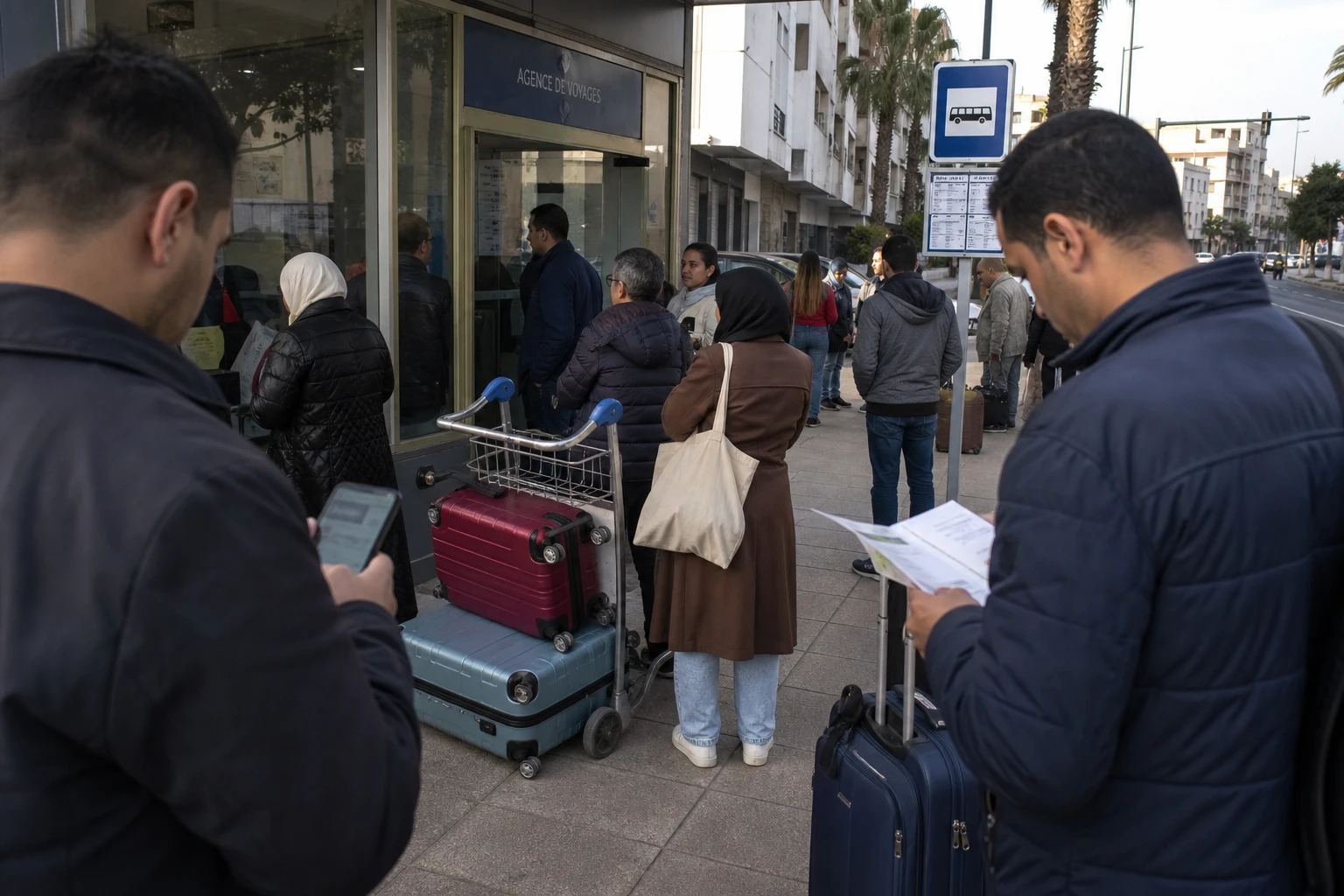
A network designed to connect families as well as markets
In Casablanca, Royal Air Maroc’s strategy is no longer being pursued solely in the major, congested airports. It is also taking shape in mid-sized European cities where the airline can serve a regular, loyal customer base that is valuable both for passenger traffic and cargo. This choice says much about the place of the Moroccan diaspora in the air transport economy: it fills seats, but also cargo holds.
For a Moroccan carrier, that is no small matter. A route performs better when it attracts recurring family trips, business travel and flows of light goods. That is precisely what the national airline is seeking with its new services to Bilbao, Alicante, Verona and Lille, all linked to Casablanca in its summer 2026 commercial network. Moroccans living abroad are therefore not merely seasonal travellers. They are becoming an economic asset.
Casablanca, the national base for a wider network
Royal Air Maroc operates from Casablanca, Morocco’s main air hub, and continues to concentrate its intercontinental services there. The airline says it has a fleet of 67 aircraft and plans to offer nearly 8.2 million seats to 86 international destinations in summer 2026, up 23% on summer 2025. Its European network already includes many cities, from Paris to Madrid and Marseille to Milan, while Lille, Bilbao, Alicante and Verona are now among the gateways highlighted in its commercial offering.
Morocco is also part of a regional environment in which air connectivity matters for the movement of people, goods and services. In the Euro-Mediterranean region, where ties between Morocco and Europe go back a long way, the national airline is seeking to reduce its reliance on major hubs alone. The reasoning is simple: it is better to go after traffic where it already exists than to wait for it at fiercely contested airports.
The figures confirm the size of this pool. In Spain, the National Statistics Institute recorded 920,693 Moroccan nationals as of 1 January 2024, making them the country’s largest foreign community. In France, the Moroccan presence is particularly visible in Hauts-de-France, with a dense population in the Lille metropolitan area and in several historic industrial towns such as Roubaix, Tourcoing and Denain. These are real centres of mobility, not statistical abstractions.
Cargo, another reason for these routes
These new routes are not just for return trips to Morocco. They also serve a logistical purpose. According to the airline, the cargo holds of its Boeing 737s can carry up to three tonnes of goods per flight. Medicines, industrial parts and perishable products can thus move more quickly between the two shores of the Mediterranean, before being redistributed from Casablanca across the airline’s African network, including Dakar, Abidjan and Pointe-Noire.
This approach matters for Morocco, which has for several years sought to consolidate Casablanca as a connecting hub between Europe and Africa. The hub serves not only holidaymakers and diaspora families. It also links often fragmented regional economies, where air transport remains a tool of competitiveness for export businesses, pharmacies, short supply chains and e-commerce operators.
The timing is favourable. The International Air Transport Association said that in February 2026, African airlines saw cargo demand rise by 21.0% year on year, the strongest regional performance of the month, in a global market up 11.2%. For an airline such as Royal Air Maroc, this trend provides an additional commercial argument for routes designed to carry both people and goods.
Expansion beyond Morocco
Royal Air Maroc’s ambition goes beyond opening a handful of European routes. It wants to strengthen Casablanca’s role in the competition with other connecting hubs, including Istanbul, Doha and Addis Ababa. This rivalry is not symbolic. It is reflected in the ability to attract transit passengers travelling between Europe, Africa and other regions, while retaining a strong base of Moroccan and African customers.
For Moroccans living in Europe, the benefit is tangible. A direct service means fewer connections, and therefore less travel time and uncertainty. For the airline, it secures a steady source of demand. For the European cities served, it improves access to a market for travellers and shipments. For the Moroccan economy, it further consolidates Casablanca’s role as a gateway to West and Central Africa.
This expansion also has continental significance. It illustrates a broader shift in African air transport: the continent’s airlines are now seeking less to imitate major international groups and more to make use of their own advantages, starting with diasporas, regional corridors and secondary markets. In this model, the Moroccan diaspora is not an added extra. It is becoming economic infrastructure in its own right, on a par with an airport hub or a well-filled cargo route.
The next test will be whether Royal Air Maroc can sustain this growth without compromising punctuality, fares or service quality. The equation is demanding: connect more cities, maintain passenger numbers and make Casablanca a credible hub for the long term. Beyond the commercial announcement, the real strength of this strategy will be judged on that basis.



