Algeria
 Egypt
 Libya
 Sudan
 Tunisia
 Benin
 Burkina Faso
 Cabo Verde
 Côte d'Ivoire
 Ghana
 Guinea
 Guinea-Bissau
 Liberia
 Mali
 Mauritania
 Niger
 Nigeria
 Senegal
 Sierra Leone
 The Gambia
 Togo
 Cameroon
 Central African Republic
 Chad
 DR Congo
 Equatorial Guinea
 Gabon
 Republic of the Congo
 São Tomé and Príncipe
 Burundi
 Comoros
 Djibouti
 Eritrea
 Ethiopia
 Kenya
 Madagascar
 Malawi
 Mauritius
 Mozambique
 Rwanda
 Seychelles
 Somalia
 South Sudan
 Tanzania
 Uganda
 Angola
 Botswana
 Eswatini
 Lesotho
 Namibia
 South Africa
 Zambia
 Zimbabwe
A protocol ceremony that also says something about Morocco today
At Rabat-Salé airport, an official arrival is never just about a carpet being rolled out and military honours. It also tells a story about how Morocco presents its power, diplomacy and public female figures. The reception of Rachel Ruto, Kenya’s First Lady, by Princess Lalla Asmaa fits into this institutional framework, in which protocol accompanies a broader political message: Morocco wants to project an active, organised monarchy that is engaged on the ground in social as well as diplomatic affairs.
The country is hosting this visit as Rabat seeks to strengthen its links with Africa, particularly with East African states. The rapprochement with Nairobi is not new: in 2025, Princess Lalla Asmaa herself travelled to Kenya for a working visit at Rachel Ruto’s invitation, in connection with the care of children with hearing disorders and cochlear implants. This two-way traffic lends depth to the events of September 2026. They go beyond simple diplomatic courtesy.
In Rabat, Rachel Ruto’s reception was designed as a signal
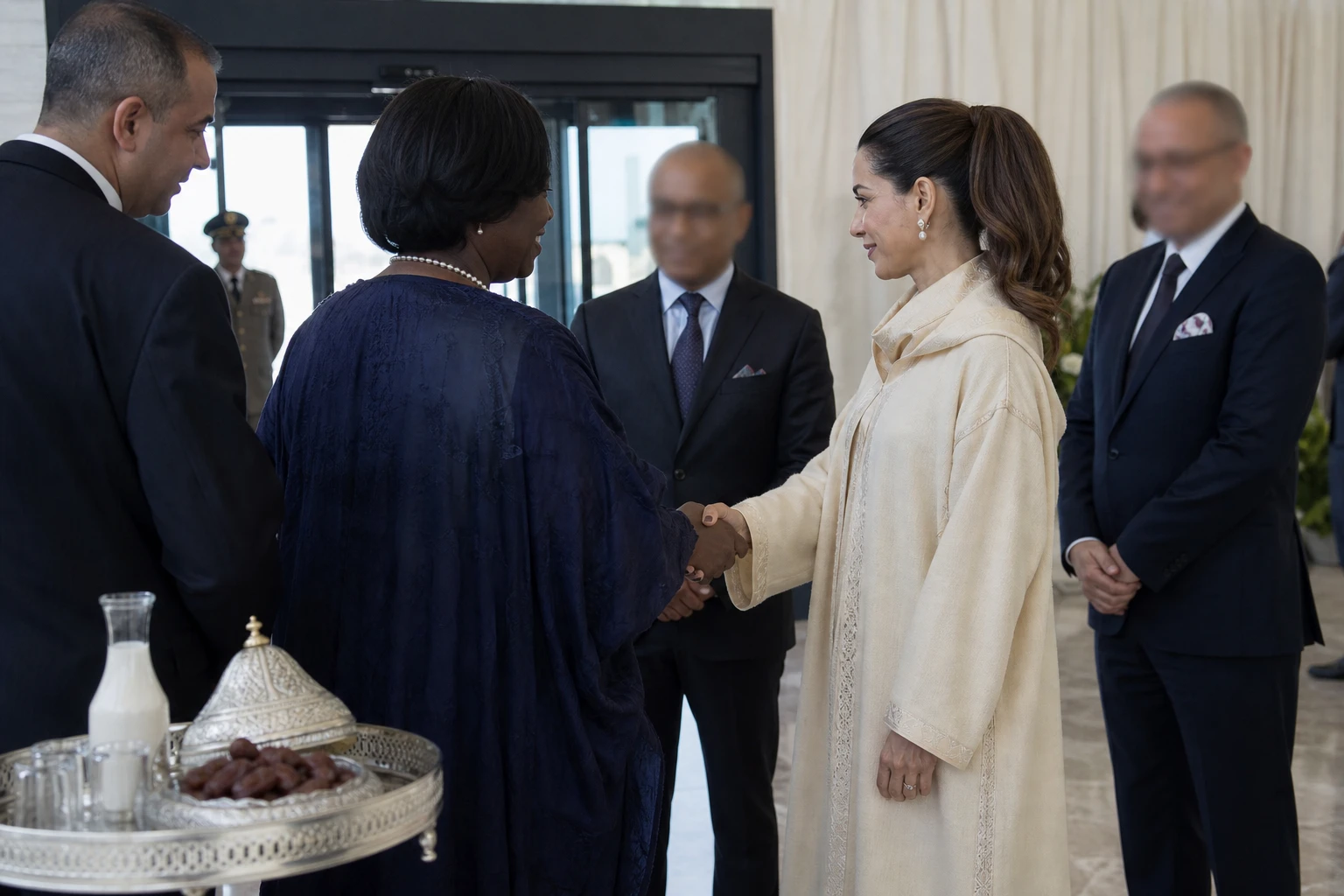
Rachel Ruto arrived in Salé on Monday for a working visit to Morocco. On disembarking at Rabat-Salé airport, she was welcomed by Lalla Asmaa. The ceremony included honours rendered by a section of the Auxiliary Forces, followed by the presentation of protocol greetings by several Moroccan officials, including the wali of the Rabat-Salé-Kénitra region, Mohamed Yacoubi, and the president of the regional council, Rachid El Abdi. Kenya’s ambassador to Morocco, Jessica Gakinya, was also present.
The ritual offering of milk and dates, often associated with Moroccan hospitality, completed the reception. This detail is not insignificant. In relations between states, protocol also conveys a hierarchy of gestures. Here, Morocco chose to have the reception led by a princess involved in social action rather than by a conventional government figure. It is a way of linking the monarchy’s image to causes seen as worthwhile, particularly health and inclusion.
The Kenyan visit comes as bilateral relations are growing closer. Nairobi opened its embassy in Rabat in 2025, a milestone that made the partnership more visible diplomatically. Exchanges between Morocco and Kenya are also underpinned by practical cooperation, particularly in health and social affairs. On a continent where alliances are rapidly reshaping, this kind of relationship gives Morocco a foothold in East Africa, beyond its North African and Maghreb base.
A royal female presence spread across several roles
Morocco’s official stage now features several princesses, each in a distinct role. Lalla Meryem works on issues related to women. Lalla Hasnaa is associated with the environment and culture. Lalla Asmaa has a more visible commitment to health, particularly on behalf of deaf and hard-of-hearing people. This division of roles gives the monarchy clearly identifiable female representatives, with specific social missions and considerable symbolic impact.
This approach was particularly visible in 2026 around the Royal Theatre of Rabat. On 22 April 2026, Lalla Khadija, Lalla Meryem and Lalla Hasnaa, accompanied by Brigitte Macron, attended the opening performance at the capital’s cultural venue. The event confirmed the growing visibility of the younger royal generation at public engagements, particularly at major cultural and diplomatic events. Rabat thus presented the image of a royal family that is present, multigenerational and active on several fronts.
Lalla Asmaa, for her part, occupies a more directly social sphere. In June 2026, she chaired in Rabat the first day for patients suffering from deafness and launched the “Hearing aid for all” programme. The Ministry of Health then said the initiative was part of shared governance with the Lalla Asmaa Foundation and several public partners. This continuity shows that her reception of Rachel Ruto is not an isolated gesture, but an extension of an agenda in which diplomacy and social action go hand in hand.
Lalla Salma, a now-rare presence and an increasingly visible void
The other backdrop to these events is Lalla Salma’s prolonged absence from major official ceremonies. Since her separation from Mohammed VI, announced in 2018, her public appearances have been very rare. However, a visit was reported in September 2025 to the Hassan II University Hospital in Fez, where she went as president of the Lalla Salma Association for the Prevention and Treatment of Cancer. The report appeared in several media outlets, but remained largely confined to the healthcare context.
The important point is not to speculate about a disappearance or rehabilitation, but to note a lasting change in the monarchy’s public presentation. The space left by Lalla Salma has been occupied by other figures, whose roles are more clearly delineated. Morocco has not done away with female representation; it has redistributed it. This redistribution can be seen in state ceremonies, foundation work and relations with foreign partners such as Kenya.
What these events reveal in Morocco and across Africa
For Morocco, the stakes are twofold. At home, the monarchy is reinforcing an image of stability, continuity and social usefulness. Abroad, it is showing that it can engage with other African capitals using a mix of diplomacy, public health and practical cooperation. In the case of Kenya, the message is clear: Rabat intends to work with Nairobi on development issues, not just protocol.
At the continental level, the visit also highlights a now well-established Moroccan approach: using foundations, health partnerships and symbolic gestures to strengthen the Kingdom’s presence in Africa. This strategy speaks as much to governments as to families affected by healthcare, education or inclusion. In the coming months, the main things to watch will be the follow-through on Moroccan-Kenyan cooperation, as well as new engagements in which Lalla Asmaa, Lalla Meryem, Lalla Hasnaa and Lalla Khadija will continue, each in her own way, to embody a royal diplomacy with several voices.