Algeria
 Egypt
 Libya
 Morocco
 Sudan
 Tunisia
 Benin
 Burkina Faso
 Cabo Verde
 Ghana
 Guinea
 Guinea-Bissau
 Liberia
 Mali
 Mauritania
 Niger
 Nigeria
 Senegal
 Sierra Leone
 The Gambia
 Togo
 Cameroon
 Central African Republic
 Chad
 DR Congo
 Equatorial Guinea
 Gabon
 Republic of the Congo
 São Tomé and Príncipe
 Burundi
 Comoros
 Djibouti
 Eritrea
 Ethiopia
 Kenya
 Madagascar
 Malawi
 Mauritius
 Mozambique
 Rwanda
 Seychelles
 Somalia
 South Sudan
 Tanzania
 Uganda
 Angola
 Botswana
 Eswatini
 Lesotho
 Namibia
 South Africa
 Zambia
 Zimbabwe
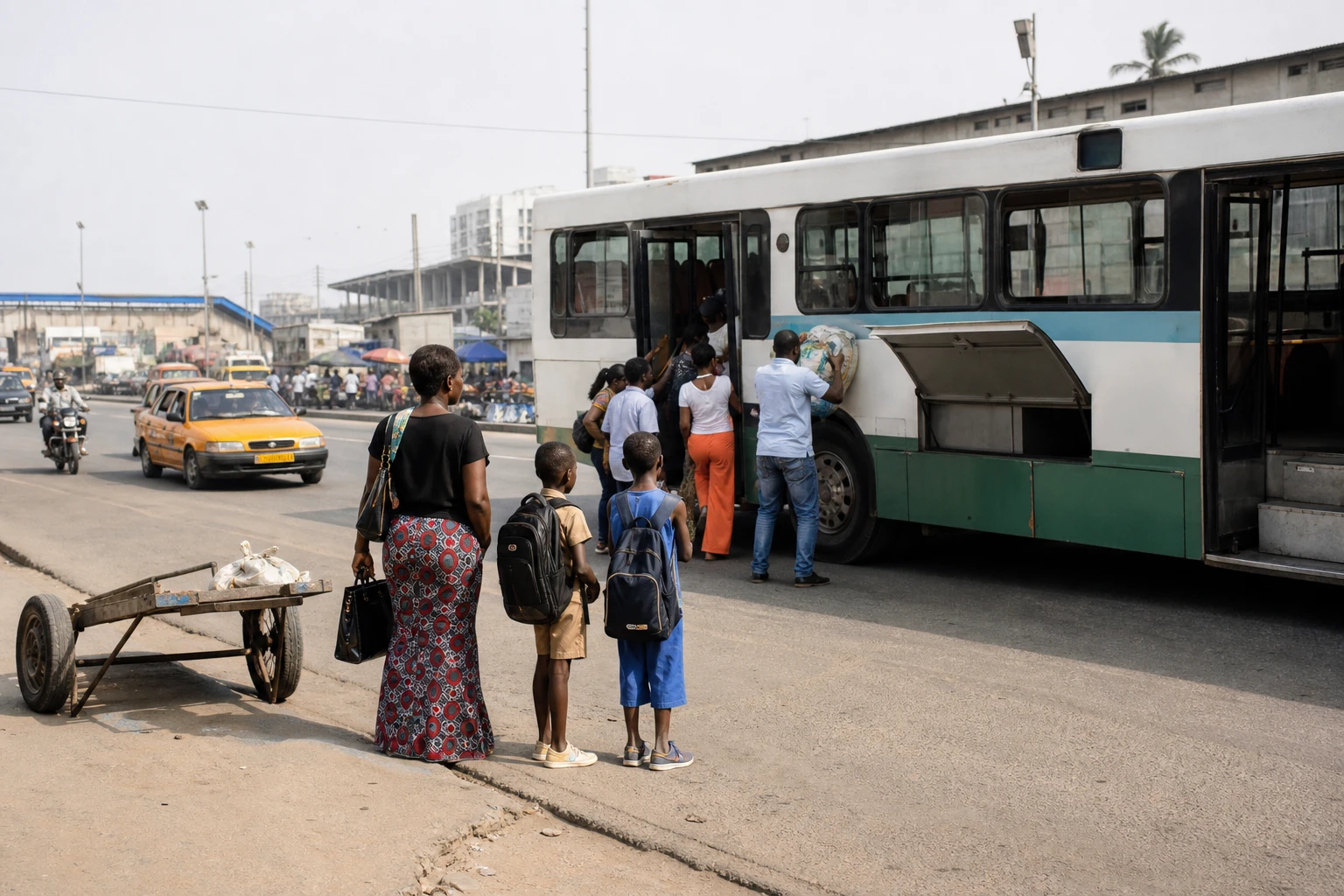
In Port-Bouët, south of Abidjan, the disappearance of the Zimbabwe neighbourhood has involved more than the destruction of homes. It has also displaced businesses, interrupted children’s education and increased the expenses of families who had sometimes lived without paying rent for decades.
On 2 June 2026, the services of the Autonomous District of Abidjan began demolishing Vridi 3, an area commonly known as Zimbabwe. The operation cleared a site near the Autonomous Port of Abidjan. Several residents say, however, that they are still waiting for a lasting rehousing or support solution.
An operation part of Abidjan’s reorganisation
The Autonomous District of Abidjan presents these operations as a response to what it considers irregular occupation, insanitary conditions and risks associated with certain urban sites. In a formal notice sent to residents in July 2024, its services had already described Zimbabwe as an area that failed to meet urban planning standards and, in their view, posed a danger to residents.
The neighbourhood was finally demolished nearly two years later. Machinery began razing homes in the early hours of 2 June 2026, while families were still trying to retrieve their belongings. The Ivorian News Agency confirmed the location, date and intervention by District services.
This sequence is part of a broader policy to redevelop Côte d’Ivoire’s largest city. Since 2024, several neighbourhoods in Abidjan have been affected by clearance operations. The French term “déguerpissement” refers to the evacuation of people from a site, followed or not by the demolition of buildings.
In Port-Bouët, the Abattoir neighbourhood had already been demolished in June 2024. Other operations have affected areas of Yopougon and Attécoubé, as well as the vicinity of the airport. The authorities highlight safety, sanitation and control of urban occupation. Residents, for their part, are calling for these aims to be accompanied by practical solutions.
Families pushed to the outskirts
For people evicted, the main difficulties begin after they leave. In Zimbabwe, some households say they had to move to Anyama or other outlying communes, sometimes more than an hour’s journey from where they used to live.
The change first affects household budgets. Families who lived in a family home, a room adjoining a business or a small premises now have to pay rent. Transport, water and electricity bills, and school costs add to the expense.
The move also affects economic activity. In this area near the port and major routes, residents worked in trade, fishing, transport, catering and small services. By leaving the neighbourhood, they lose some of their customers and professional networks.
Households unable to rent turn to relatives. This avoids the streets, but creates another strain. Several families have to share a small space, sometimes in conditions that make daily life and living together difficult.
The collective representing people evicted also says that some children have stopped going to school. Moving to another commune, transport costs and a lack of places at a new school can interrupt their education. The impact is particularly severe for single-parent families, older people and workers in the informal economy.
Promised housing still awaited
The Ivorian government has announced the construction of 12,000 affordable rental homes at two sites, in Songon and along the Northern Motorway. The announcement is intended to benefit people affected by several clearance operations in Abidjan.
The measure offers a prospect, but does not immediately address urgent needs. Between the announcement of a housing programme and the handover of keys, households still have to find somewhere to live, work and send their children to school. The construction timetable, eligibility criteria and actual rent levels will therefore be crucial.
The government has also launched one-off social support initiatives. On 23 June 2026, the Ministry of National Cohesion, Solidarity and the Fight Against Poverty distributed food and essential goods to families affected in several Port-Bouët neighbourhoods, including Vridi 3, the site corresponding to Zimbabwe.
This aid addresses an immediate need, but does not replace a rehousing scheme. Residents are calling in particular for a transparent census, compensation where legal conditions are met, and support tailored to tenants, property owners, shopkeepers and workers without formal land title.
A test of approach for the economic capital
The debate extends beyond Zimbabwe. Abidjan faces strong land and population pressures. Neighbourhoods close to the port, airport, major roads and industrial areas are particularly sought-after. They bring together jobs, strategic infrastructure and housing built up over time.
For the authorities, keeping these areas safe and improving sanitation is a legitimate priority. For residents, the question is who benefits from urban transformation and who bears its cost. A modernised city cannot be judged solely by its roads, buildings or cleared spaces. It must also be assessed by the ability of displaced households to rebuild their lives.
Port-Bouët’s experience also shows the limits of a response based exclusively on demolition. Without sufficiently clear prior information, a mechanism for appeals and an available solution before people leave, a safety operation can become a social crisis for the families concerned.
An issue under regional scrutiny
Côte d’Ivoire remains one of West Africa’s economic hubs and a central member of the Economic Community of West African States, ECOWAS. The choices made in Abidjan are therefore of interest to other cities facing urban growth, pressure on land and the expansion of informal housing.
The next test will be delivering the promised housing and the public authorities’ ability to provide tailored support. Property owners, tenants, shopkeepers and people staying with others have different needs. Likewise, a household living near its workplace cannot be treated in the same way as a family that has already left the area where it earns a living.
In Yamoussoukro as in Abidjan, the question is now clear: how can a better-organised city be built without permanently pushing away the people who keep it running? The answer will depend less on announcements than on concrete follow-up for families displaced after the demolition of Zimbabwe.