Algeria
 Egypt
 Libya
 Morocco
 Sudan
 Tunisia
 Benin
 Burkina Faso
 Cabo Verde
 Côte d'Ivoire
 Ghana
 Guinea
 Guinea-Bissau
 Liberia
 Mali
 Mauritania
 Niger
 Senegal
 Sierra Leone
 The Gambia
 Togo
 Cameroon
 Central African Republic
 Chad
 DR Congo
 Equatorial Guinea
 Gabon
 Republic of the Congo
 São Tomé and Príncipe
 Burundi
 Comoros
 Djibouti
 Eritrea
 Ethiopia
 Kenya
 Madagascar
 Malawi
 Mauritius
 Mozambique
 Rwanda
 Seychelles
 Somalia
 South Sudan
 Tanzania
 Uganda
 Angola
 Botswana
 Eswatini
 Lesotho
 Namibia
 South Africa
 Zambia
 Zimbabwe
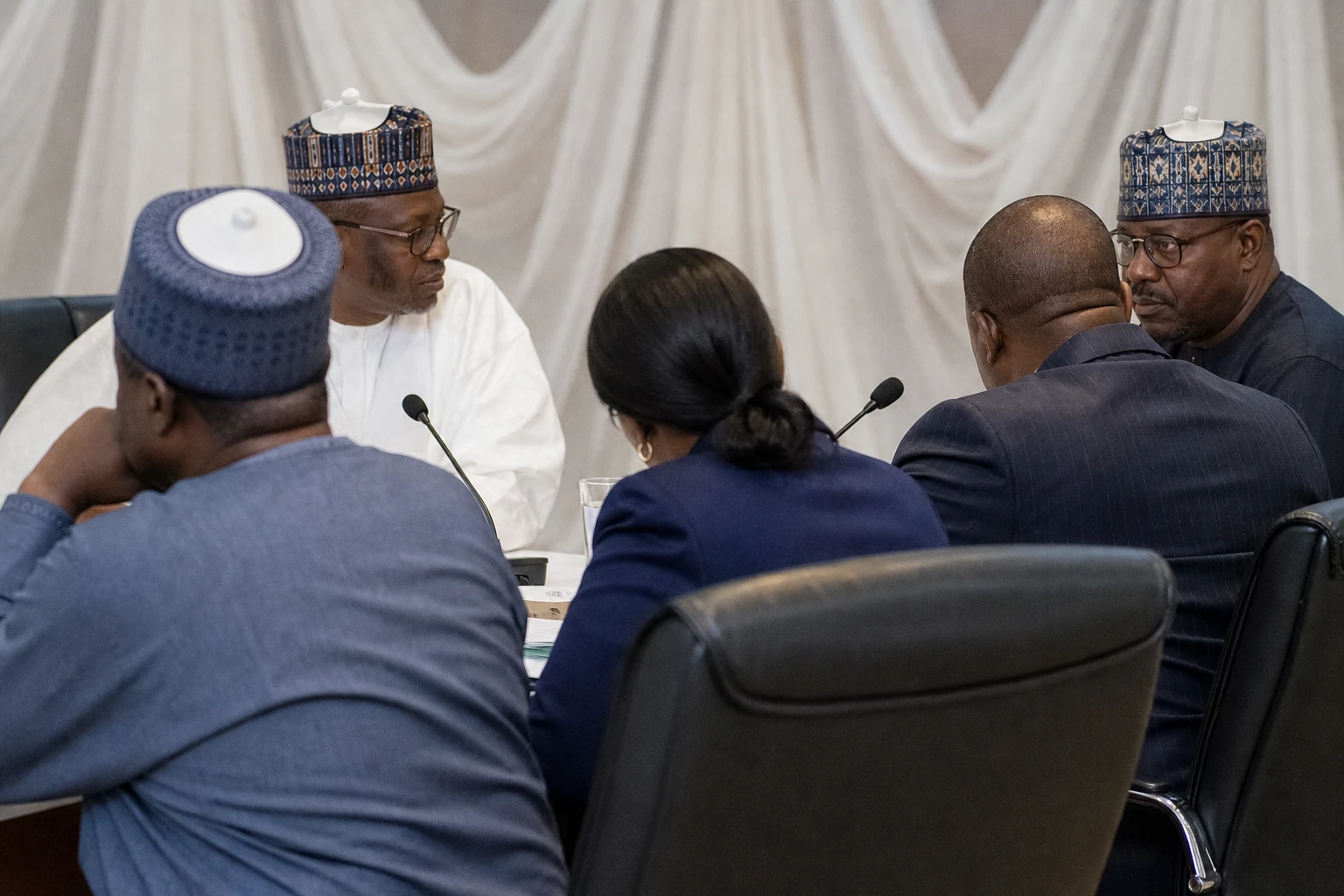
A roadblock, a clear political message
In Benue, a simple humanitarian visit was enough to recall a much broader reality: in Nigeria, political competition is also played out in the security of people and access to territory. When an opposition figure wants to visit displaced families, the issue is no longer just a visit. It becomes a test of freedom of movement, local authority and democratic maturity.
Nigeria is already entering the run-up to the 2027 presidential and legislative elections. The Independent National Electoral Commission, based in Abuja, has published the timetable for the cycle, with presidential and legislative voting scheduled for 16 January 2027, followed by governorship and state assembly elections on 6 February 2027. In a country marked by recurring pre-election tensions, every incident on the ground becomes a political signal.
Benue, a state under security pressure
The incident took place on Tuesday 8 September 2026, in Benue State, in central Nigeria. Peter Obi, an opposition candidate and former governor of Anambra, had travelled there to meet families displaced by the violence that has affected this farming region for years. His convoy was stopped on the road to Yelwata, in the Guma area, by young people who blocked access for several hours. Police, according to several Nigerian media outlets, later had to deploy officers to escort him and secure his departure.
The Benue government denied any involvement and said it had not been informed of the visit in advance. Peter Obi’s team, for its part, denounced what it called a coordinated obstruction. Local authorities stressed that the issue was one of protocol and security, while the opposition camp described it as political intimidation. At this stage, responsibility remains disputed. What is established, however, is that the convoy was blocked and that the visit created tension.
Yelwata, the recent memory of a tragedy
The destination was not an arbitrary choice. In 2025, Yelwata became one of the symbols of the deadly violence affecting Benue. In June 2025, an armed attack there caused heavy casualties. The National Emergency Management Agency put the number of displaced people at 6,527, while the Associated Press, citing survivors and local officials, reported at least 150 deaths. Other sources later spoke of more than 200 victims. The exact figure varied between reports, but the scale of the tragedy was never in doubt.
This variation in casualty figures illustrates a familiar problem in Nigeria: in areas hit by armed attacks, initial reports are often incomplete and are then refined as information is cross-checked. In Yelwata, the shock led to a further influx of internally displaced people and increased the vulnerability of rural communities already exposed to clashes between herders and farmers, competition for land and insecurity on road routes. The UN and its agencies have described Benue as one of the states most affected by internal displacement in the country.
What the episode reveals about the 2027 campaign
Politically, the affair goes beyond Peter Obi himself. It raises a broader question: who controls public space in a campaign that has already begun, and under what conditions can an opposition figure travel in a state governed by a local administration from the opposing camp? The debate also concerns the relationship between civil institutions, security and governance. The fact that police had to escort the convoy out shows that security forces are already being called upon to manage scenes of political competition.
Governor Hyacinth Alia, a member of the ruling All Progressives Congress, rejected the accusations against his administration. His camp emphasised the need for advance notice to organise security arrangements. Obi’s camp, meanwhile, sees the incident as a warning about how the opposition may be treated as 2027 approaches. In both cases, the episode illustrates a familiar tension in Nigeria: the often blurred line between public order, party loyalty and the political use of local government.
For Benue’s residents, the stakes are less symbolic. They are concrete. In urban centres, the incident has reignited debate about civil liberties. In rural areas, it is above all a reminder that security remains precarious on several road corridors, just as displaced people await protection, aid and a lasting return home. The families affected by the violence of 2025 do not need another political standoff over their plight. They need safe access to aid, roads and a credible state presence.
A warning for Nigeria, and for West Africa
At regional level, the issue matters to all of West Africa. Nigeria is not only the region’s most populous country; it is also one of the main political and economic centres within ECOWAS, the Economic Community of West African States. When a candidate’s movement is blocked in a federated state, the quality of democratic competition is being watched far beyond Abuja.
What must now be monitored is not only the account given by each camp. It is the police response, the ability of Benue’s authorities to calm the situation, and the way other political figures will test—or not—their access to sensitive areas ahead of 2027. In a country where campaigning begins well before the official timetable, Benue is already serving as a barometer of electoral security, freedom of movement and the balance of power between local government and the opposition.