
 Algeria
 Egypt
 Libya
 Morocco
 Sudan
 Tunisia
 Benin
 Burkina Faso
 Cabo Verde
 Côte d'Ivoire
 Ghana
 Guinea
 Guinea-Bissau
 Liberia
 Mali
 Mauritania
 Niger
 Nigeria
 Senegal
 Sierra Leone
 The Gambia
 Togo
 Cameroon
 Central African Republic
 Chad
 Equatorial Guinea
 Gabon
 Republic of the Congo
 São Tomé and Príncipe
 Burundi
 Comoros
 Djibouti
 Eritrea
 Ethiopia
 Kenya
 Madagascar
 Malawi
 Mauritius
 Mozambique
 Rwanda
 Seychelles
 Somalia
 South Sudan
 Tanzania
 Uganda
 Angola
 Botswana
 Eswatini
 Lesotho
 Namibia
 South Africa
 Zambia
 Zimbabwe
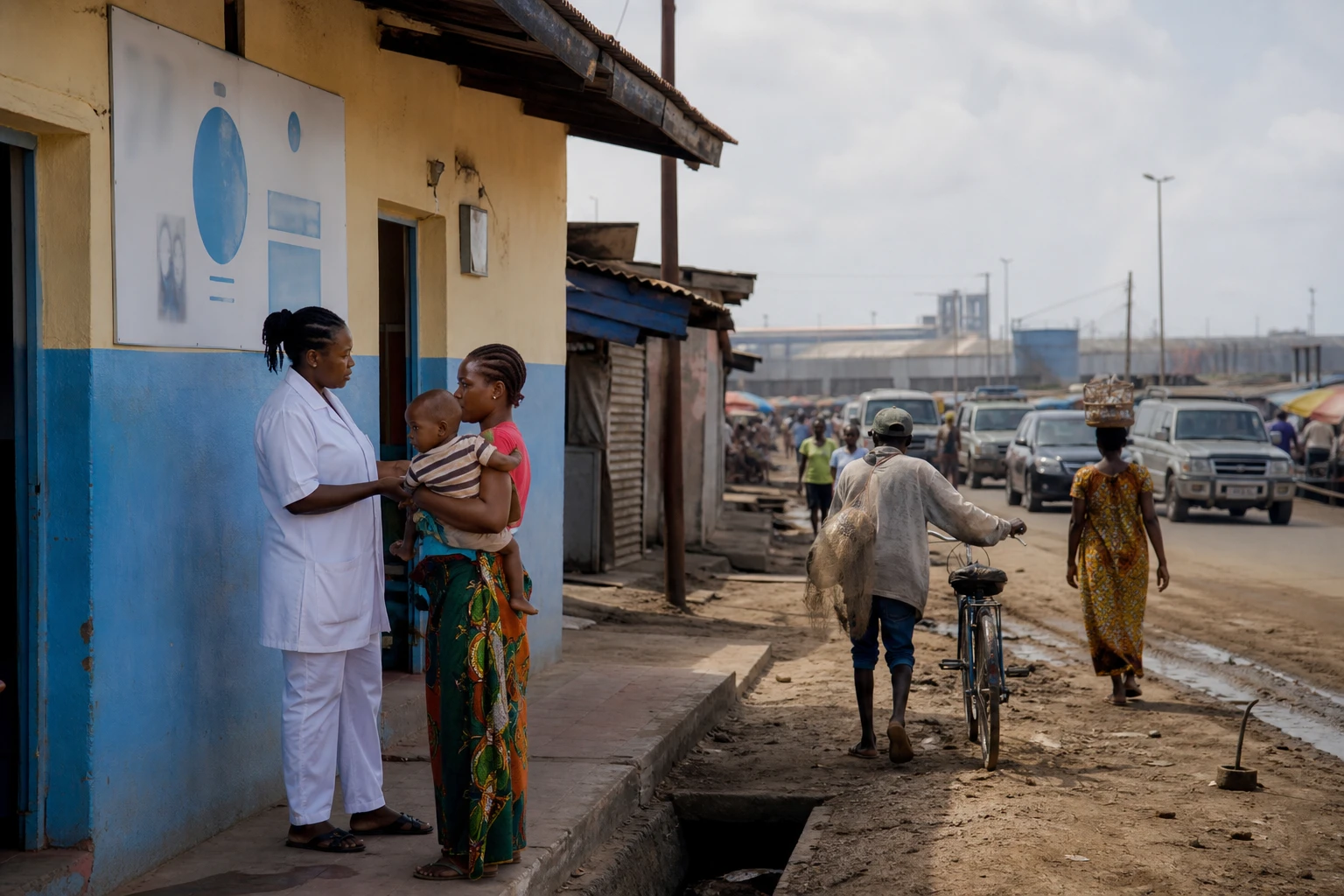
In Muanda, the issue is no longer just oil, but the cost borne by nearby residents
On the coast of Kongo Central, Muanda’s residents have lived for years with an oil economy that is about more than the barrels extracted. It also affects the air, soil and rivers, and ultimately reaches health centres. In a country where the oil industry remains concentrated in a single major company operating both offshore and onshore, environmental transparency is a public health issue as much as one of economic sovereignty.
Kongo Central occupies a strategic position for the Democratic Republic of the Congo. It is the country’s maritime outlet, with a narrow coastal strip of just 37 kilometres, and Muanda is home to most of the country’s oil facilities. In this context, the debate over pollution is not about some distant periphery. It concerns an area where villages, port activities, fishing, public services and industrial interests coexist.
What the investigation documents, and why Kinshasa is now under pressure
On 27 July 2026, Human Rights Watch published damning findings about Perenco’s activities in the Democratic Republic of the Congo. The organisation says the company’s operations expose communities in Muanda to serious health risks. It says its findings are based on interviews conducted in January 2026 with 45 people, including residents, oil workers, public officials and health and environmental specialists, as well as satellite images and geolocated videos.
According to the investigation, the practices observed include gas flaring — the open-air burning of gas associated with oil — the incineration of waste near residential areas, and spills from wells and pipelines onto soil or into waterways. HRW also says it detected flaring at five sites between January 2025 and March 2026, with some incidents less than 80 metres from homes.
The NGO does not present these findings as an isolated incident. It places them in a longer history. Independent studies have already documented significant contamination in the Muanda area, in 2013 and again in 2025, with exposure to hydrocarbons, heavy metals and other toxic compounds. An earlier investigation backed by Congolese civil society had already identified heavily polluted soil and an increase in respiratory cases around oil sites.
In the report, a local hospital official says villages near oil infrastructure experience more respiratory illnesses than areas without production. This account matters because it links the industrial footprint to visible effects in healthcare facilities, where families turn when symptoms are no longer abstract. HRW also reports chest pain, nausea and irritation associated with fumes from the burning of waste near a treatment site.
The demand addressed to the Congolese state is clear: publish without delay the preliminary findings of the environmental audit commissioned in December 2024, and release air, soil and water monitoring data. HRW says it wrote to the government in May 2026 but received no response. This lack of information is at the heart of the case. It fuels local distrust and makes it impossible to know whether remedial measures exist, whether they are being implemented and whether they are sufficient.
An environmental case, but also a test of governance for DR Congo
The issue goes beyond the company in question. In Kinshasa, the government has already acknowledged that an audit of Perenco is under way. The Ministry of Hydrocarbons has even confirmed in its own communications that an international audit firm was appointed and a task force established. The same ministry describes Perenco RDC as the country’s main oil operator, producing from onshore and offshore fields along the coast.
In other words, the question is not just whether a company is polluting. It is also whether the state monitors, measures, publishes and imposes sanctions. In such a sensitive sector, the absence of a public timetable for the audit, or of accessible interim findings, undermines the credibility of the regulatory system. It leaves communities in uncertainty even as they live in direct proximity to the facilities.
The case also highlights a familiar tension in producer countries: the promise of revenue and jobs on one side, the environmental and health burden on the other. In Muanda, the benefits of extractive activity remain difficult for ordinary households to measure, while the risks are visible and immediate. Fishermen, families living near the sites and health centres are on the front line. In the city, the state can talk about standards. In the villages, people first breathe what comes out of the flares.
The issue also resonates across Kongo Central, where provincial lawmakers had already called in 2025 for monitoring sensors to be installed at sites at risk of pollution and for the companies concerned to submit data monthly. This demand shows that local civil society and some political leaders are seeking not so much to comment as to measure. That is an important step. Without public data, the debate remains stuck between accusation and denial.
What the case says about Central Africa, and what to watch next
In the region, this kind of controversy is part of a broader shift: producer states are increasingly being pressed to prove that resource extraction does not come at the expense of their populations. In Central Africa, this demand also weighs on companies, technical ministries and provincial authorities. It is all the more pressing as the global energy transition puts hydrocarbons under pressure, while producer countries continue to seek secure revenues.
For DR Congo, the next focus is therefore institutional. It concerns the publication of the audit, the release of environmental data and the ability of state agencies to require corrective action. If breaches are confirmed, the case could set a precedent for other extractive sites in the country. If they are not, the findings will still need to be clearly explained to Muanda’s residents, who already live with the consequences of an industry whose effects do not stop at the boundaries of its concessions.



