Algeria
 Egypt
 Libya
 Morocco
 Sudan
 Tunisia
 Benin
 Burkina Faso
 Cabo Verde
 Côte d'Ivoire
 Ghana
 Guinea
 Guinea-Bissau
 Liberia
 Mali
 Mauritania
 Niger
 Nigeria
 Sierra Leone
 The Gambia
 Togo
 Cameroon
 Central African Republic
 Chad
 DR Congo
 Equatorial Guinea
 Gabon
 Republic of the Congo
 São Tomé and Príncipe
 Burundi
 Comoros
 Djibouti
 Eritrea
 Ethiopia
 Kenya
 Madagascar
 Malawi
 Mauritius
 Mozambique
 Rwanda
 Seychelles
 Somalia
 South Sudan
 Tanzania
 Uganda
 Angola
 Botswana
 Eswatini
 Lesotho
 Namibia
 South Africa
 Zambia
 Zimbabwe
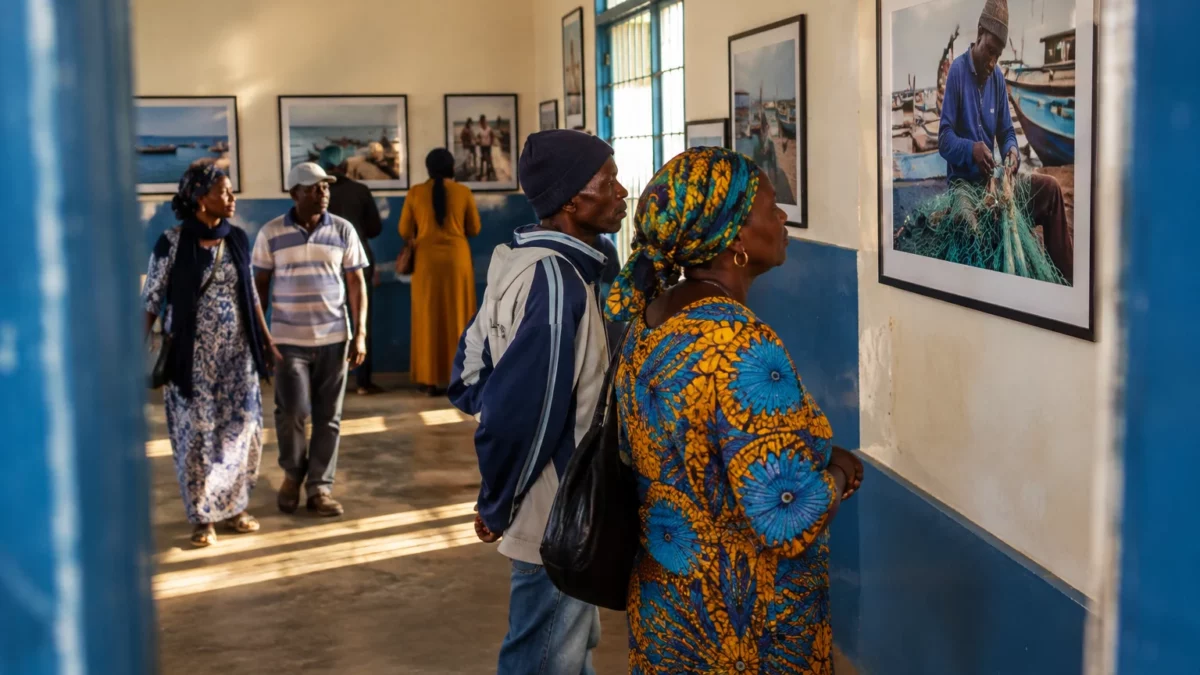
In Ouakam, art does not ask residents to cross the doors of a museum. It sets up near the pirogues, in the Maison des pêcheurs, and tells the story of a daily life the neighbourhood knows from the inside: fishing practices, faces on the quay, but also the dangers of the sea.
The exhibition is part of the 16th Dakar Biennale, held from 19 November to 19 December 2026 under the theme “(Anti)fragility”. While the official programme is concentrated in the capital, the “Off” brings independent initiatives to different venues and neighbourhoods. In Ouakam, photography thus becomes a meeting place for artists and the coastal community.
In Ouakam, fishing practices become images
The Maison des pêcheurs stands between the Grande Mosquée de la Divinité and the quay. It is a familiar place, frequented by neighbourhood residents. The photographs show fishers at sea, life on the quay and practices often passed down from generation to generation, such as the hand-mending of nets.
Mbaye Fall, an oceanographic research investigator responsible for recording catches, recognises in the images a world he also observes in his work. He pauses in particular before a portrait of a man he knows, mending a net. For him, the exhibition makes residents’ skills and talent visible.
The project brings together fisher Mamadou Sall, who curates it, and photographers Pascal Villeneuve and Larissa Rolley. Sall also exhibits his own photographs. Born in Ouakam, he sums up his attachment to the place in these words: “I was born here, with my feet in the sand and my eyes on the sea.”
For Rolley, showing the works in a neighbourhood space reduces the distance between the art and its audience. A gallery with codes that can sometimes feel intimidating gives way here to a simple experience: looking, appreciating or moving on. This approach aligns with the ambition of the “Off”, which brings art beyond institutional spaces alone.
Fragility can also be seen in the sea
The images do not dwell solely on the beauty of these practices. Some evoke the wrecks of pirogues travelling the route to the Canary Islands, rocks that are difficult to spot and bodies recovered from the water. The exhibition thus gives space to a painful subject without reducing Ouakam to migration.
Mamadou Sall says he raises awareness among young people around him about the risks of these crossings. He says no pirogue has left Ouakam for Spain, a result he attributes to work he first undertook among those close to him. His warning is summed up in one sentence: “Spain is not paradise.” This testimony reflects local experience; on its own, it is not enough to measure departures from the neighbourhood or the scale of the phenomenon nationally.
The data must indeed be read precisely. In 2024, Spanish authorities recorded nearly 47,000 arrivals in the Canary Islands by sea, across all nationalities, according to figures reported by the Associated Press. That total does not correspond to the number of people who left Senegal. Senegalese and Spanish statistics do not necessarily measure the same populations or the same stages of the journey.
Fishing, too, faces pressures that extend beyond the neighbourhood: the state of resources, household incomes, access to work and the prospects available to young people. The exhibition offers no assessment of these issues. Instead, it sets daily work on the coast alongside the risks that some residents associate with a lack of prospects. This distinction matters: documenting departures does not mean normalising them or presenting migration as the only horizon for Senegalese youth.
A biennale taking root in the city
The theme of this edition, “(Anti)fragility: arts of repair and strategies of resilience”, invites reflection on ways of facing shocks and building connections. In Ouakam, this idea takes concrete form: residents are not merely the subject of the photographs. The venue, local knowledge and a fisher’s involvement in curating the project all help shape it.
The Dakar Biennale is an important event for African art scenes and their diasporas. Its official programme and independent exhibitions do not play the same role, but their coexistence broadens the places where art can be seen. The presence of initiatives in neighbourhoods also raises a practical question: how can exchanges be sustained and cultural spaces supported beyond the biennale period?
Across West Africa, the subject resonates along a coastline where fishing, the movement of people and regional mobility extend beyond national borders. Senegal is a member of ECOWAS, the Economic Community of West African States, which organises some aspects of regional cooperation. But the photography on show in Ouakam begins with a specific place and its residents: it reminds us that major debates about art, the sea and departures also take shape in the everyday practices of a Dakar neighbourhood.
The exhibition “Bienvenue à Ouakam”, by Mamadou Sall, Pascal Villeneuve and Larissa Rolley, is scheduled to run at the Maison des pêcheurs until 19 December as part of the Biennale. Its interest lies as much in the images as in the place where they are shown: here, the audience does not have to identify with a distant story. It can find faces, practices and questions already present in daily life.