Algeria
 Egypt
 Libya
 Morocco
 Sudan
 Tunisia
 Benin
 Burkina Faso
 Cabo Verde
 Côte d'Ivoire
 Ghana
 Guinea
 Liberia
 Mali
 Mauritania
 Niger
 Nigeria
 Senegal
 Sierra Leone
 The Gambia
 Togo
 Cameroon
 Central African Republic
 Chad
 DR Congo
 Equatorial Guinea
 Gabon
 Republic of the Congo
 São Tomé and Príncipe
 Burundi
 Comoros
 Djibouti
 Eritrea
 Ethiopia
 Kenya
 Madagascar
 Malawi
 Mauritius
 Mozambique
 Rwanda
 Seychelles
 Somalia
 South Sudan
 Tanzania
 Uganda
 Angola
 Botswana
 Eswatini
 Lesotho
 Namibia
 South Africa
 Zambia
 Zimbabwe
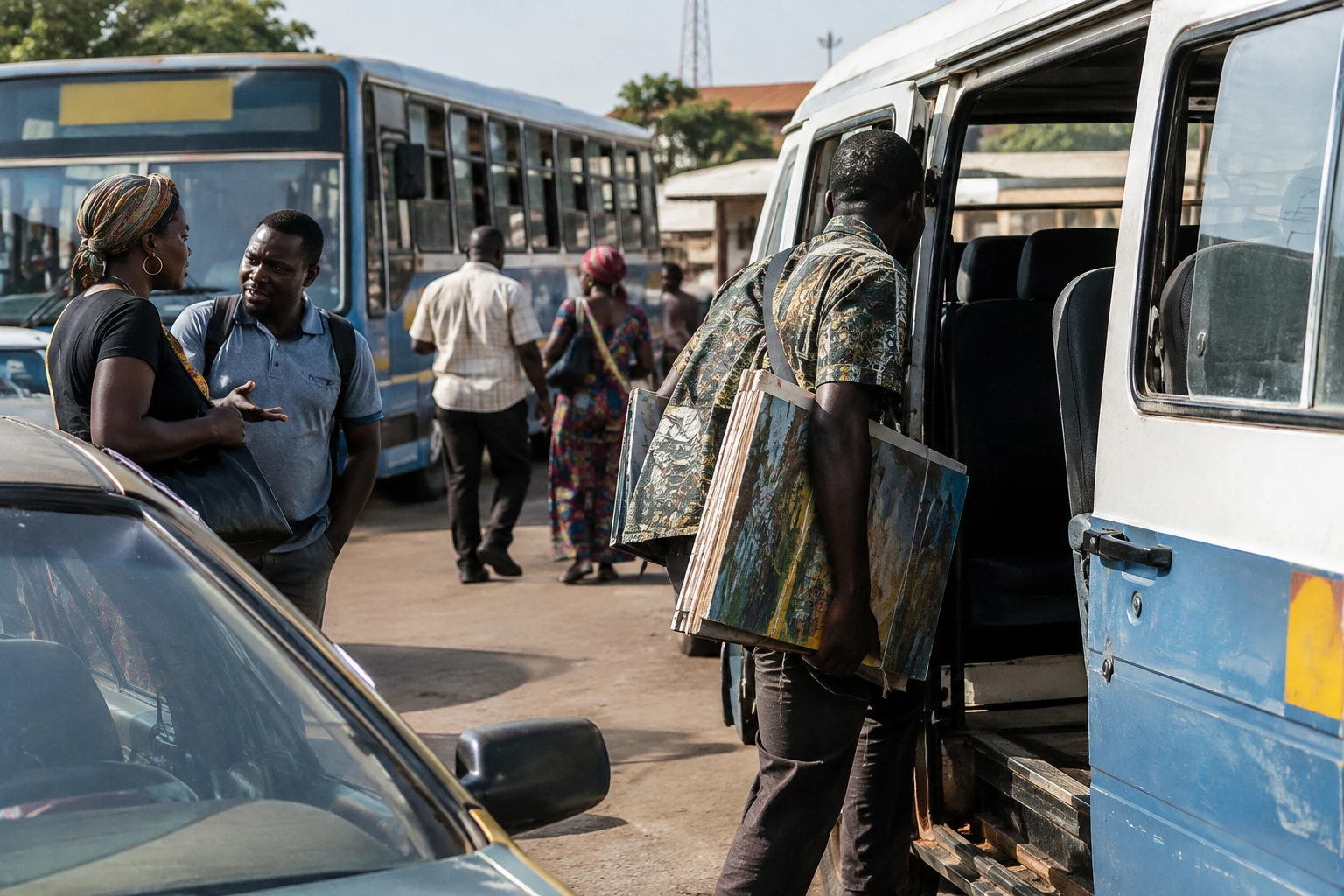
Can we talk about divisions in the world without turning away from those in our own country? Bissau-Guinean artist Nú Barreto makes this question a guiding thread. His work links political fractures, collective memory and the possibility of continuing to live together.
From flags to political fractures
Born in São Domingos, Guinea-Bissau, Nú Barreto has spent several decades developing a body of work in painting, drawing and collage. His often fragmented figures evoke social and political tensions. They do not merely depict crises: they examine the mechanisms that set individuals and societies against one another.
At the 2025 edition of the AKAA fair in Paris, the artist presented a diptych on divisions in the United States and the resurgence of imperialist logic. The American flag appears upside down and without its stars. This visual choice shifts a symbol of power. It invites viewers to look differently at power relations and their effects.
“I am an artist who does not belong simply to the African continent, but also an artist who engages with the world,” he says. This ambition does not erase his roots in Guinea-Bissau. On the contrary, it starts from a specific experience to address questions that affect several societies.
The diptych places two images side by side. It can reveal opposition, but also a relationship between the elements. For Barreto, this form accompanies a recurring question: how can we acknowledge divisions without seeing them as irreversible?
Work that also looks at Guinea-Bissau
This question has already taken a distinctly African form in the series “The Disunited States of Africa”. In it, the artist challenges the continent’s leaders over their exercise of power and the divisions they can perpetuate. The title reworks a familiar phrase, but the issue is concrete: what happens to collective bonds when institutions and political leaders weaken them?
This perspective resonates in Guinea-Bissau, a West African country whose political life has seen repeated institutional tensions. In 2025, disagreements over the electoral timetable and divisions among political actors preceded the general election on 23 November. The African Union’s observation mission noted a lack of consensus on how the process was organised, despite political participation in the election.
Three days after the vote, on 26 November 2025, military officers announced that they had taken control of the country and suspended the institutions and electoral process. The African Union and ECOWAS condemned the unconstitutional change of power. This context is a reminder that national cohesion is more than a symbol: it also depends on trust in institutions, common rules and the ability of citizens to make their voices heard.
ECOWAS, a West African regional organisation tasked in particular with promoting co-operation and stability among its member states, closely monitors political crises in the region. For people in Guinea-Bissau, these tensions are experienced differently depending on where they live and what they do: national decisions affect daily life in Bissau and the regions, as well as political actors, artists, associations and businesses.
Creating spaces for art in Bissau
Barreto’s thinking extends beyond his paintings. He is also involved in developing the culture of his country of origin. In 2025, the first Guinea-Bissau Biennale of Art and Culture, MoAC Biss, organised activities at several venues in Bissau. The artist curated the fine and visual arts programme.
The biennale brought together exhibitions, music, literature, cinema, performing arts and debates. Its programme featured Bissau-Guinean creators and participants from other countries. Its stated aim was to support contemporary creativity and foster exchanges. The event thus offered a meeting place in the capital, beyond the usual circuits of foreign fairs and galleries.
This initiative matters because an art scene is not built solely through international recognition for a handful of artists. It also needs places where the public can discover works, young creators can present their work and professionals can forge collaborations. A biennale cannot by itself solve the difficulties facing a cultural sector. It can, however, help make these activities visible and create opportunities for passing on knowledge.
MoAC Biss therefore goes beyond the programme of a single event. It raises questions of resources and continuity: how can spaces for creativity, training and dialogue be established over the long term? The answer will depend, in particular, on the ability of cultural actors and their partners to maintain these connections after the first edition.
Connecting art scenes without reducing Africa to a single voice
Nú Barreto’s presence at AKAA illustrates another aspect of this journey: the movement of artworks between the continent and international art scenes. This visibility can open up opportunities for wider circulation. It cannot, however, replace the building of an audience and artistic infrastructure in Guinea-Bissau.
His work also rejects the idea that an African artist should speak only about their country or an assigned identity. By addressing the United States, imperialism and African divisions, Barreto claims a place in global debates without erasing his origins. This stance is a reminder that artists from the continent are not merely witnesses to local realities: they interpret them and engage with other experiences.
At 60, the artist emphasises passing on knowledge and his faith in humanity’s ability to “remake the world in the right way”. The phrase expresses hope, but also a responsibility: to name fractures, question power and create spaces where discussion remains possible. In Guinea-Bissau, the future of the biennale and the continuation of cultural activities in Bissau will be concrete markers of whether this ambition can endure.