Algeria
 Egypt
 Libya
 Morocco
 Sudan
 Tunisia
 Benin
 Burkina Faso
 Cabo Verde
 Ghana
 Guinea
 Guinea-Bissau
 Liberia
 Mali
 Mauritania
 Niger
 Nigeria
 Senegal
 Sierra Leone
 The Gambia
 Togo
 Cameroon
 Central African Republic
 Chad
 DR Congo
 Equatorial Guinea
 Gabon
 Republic of the Congo
 São Tomé and Príncipe
 Burundi
 Comoros
 Djibouti
 Eritrea
 Ethiopia
 Kenya
 Madagascar
 Malawi
 Mauritius
 Mozambique
 Rwanda
 Seychelles
 Somalia
 South Sudan
 Tanzania
 Uganda
 Angola
 Botswana
 Eswatini
 Lesotho
 Namibia
 South Africa
 Zambia
 Zimbabwe
In Côte d’Ivoire, youth employment is no longer decided only in ministerial offices
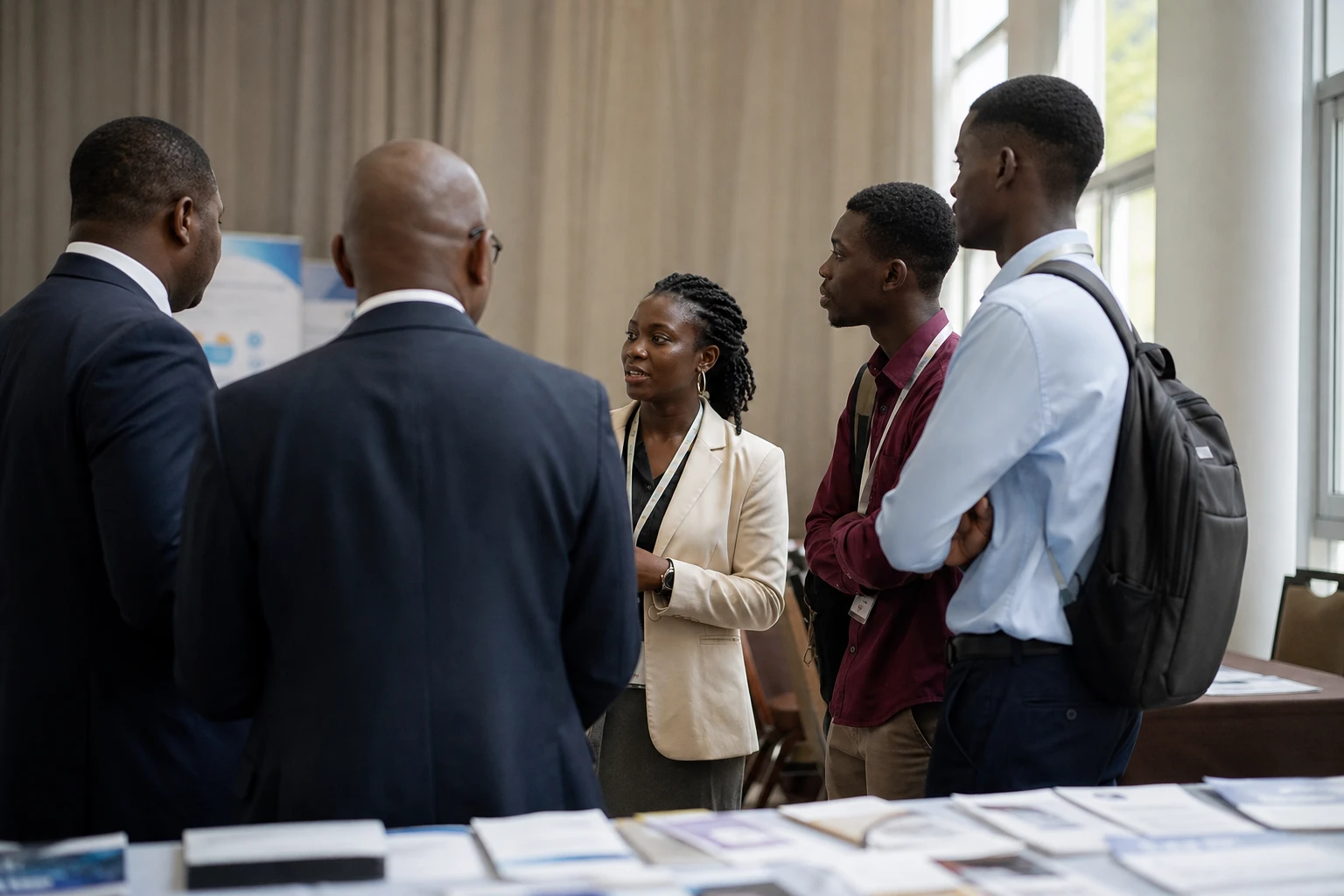
Career, internship and guidance fairs are multiplying in Abidjan because one question remains open: how can thousands of graduates be connected with companies that are actually hiring? In the country, access to employment has become a central issue, championed by the state, local authorities and private companies alike. NSIA Banque Côte d’Ivoire is part of this movement, with a clear message: employability is not limited to a degree; it is also built through experience, networks and an understanding of professional life.
This approach comes amid stronger measures by the Ivorian authorities in support of young people. The Government Youth Programme 2023-2025 and the various job fairs held in Abidjan aim to speed up access to internships, training and first contracts. The government has even said that the National Employment and Recruitment Fair in July 2025 brought together 62,052 opportunities for young people. At the same time, the ministry responsible for entrepreneurship says its mission is to promote SMEs, develop an entrepreneurial culture and support self-employment, particularly among young people.
The bank has chosen two complementary areas: talent and SMEs
NSIA Banque Côte d’Ivoire took part in the Internship and Employment Forum on 21 August 2025, followed by the Cocody Careers Fair on 4 and 5 September 2025. At these events, the bank presented its professions, spoke with students, young graduates and project founders, and highlighted pathways between education and the world of work. One of its executives led a discussion on professional integrity, stressing that reputation and ethics matter as much as technical skills in a banking career.
The second area is more economic and more structural. At the Cocody Careers Fair, the bank put forward a pragmatic view of Ivorian SMEs: they create value, but need financing, advice and stronger structures to last. This approach extends a strategy already evident on NSIA Banque CI’s institutional pages, with initiatives such as SME Pitch Day, which allows companies to present their projects to a panel in order to receive support in securing suitable financing. The bank has also highlighted targeted support for women’s entrepreneurship through dedicated partnerships.
A useful signal in an economy where SMEs remain under pressure
The issue goes beyond corporate communications. In Abidjan, SMEs are a fragile but crucial link in the formal economy. They support urban employment and services, account for part of commerce and drive a significant share of local innovation. Yet the Council of Ministers on 9 April 2025 reported a fall in the share of the value of public contracts awarded to SMEs, from 45.4% at the end of December 2023 to 34.9% at the end of December 2024. This decline shows that access to markets is just as important as access to credit.
In this context, NSIA Banque CI’s approach responds to a very practical reality. For young people, the challenge is to gain access to clearer recruitment channels without relying solely on personal connections. For SMEs, several steps must be taken at once: formalisation, governance, accounting, cash-flow management and then financing. The bank cannot solve these obstacles alone, but it is addressing an often-neglected area: non-financial support. This is where banking expertise can have a lasting impact, especially when businesses are seeking to move from an informal project to a viable organisation.
An Ivorian perspective, with a West African dimension
This series of events says something broader about Côte d’Ivoire and West Africa. On one hand, states continue to lead efforts on youth employment through public programmes, work placements and recruitment fairs. On the other, banks and companies are seeking to attract talent, support SMEs and build their employer brands. Across ECOWAS, where youth mobility, demographic pressures and the role of small businesses remain major issues, this kind of initiative shows that financing alone is no longer enough: there is also a need to train, guide and reassure.
For Côte d’Ivoire’s business community, the benefits are twofold. In the short term, the bank strengthens its image as a useful player in a competitive market. In the medium term, it aligns itself with a broader national need: to make the private sector a partner in helping people find work, not just a destination for jobseekers. In Yamoussoukro as in Abidjan, the message to young Ivorians is the same: the labour market is no longer limited to the state as an employer. It also depends on companies that train, recruit, finance and support people’s career paths.