Algeria
 Egypt
 Libya
 Morocco
 Sudan
 Tunisia
 Benin
 Burkina Faso
 Cabo Verde
 Côte d'Ivoire
 Ghana
 Guinea
 Guinea-Bissau
 Liberia
 Mali
 Niger
 Nigeria
 Senegal
 Sierra Leone
 The Gambia
 Togo
 Cameroon
 Central African Republic
 Chad
 DR Congo
 Equatorial Guinea
 Gabon
 Republic of the Congo
 São Tomé and Príncipe
 Burundi
 Comoros
 Djibouti
 Eritrea
 Ethiopia
 Kenya
 Madagascar
 Malawi
 Mauritius
 Mozambique
 Rwanda
 Seychelles
 Somalia
 South Sudan
 Tanzania
 Uganda
 Angola
 Botswana
 Eswatini
 Lesotho
 Namibia
 South Africa
 Zambia
 Zimbabwe
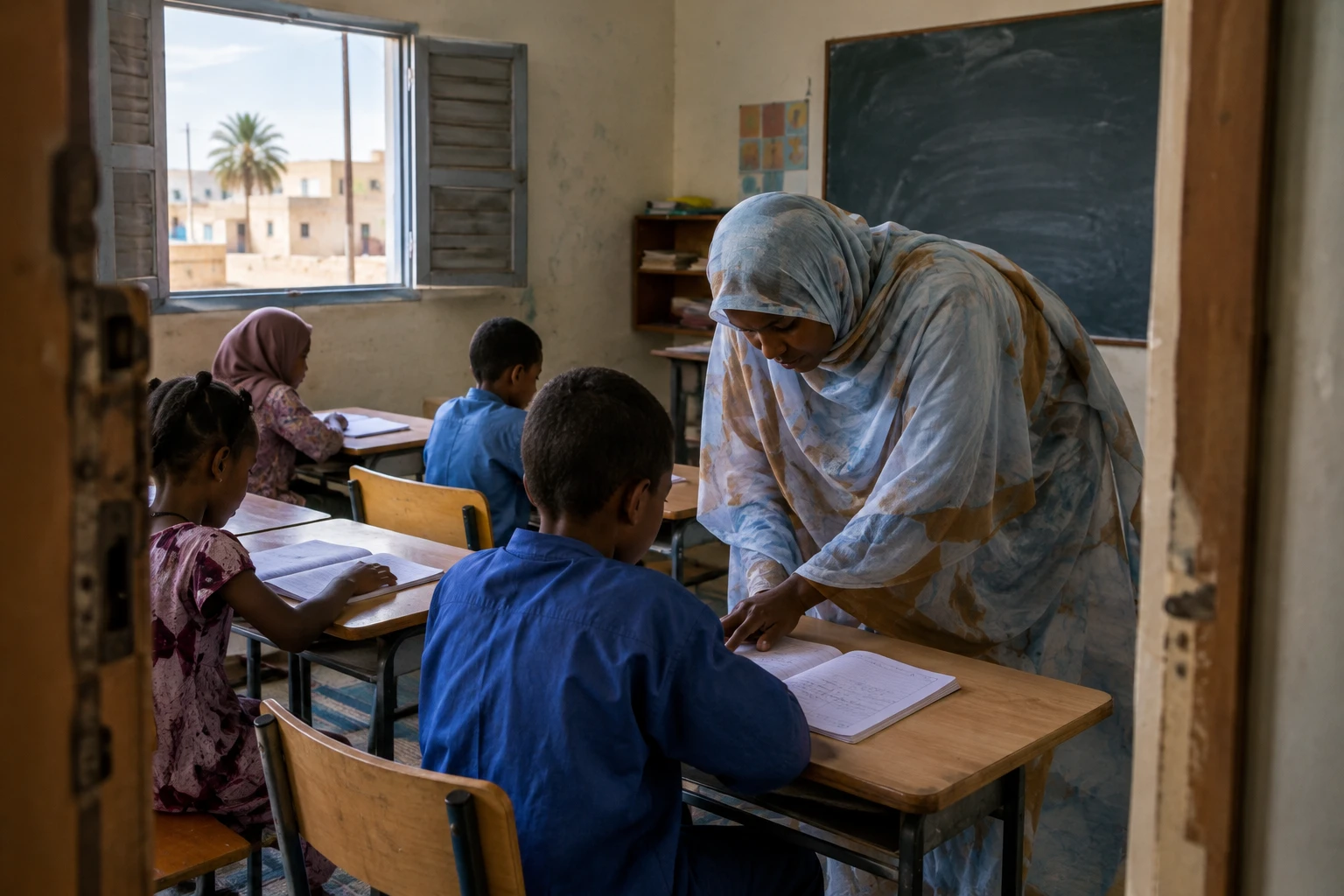
In Dar El Barka, a neighbourhood in Nouakchott, the start of the school year is not taking place only in public or private schools. Part of Abidina Doro Coulibaly’s house has become a classroom. Young people from the neighbourhood volunteer to teach children who risk being left out because there are no places or their families lack the means.
A classroom opens in the neighbourhood
A few days before the start of the 2025-2026 school year, pupils were already gathered in front of a blackboard, with desks lined up. The initiative continues throughout the school year. According to its founder, dozens of children attend classes taught by volunteers.
Abidina Doro Coulibaly chairs the Association of Young People Determined to Develop. He says he wanted to address difficulties accessing education in the neighbourhood. He welcomes, in particular, children whose families cannot afford private school, as well as those facing administrative obstacles to enrolment.
The volunteers are not a substitute for a recognised school: they provide a learning environment and support. The association also seeks to prepare pupils to continue their education, including by moving on to secondary school. However, regular classes and suitable conditions remain essential if this support is to lead to sustained schooling.
For Thierno Ali Diaw, a parent, the initiative meets a practical need. He says he sends his children there throughout the year and points out that the two schools serving the area cannot accommodate all families. His account highlights an everyday challenge: when school places are far away or full, the cost of private education falls first on lower-income households.
Figures need to be read by age group
A widely cited figure on out-of-school children in Mauritania needs clarification. An analysis of the education sector published by UNESCO’s International Institute for Educational Planning estimates that in 2019, nearly 340,000 children aged 6 to 15 were attending neither formal education nor a traditional school, representing about 30% of this age group. This is therefore not an updated count for 2025.
The breakdown reveals different situations by level: the study estimates that nearly 210,000 children aged 6 to 11 were out of any form of schooling, as were more than 130,000 young people aged 12 to 15. Meanwhile, a UNICEF budget analysis for 2025 says that more than 94% of children over the age of six are enrolled in the formal system, but notes low pre-school coverage and significant challenges at lower-secondary level. These figures do not cover exactly the same age groups or indicators, so they cannot be compared as if they described a single reality.
The challenge is not simply the number of buildings. The location and capacity of schools, class sizes and enrolment rules also matter. In Nouakchott, neighbourhood growth and the distribution of schools can leave families without a nearby option. A former education inspector cited in the available material also criticised school planning for not being sufficiently tailored to local needs.
Public education reform puts capacity to the test
Mauritania’s policy aims to strengthen public education and the so-called republican school, which seeks to bring pupils together in a common setting. At the same time, the authorities are gradually withdrawing some primary classes from the private sector. This approach pursues a goal of unification, but raises an immediate question: do public schools in every neighbourhood have enough places for the pupils concerned?
Announcements of new construction and measures to prepare for the start of the school year are not, on their own, enough to answer this question. On 6 October 2025, the Mauritanian News Agency reported that the 2025-2026 school year had begun across the country and that officials had visited several schools in Nouakchott’s three wilayas. The official start confirms that the school year has opened; it does not show that places are available to meet demand in every area.
In this context, the makeshift school in Dar El Barka provides a local service. But it cannot replace sufficient numbers of trained teachers, suitable premises or an accessible enrolment system. It also highlights inequalities in families’ resources: some can turn to private schools or arrange longer journeys; others depend on the public provision in their neighbourhood and local support.
A useful stopgap, not a structural solution
The young people’s solidarity gives children time to learn and adult support. It can also help pupils stay connected to their studies when they encounter obstacles. But volunteer teaching raises questions about continuity: the availability of volunteers, materials, monitoring of progress and recognition of pupils’ learning. These factors determine whether pupils can subsequently join a formal school.
Nationwide, Mauritania must therefore reconcile two priorities: expanding access to a shared public school system and providing enough places in neighbourhoods where the school-age population is growing. Associations and parents can flag needs, but planning classes, enrolment and resourcing are primarily the responsibility of the public authorities.
Mauritania belongs to the Arab Maghreb Union, a regional organisation bringing together five North African countries, and also takes part in West African and Sahelian dynamics. Access to education therefore extends beyond Dar El Barka: it concerns young people’s education and states’ ability to make services accessible, particularly to children without documents. For families in the neighbourhood, the immediate and more pressing issue is simpler: finding a place where their children can learn and continue their schooling.
IIEP-UNESCO’s analysis of the Mauritanian education system, UNICEF’s 2025 education budget analysis, the Mauritanian News Agency’s report on the start of the 2025-2026 school year and the list of Arab Maghreb Union member countries help put these issues in context.