Algeria
 Egypt
 Libya
 Morocco
 Sudan
 Tunisia
 Benin
 Burkina Faso
 Cabo Verde
 Côte d'Ivoire
 Ghana
 Guinea
 Guinea-Bissau
 Liberia
 Mali
 Niger
 Nigeria
 Senegal
 Sierra Leone
 The Gambia
 Togo
 Cameroon
 Central African Republic
 Chad
 DR Congo
 Equatorial Guinea
 Gabon
 Republic of the Congo
 São Tomé and Príncipe
 Burundi
 Comoros
 Djibouti
 Eritrea
 Ethiopia
 Kenya
 Madagascar
 Malawi
 Mauritius
 Mozambique
 Rwanda
 Seychelles
 Somalia
 South Sudan
 Tanzania
 Uganda
 Angola
 Botswana
 Eswatini
 Lesotho
 Namibia
 South Africa
 Zambia
 Zimbabwe
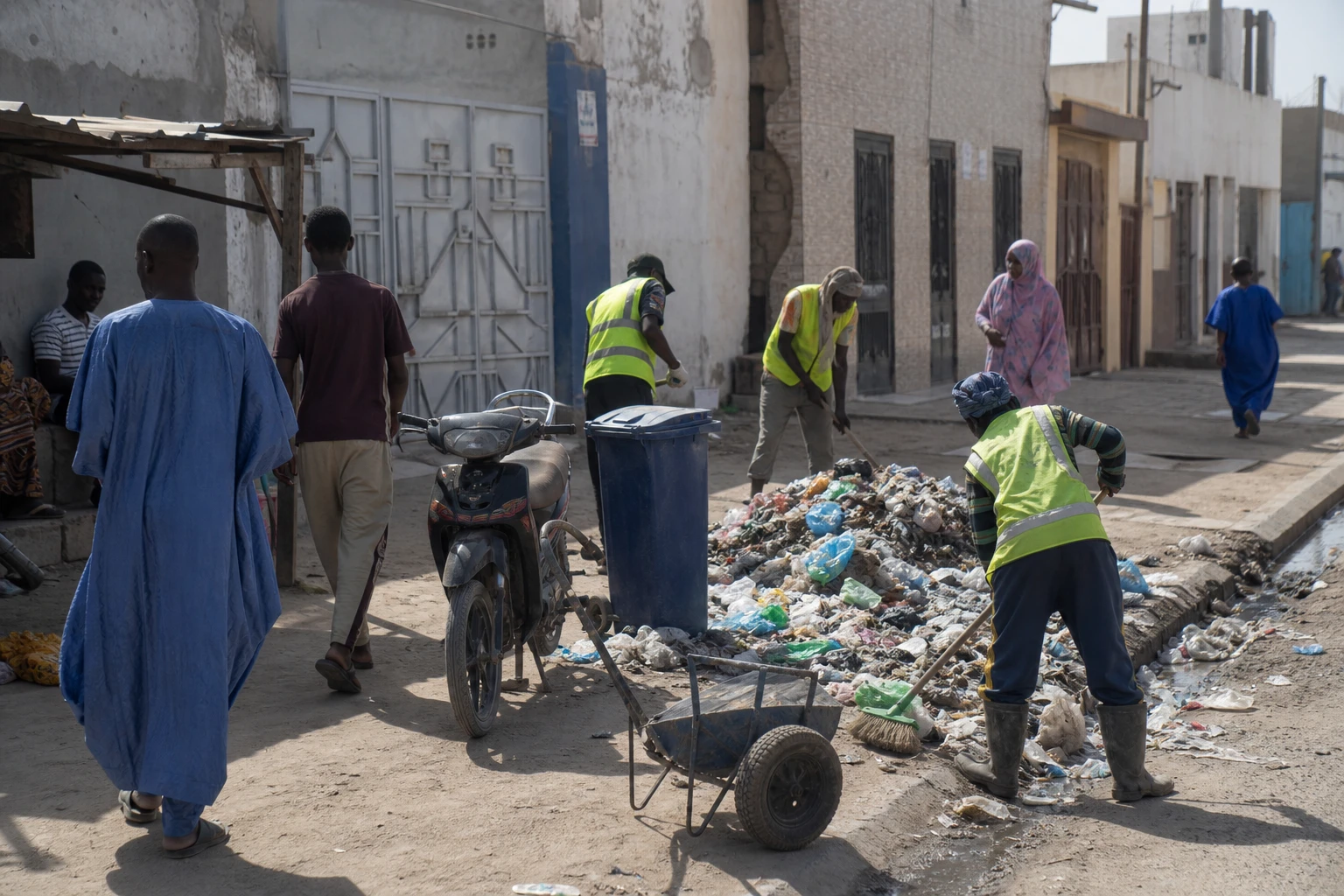
In Nouakchott, cleanliness is not a minor street-level issue. It is a test of governance.
In Mauritania’s capital, waste quickly piles up when collection slows, neighbourhoods expand and the dry season allows dust to settle everywhere. In Riyad, south of Nouakchott, residents have long described a daily life in which rubbish mixes with wastewater and illegal dumping. This reality raises a simple question: who, in practice, provides basic urban services in a rapidly growing city?
The answer lies with national and local institutions, as well as the operators responsible for work on the ground. In Mauritania, solid waste management was already covered by a law adopted in 2023, after an official study estimated Nouakchott’s annual production at 261,599 tonnes of assorted waste. Since then, the executive has stepped up cleanliness campaigns in the capital’s three wilayas, with support from Arma, the company responsible for urban cleaning.
Political order as the city overflows
On Monday 3 August 2026, Interior Minister Mohamed Ahmed Ould Mohamed Lamine convened the departments involved in cleaning Nouakchott. The message was firm: the current situation is deemed unacceptable, and an action plan must bring visible improvements to sanitation in the capital. The announcement comes as the Mauritanian authorities have already launched field operations over several months to address persistent trouble spots in Nouakchott’s three wilayas.
The issue is not new. In February 2026, a member of the government inspected progress on the urban cleanliness plan and called for shortcomings identified on the ground to be addressed. In September 2025, another campaign was launched to target the most exposed areas. These episodes point to the same conclusion: cleanliness in Nouakchott is no longer merely a matter of political visibility, but a chain of responsibilities that must be sustained over time.
On the ground, residents pay the price for interruptions or shortcomings in services. In Riyad, locals say illegal dumping attracts more rubbish, worsens nuisances and makes daily life harder. This is not just an aesthetic nuisance. In a capital where urban density is rising, every pile of refuse is also a public health, traffic and urban dignity problem.
What Nouakchott’s poor sanitation reveals
The waste issue highlights a key point: Mauritania’s capital must manage rapid urbanisation with resources that remain under strain. Nouakchott has grown through the successive expansion of neighbourhoods, often without infrastructure keeping pace with housing. In this type of city, waste collection, drainage and the removal of standing water are all part of the same challenge. When one link weakens, the entire urban ecosystem is disrupted.
The health dimension is just as clear. The World Health Organization has for years warned that environment-related diseases remain a major burden in Mauritania, with particular effects on children and households in the most exposed areas. The WHO has also supported prevention efforts against malaria and other vector-related risks, showing that urban hygiene is not just about cleaning, but also about public health strategy. In poorly serviced neighbourhoods, waste encourages mosquitoes to proliferate and makes prevention more difficult.
The issue also affects the day-to-day economy. In the capital, small businesses, transport operators, street vendors and households bear the direct consequences of obstructed roads and uncontrolled dumping. A dirty street means less footfall, higher indirect costs, more time lost and, often, greater pressure on families, which have to make up for failings in public services themselves. In this sense, poor sanitation is not just a municipal problem; it is a social bill.
Implications beyond Nouakchott
The current push forms part of a broader effort by the Mauritanian state to show that it can improve urban services while pursuing sustainability goals. In 2026, the authorities also highlighted initiatives such as “Mauritania Zero Waste” and environmental awareness days. The message is clear: waste is becoming a marker of administrative modernisation, alongside energy, water and urban mobility.
Across the region, Nouakchott’s experience resonates in several Sahelian and Maghreb capitals facing the same equation: population growth, urban sprawl, tight budgets and an arid climate. Mauritania, at the crossroads of the Maghreb and West Africa, is operating in a region where technical solutions matter as much as political coordination. The challenge is therefore not limited to “cleaning up the city”; it is about making an urban public service sustainable over time.
What happens next will depend on the authorities’ ability to move from announcements to implementation, neighbourhood by neighbourhood, with concrete indicators: regularity of collection, treatment of dumping sites, involvement of municipalities and oversight of contractors. In a capital such as Nouakchott, the success or failure of such a plan will say much about the Mauritanian state’s ability to turn a visible emergency into a lasting urban policy.