Algeria
 Egypt
 Libya
 Morocco
 Sudan
 Tunisia
 Benin
 Burkina Faso
 Cabo Verde
 Côte d'Ivoire
 Ghana
 Guinea
 Guinea-Bissau
 Liberia
 Mali
 Mauritania
 Niger
 Senegal
 Sierra Leone
 The Gambia
 Togo
 Cameroon
 Central African Republic
 Chad
 DR Congo
 Equatorial Guinea
 Gabon
 Republic of the Congo
 São Tomé and Príncipe
 Burundi
 Comoros
 Djibouti
 Eritrea
 Ethiopia
 Kenya
 Madagascar
 Malawi
 Mauritius
 Mozambique
 Rwanda
 Seychelles
 Somalia
 South Sudan
 Tanzania
 Uganda
 Angola
 Botswana
 Eswatini
 Lesotho
 Namibia
 South Africa
 Zambia
 Zimbabwe
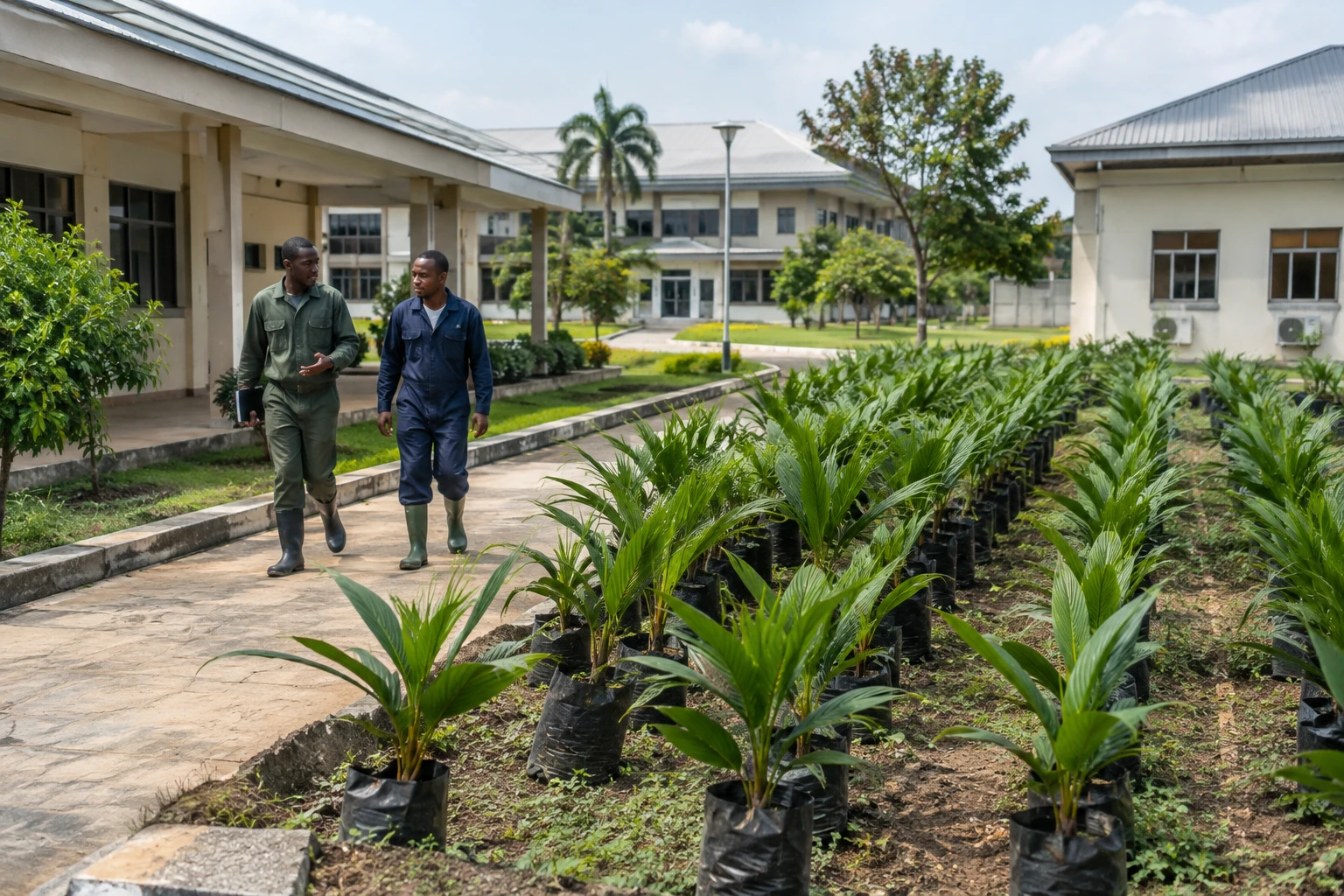
Nigeria can harvest more palm fruit without quickly reducing its imports. Between the revival of public plantations and new private projects, the sector is seeking to take a decisive step: turning land announcements into oil that is available, processed and affordable on the domestic market.
The issue extends beyond large plantations. It also concerns communities living near farmland, small-scale producers, processing units and companies that use palm oil in food, soaps or cosmetics. In Abuja, the federal authorities want to coordinate this value chain. But most projects are negotiated in the producing states, where access to land, roads and electricity has a direct bearing on their success.
Projects across several producing states
In Cross River, in the south-east of the country, the state government unveiled a 4,000-hectare plantation project in the Yala area on 10 October. The concession agreement with ValueFronteira Limited was reportedly signed on 7 August. The company plans to invest more than $20 million over five years. These figures represent announced commitments: on their own, they do not prove that the plantations or processing facilities are already operational.
This distinction matters to local communities. Developing agricultural land can create jobs and boost economic activity, but its effects depend on the terms of the concession, consultations and the benefits actually shared. The plantation timetable, environmental safeguards and arrangements for local farmers’ access to land therefore remain issues to watch.
In Enugu, a public-private partnership — cooperation between a public authority and a company — has already reached the production stage. Enugu United Palm Products Limited, established with Pragmatic Palms, began marketing palm oil in September 2026. According to the Enugu State government, the company has revived several public plantations and replanted more than 1,000 hectares. It also plans to invest $2.2 million in a refinery and industrial complex.
The Enugu project illustrates an issue that is often less visible than the area under cultivation: local processing. A refinery can produce oils and ingredients for a range of industrial uses. It can also help retain more value in the country, provided it has a regular supply and commercial outlets.
In Abia State, Presco mentioned a planned investment of $200 million in March, including a 14,000-hectare plantation and processing facilities. The company estimated that the project could create more than 5,000 direct and indirect jobs. These prospects were reported during discussions with local authorities; they should not be confused with jobs already created or a completed project.
National strategy to address the production deficit
These initiatives follow the approval in Abuja, on 2 April 2026, of Nigeria’s first national strategy dedicated to developing the oil palm sector. The federal government wants to improve yields, expand cultivated areas and modernise processing equipment. It is targeting a 10% share of the global market within the next six years and national self-sufficiency by 2050.
These goals are ambitious given the current situation. The US Department of Agriculture estimates Nigerian production at about 1.5 million tonnes for the 2025/2026 season. An earlier report by its specialist service in Nigeria puts consumption at 1.96 million tonnes for 2024/2025 and says Malaysia supplies about 92% of declared imports. The figures cover different seasons, but they show the persistent gap between domestic supply and demand. Projections for 2026/2027 should also be read as estimates, not as a final tally.
The sector, however, is not defined solely by import volumes. Derivative products also move through informal cross-border channels, notably from Benin, Togo and Cameroon. These exchanges meet commercial needs, but their limited traceability makes it harder to measure supply and collect revenue. Official statistics therefore may not cover all flows.
Land, infrastructure and small-scale producers on the front line
For state governments, attracting investors can help rehabilitate public plantations and improve rural roads. For companies, the size of concessions and continuity of supply matter as much as financial announcements. For residents of the areas concerned, the consequences are determined by access to land, jobs on offer, promised infrastructure and the scope left for family farms.
Small-scale producers remain essential to a sector that cannot rely solely on a handful of large estates. They need suitable seedlings, technical advice, markets and ways to transport their harvests. Without this support, an increase in planted area may not lead to a proportionate rise in production. Newly established plantations also take time to reach full yield.
Processing is another test. A plantation without a nearby mill can lead to losses or high transport costs. Conversely, a refinery can operate sustainably only if it receives enough raw material. Progress will therefore need to be measured using concrete indicators: hectares actually planted, volumes processed in Nigeria, employment contracts, participation by local suppliers and production regularity.
A challenge of competition and West African integration
Nigeria, the continent’s most populous economy, is seeking to consolidate agricultural production that can supply its households and industries. Dependence on Asian suppliers exposes the market to price fluctuations and transport disruptions. At the same time, trade with neighbouring countries shows that regional commerce is already part of the sector’s balance.
The Economic Community of West African States (ECOWAS), which brings the countries of the region together for economic cooperation, is concerned by the movement of these products. Increased Nigerian production could alter trade flows, but would not necessarily eliminate exchanges with neighbours. A better understanding of formal and informal channels would help distinguish competition, complementarity and supply needs.
The federal strategy thus sets a direction, while states and investors are pursuing projects with different timetables and levels of progress. The next step will be less about announcing new areas than demonstrating lasting results: productive plantations, local processing, transparent land agreements and measurable benefits for communities. Only then can Nigeria reduce its deficit without shifting the costs to producers and the regions concerned.