Algeria
 Egypt
 Libya
 Morocco
 Sudan
 Tunisia
 Benin
 Burkina Faso
 Cabo Verde
 Côte d'Ivoire
 Ghana
 Guinea
 Guinea-Bissau
 Liberia
 Mali
 Mauritania
 Niger
 Senegal
 Sierra Leone
 The Gambia
 Togo
 Cameroon
 Central African Republic
 Chad
 DR Congo
 Equatorial Guinea
 Gabon
 Republic of the Congo
 São Tomé and Príncipe
 Burundi
 Comoros
 Djibouti
 Eritrea
 Ethiopia
 Kenya
 Madagascar
 Malawi
 Mauritius
 Mozambique
 Rwanda
 Seychelles
 Somalia
 South Sudan
 Tanzania
 Uganda
 Angola
 Botswana
 Eswatini
 Lesotho
 Namibia
 South Africa
 Zambia
 Zimbabwe
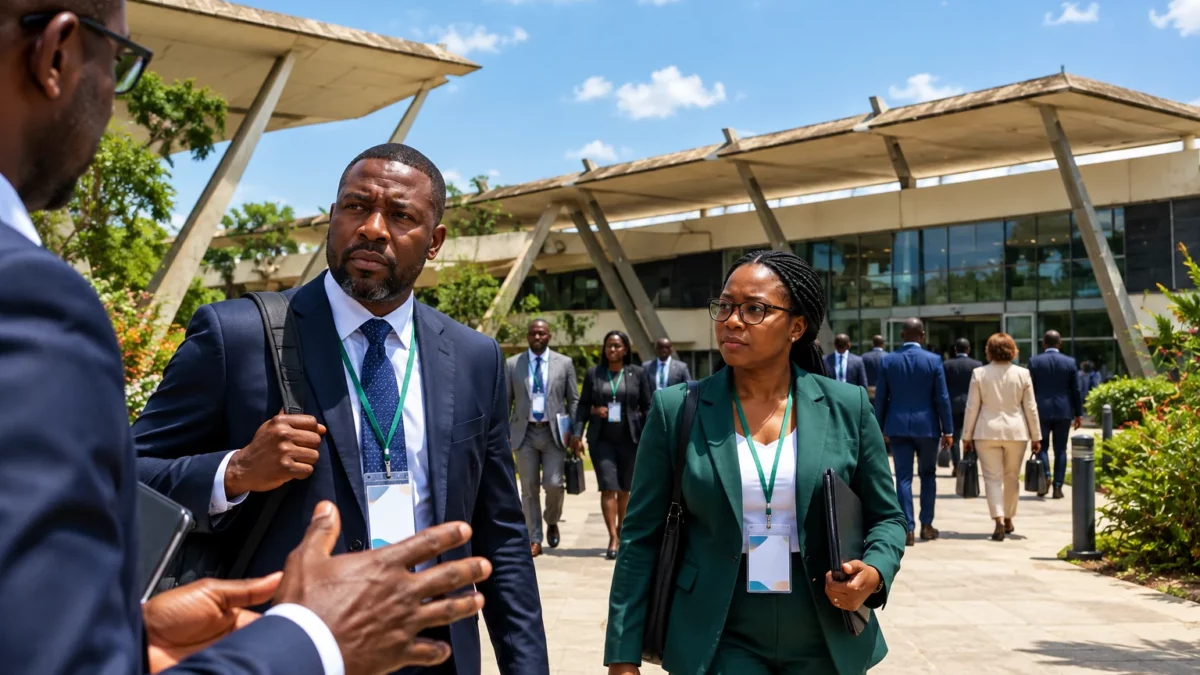
Africa’s 54 federations account for nearly a quarter of the votes at the FIFA Congress. In Abuja, their announced support for Gianni Infantino highlights a central question ahead of the next election: who sets the priorities of world football, and under what funding rules?
A significant voting bloc, but not a guaranteed vote
The Confederation of African Football (CAF) brings together the continent’s national federations. It is one of the six regional confederations recognised by FIFA, the body that organises the World Cup, among other competitions. Its 54 member associations each have one vote at the FIFA Congress, which has 211 votes in total.
This gives African officials real negotiating power. It does not, however, mean that the federations will necessarily vote as a bloc on election day: the announcement of joint support is a political statement, not an election result already secured.
The context is also financial. Since taking the helm at FIFA in 2016, Infantino has made development programmes a central part of his record. These funds can support infrastructure, competitions or training projects. Their practical impact depends, however, on each country’s needs, the management of its federations and transparency in how the money is used.
Motsepe announces support of all 54 federations in Abuja
On 21 November, at the CAF general assembly in Abuja, Nigeria, its president Patrice Motsepe said he had a report confirming the unanimous support of all 54 African federations for Infantino’s candidacy. He invited delegates to stand and applaud the FIFA president.
Gianni Infantino, for his part, announced that each FIFA member association should receive up to $25 million for football development during the next funding cycle, starting in 2027. FIFA presents this package as an investment intended to expand opportunities to play and support infrastructure. The timetable and terms will need to be set out by the organisation’s relevant bodies.
The announced figure should be distinguished from previous payments. Infantino recalled that when he was elected in 2016, federations received $250,000 a year, or $1 million over four years. This comparison alone is not enough to establish how much will actually be available to each association: funding cycles, allocation criteria and conditions on the use of funds also matter.
Philippe Diallo, president of the French Football Federation and a declared candidate for the FIFA presidency, attended the assembly. He stood during the ovation. His presence made the electoral dimension of the meeting visible, but does not allow any conclusion to be drawn about a change in his position.
Funding also strengthens power dynamics
For federations with limited resources, international aid can support projects they would struggle to finance alone. But announcing a total funding package does not yet say which projects will be selected, how quickly the money will be paid or how its use will be monitored.
The effects may also vary from one country to another. A federation with pitches, technical staff and a strong administration can turn a grant into lasting activity more quickly. Elsewhere, maintenance costs, disparities between the capital and the regions, or the standing of amateur football may affect the results. Benefits for young people will therefore depend as much on implementation as on the headline figure.
This link between funding and influence fuels a debate about governance. Officials may defend the resources secured for their associations while also assessing how they are allocated. The point is not to reduce the announced support to an electoral quid pro quo, for which there is no evidence, but to examine the rules, oversight and tangible benefits for football in each country.
FIFA was also criticised in 2026 over a proposal to open up its commercial activities to private investors. The organisation ultimately abandoned the proposal, which would have mobilised up to $4.2 billion, according to published reports. The episode places the funding announcements in a broader context: the management of competition revenues and the transparency of decisions remain governance issues.
The 2027 vote, the next test
The election is scheduled for 18 March 2027 in Rabat, Morocco. Infantino is seeking a new term against Philippe Diallo and Japan’s Kohzo Tashima. The votes of member associations are not the same as the support expressed by confederations: each federation formally retains its own vote.
Meanwhile, the ten members of the South American Football Confederation have also expressed their support for Infantino. These announcements strengthen his position ahead of the campaign, but do not make it possible to predict the outcome of the vote. The positions taken by the other confederations, the candidates’ commitments and the final terms of the funding will remain worth watching.
For African football, the stakes go beyond the choice of president. They also concern how FIFA’s resources will be distributed, which projects will be assessed and what role the continent’s federations will play in decision-making. The support announced in Abuja gives their leaders weight in this discussion; the results will then be measured by the programmes delivered and their reach beyond federation headquarters.